
Lately there has been a lot of discussion on the internet about cueing, attentional focus, glute activation, and related topics. I decided to write an article sharing my thoughts as I have a unique set of experiences and outlook compared to the other researchers and coaches. I confess to having not read up on all of the research from Dr. Gabrielle Wulf, Dr. Keith Lohse, and others (see Sam’s blogpost for these references). However, I have more practical experience in this area than most coaches and employ these techniques daily, which gives me a unique perspective.
Some of my readers like to be thorough so here are some links you can read in order to be up to snuff (my thoughts are in parenthesis).
Stuff You Might Want to Read and Listen to in Order to Get Up to Snuff
Before I provide links, I want to emphasize up front that I have a ton of respect for the folks listed below and am proud to be friends with several of these individuals.
1. Sam Leahey’s article on his blog: The Science & Application of Coaching Cues (I’ve mentioned this before – Sam is one of the brightest young minds in S&C. I feel that this article provided the most balance and I was in agreement with most of what Sam wrote. I especially liked the dialogue between Dr. Wulf and Sam in the comments section. I’m with Sam on this one, but Dr. Wulf presents a compelling case with her references.)
2. Nick Winkelman’s commentary: The Strength Coach Podcast (Nick is speaking from 26:18 – 32:30 – Nick is very well-educated and incredibly passionate about this topic. He’s also a top-notch strength coach for Athletes’ Performance. So I have a ton of respect for Nick. However, as you’ll see below, I don’t feel he painted the entire picture.)
3. Mike T. Nelson’s article on The PTDC: Stop Telling Your Clients to Activate their Glutes (Mike is very intelligent and I always value his insight, but I do not agree with this particular article at all. My experiences have led me to feel quite differently. But it’s okay to disagree as long as both sides have science in mind and are open to findings from future research.)
4. Mark Rippetoe quote: Sleepy Muscles (Mark is a legend in our field but I disagree with what he wrote in this article. I see his point, but I could provide a much more elaborate and in-depth explanation based on my understanding of biomechanics and I don’t feel he’s painting the entire picture.)
5. Jon Fass’s commentary: Fitcast (Jon talks about this at 39:15 – Jon is freaky smart and is a true evidence-based practitioner, but I don’t feel he painted the entire picture.)
6. Kenneth Jay’s “The Big 10 to Avoid in Kettlebell Training” PDF: See Mistake #10 (I don’t know Kenneth Jay, but he seems to be very intelligent. I disagree with his point as I don’t feel he’s telling the entire picture. I’m skeptical of some of the Z-Health stuff as I feel some of it is based on improper extrapolations from research.)
Some Quick Things You Should Know Up Front
1. Dr. Gabrielle Wulf, a Kinesiology professor out of UNLV, is known for being the leading research in the area of attentional focus. Her CV is incredible!
2. In Dr. Wulf’s words, attentional focus, or focus of attention, refers to:
This area of research examines how the individual’s focus of attention affects the performance and learning of motor skills. In numerous studies, we have shown that instructions and feedback that direct the performer’s attention to the movement effect on the environment (e.g., an implement) (external focus) facilitate performance and learning compared to those that direct attention to the movements themselves (internal focus), or no attentional focus instructions (control conditions). The adoption of an external focus promotes the utilization of relatively automatic control processes – making performance more effective and efficient. These findings have important implications for practical settings, such as sport, music, and physical or occupational therapy.
3. The Constrained Action Hypothesis, which is the current best hypothesis for explaining the superiority of external attentional focus over internal attentional focus, discussed in this LINK, goes like this:
The performance and learning of motor skills are enhanced when performers employ an external focus relative to an internal focus of attention (3-5). Wulf et al. (2001) explained this benefit of an external focus of attention by postulating the “constrained action hypothesis”. According to this view, individuals who utilize an internal focus constrain or “freeze” their motor system by consciously attempting to control it. This also seems to occur when individuals are not given attentional focus instructions (2). In contrast, an external focus promotes the use of more automatic control processes, thereby enhancing performance and learning (3,5).
4. In this blogpost, I’ll use the term “internal cues” to refer to “internal attentional focus,” and “external cues” to refer to “external attentional focus.”
My Thoughts
1. Knowledge of the Importance of External Attentional Focus is Paramount
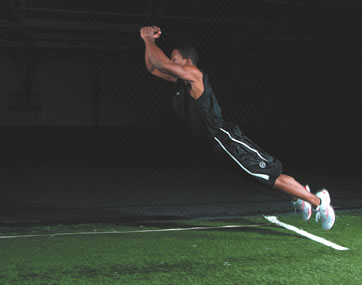
This is a very important area of research and personal trainers, coaches, and physical therapists should be aware of it. Let’s say you’re testing broad jumps with your athletes – you wouldn’t want to tell them to feel the glutes or quads maximally contracting, or to make sure they achieve triple extension. Instead, you might mark their previous best and tell them to focus on the mark and clear it, or you might tell them to pretend that there’s a pit full of lava and if they don’t make it past that distance they’ll fall in…or at least something along those lines. But you definitely don’t want them thinking about internal mechanics as that will not maximize their performance nor will it enhance their motor learning.
2. Internal Goals are Legitimate Goals
Often our goals as coaches are external in nature. For example, the NFL Combine Test contains a bunch of tests where the coach would want to utilize external attentional focus strategies during training and testing periods. However, there are also times when a coach has internal goals in mind, and this is where internal cueing is valuable. Dozens of world class coaches and clinicians have recognized the value of internal cueing.
For example, Stu McGill cues individuals to feel the glutes as prime movers in a glute bridge rather than the hamstrings. Louie Simmons instructs powerlifters to keep the chest up and knees out in a squat. I believe that these internal cues should NOT be disregarded and replaced with external cues.
I’m extremely passionate about this topic due to my focus on the lumbopelvic-hip complex (LPHC) and proper spinal, pelvic, and hip mechanics during squats, deadlifts, back extensions, hip thrusts, and other exercises. Form on these exercises is horrendous with beginners. Sedentary individuals simply do not move properly and you have to spend considerable time teaching them how to move at the hips while keeping the spine in neutral and properly positioning the pelvis to assist in keeping a neutral spine.
Imagine trying to teach individuals proper LPHC mechanics without having internal cues at your disposal. This is an area where internal cueing is of huge benefit and more research needs to be conducted to determine its effectiveness. My hypothesis is that internal cueing for this purpose would greatly outperform external cueing in terms of motor learning and skill acquisition.
3. Cue Specificity: A Time and Place for Internal and External Attentional Focus
I want to mention up front that this is just my hypothesis and requires future research. I am of the belief that cueing, like many other things in the field of Strength & Conditioning, should be specific to the goals of the coach.
- If the coach is seeking an internal change in movement, such as activating a certain muscle to a greater or lesser extent, or preventing an energy leak, then an internal cue is most appropriate.
- Conversely, if the coach is seeking optimal performance for an external goal requiring strength, power, or precision, such as performing a max deadlift, jumping for max height, shooting a free-throw, or putting a golf ball, then an external cue is most appropriate.

It is my understanding that Dr. Wulf, leading research in this area, would argue that the chart listed above isn’t correct and that external cues are always superior to internal cues.
4. Evidence from Lewis and Sahrmann
In 2009, Cara Lewis and Shirley Sahrmann published an excellent article titled, Muscle Activation and Movement Patterns During Prone Hip Extension Exercise in Women. Click HERE to download the full paper. This research showed us several very important things. Here’s a summary in the authors’ words:
We found that during prone hip extensions, women without hip or back pain displayed a consistent and distinguishable order of muscle activation that began with the medial hamstrings muscles, was followed by the lateral hamstrings muscle, and concluded with the gluteus maximus muscle. Compared with the no-cues condition, the glut-cues condition resulted in nearly simultaneous activation of the gluteus maximus and hamstrings muscles, decreased activation of the hamstrings muscles around the initiation of movement, increased activation of the gluteus maximus throughout the movement, and decreased knee flexion.
Here is a chart showing muscle activation according to the cues:
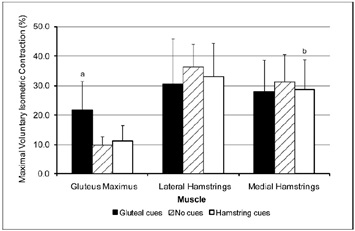
Notice you get double the glute activation when cueing glutes in a prone hip extension, and equally important is that this is achieved with less hamstring activation. I believe that this study is incredibly important!
5. New Research from Tateuchi et al.
A brand new article titled, Balance of hip and trunk muscle activity is associated with increased anterior pelvic tilt during prone hip extension, linked HERE, concluded the following:
In conclusion, increased activity of the hip flexor (tensor fasciae latae) relative to the hip extensors (the gluteus maximus and semitendinosus) and delayed onset of firing of the bilateral multifidus and contralateral erector spinae were associated with an increased anterior pelvic tilt during prone hip extension. Furthermore, a decrease in the activity of the gluteus maximus relative to the activity of the semitendinosus was related to increased muscle activity of the ipsilateral erector spinae. We propose that alterations in the balance of muscle activity in hip-joint muscles and relative timing of the activity of the hip and trunk muscles may lead to increased motion in the lumbopelvic region.
Clients are not showing up on personal trainers’ doorsteps knowing how to use their glutes. They substitute lumbar hyperextension and anterior pelvic tilt for end-range hip extension, they substitute lumbar flexion for hip hinging/flexed-range hip extension, they rely too much on hamstrings, their erectors are on overdrive, and their glutes are soft. I can’t imagine that external cueing would be more effective in teaching proper hip extension mechanics compared to internal cues.
6. More Evidence
There are other studies in the literature that provide a case for internal cueing. A recent study showed that cueing glute activation in a squat increased glute activation during the concentric phase of a bodyweight squat. A prior study showed that focusing on getting a stretch in the lats and squeezing them during the movement increased lat activation in a pulldown. Bodybuilders refer to this as forming a “mind-muscle connection,” but this is of great relevance to coaches and clinicians simply because certain muscles like the glutes typically shut down and need to learn how to activate properly. Last, a study last year showed that telling runners to feel their glutes contracting during ground contact led to improvements in knee valgus in runners exhibiting valgus collapse (but they also envisioned the legs moving in a straight line).
Not trying to “appeal to authority” and commit logical fallacy, but Vladimir Janda, Stu McGill, Mark Verstegen, Pavel Tsatsouline, and just about every other notable expert I can think of has recognized the phenomenon of weak, atrophied, and poorly-activating glutes during movement. McGill refers to it as “gluteal amnesia.” The glutes might learn to reactivate just by squatting, lunging, sprinting, etc., but if the glutes aren’t being used and the hamstrings are the dominant hip extensors, then individuals could simply continue to get stronger by relying on the hammies for hip extension without using much glutes. People can and do get extremely strong without really using their glutes much – I’ve personally witnessed this via EMG testing. This is not ideal and sets the body up for injury, for example anterior hip pain, knee pain, or back pain.
Many experts (including myself) feel that progress can be fast-forwarded tremendously by employing glute activation cues (internal cues) and relying on specific low-load exercises to entice a shift in recruitment away from the hammies toward the glutes. This is the essence of Shirley Sahrmann’s “synergistic dominance” perspective.
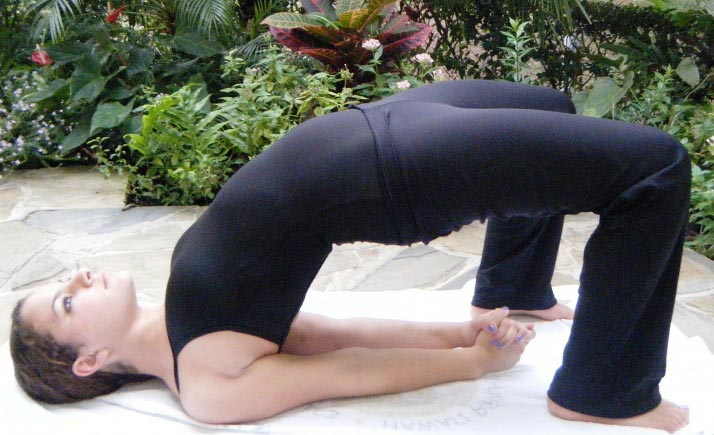
Not good
Finally (this doesn’t make me “right,” but it’s worth mentioning), I have many clients, former clients, trainers/coaches/therapists who have attended my seminars, and colleagues who are highly skilled in LPHC mechanics/glute development, and pretty much everyone agrees that internal cueing is HUGE for getting people to move correctly and teaching the glutes to engage optimally. Most of us couldn’t imagine being nearly as effective without the availability of these cues.
7. Value of Glute Activation
Lately I’ve been performing low-load glute activation and having my clients do it as well. I used to not be a huge fan as long as one’s glutes were up-to-par, but one of my clients saw such dramatic results in terms of glute development and low back pain improvements, which he attributed to glute activation drills especially the PPTHT (posterior pelvic tilt hip thrust). Before this he wasn’t able to hip thrust without experiencing back pain, but the frequent practice quickly allowed him to go heavy on hip thrusts pain-free, and within two months he was using 500 lbs!
I receive several emails per week from folks around the world informing me that the glute exercises I recommend have helped them achieve new PR’s in the squat or deadlift, have helped them grow their booties, have increased their speed, or have decreased their low back pain. There really is something to glute-activation and hip strengthening, and we need more research demonstrating its utility.
To me, the glutes are special, and they really are “that important.” Of course I don’t feel that we should be cueing “squeeze the glutes” or “feel the glutes” during explosive and technical “on the field” skills, but I do feel that we should be doing so during low load glute activation work and even heavy hip extension exercise, and this will lead to improvements in athletic performance via increases in glute muscle CSA, neural drive to the glutes, glute muscle moment arms/leverage, etc.
8. Value of Cueing the Glutes
Getting people to think “glutes” during hip extension exercises is crucial in my experience if the goal is to maximize gluteal activation and hypertrophy. This is what a vast majority of my clients approach me for, and I try my best to deliver maximum results.
I tested a female squatter who could full squat 185 and lunge with 50 lb dumbbells, and her mean glute activation was around 10% of MVC on each movement. She was relying on the quads to squat and lunge, and her form appeared excellent. It’s no surprise that this same individual tended to hyperextend her spine when performing back extensions and struggled to dissociate her pelvis from her spine and couldn’t hold a posterior pelvic tilt.
Glute activation and glute cueing has done wonders for this client over time. This female isn’t the exception; she’s the norm! Most people don’t use the glutes optimally. Most advanced individuals don’t even use their glutes to their fullest extent in my opinion, and many leave room on the table for increased performance.
Some clients learn how to fire their glutes during various exercises rather quickly, whereas others can take two months to learn how to really feel their glutes working during various exercises. This occurs following consistent internal cueing and attentional focus toward feeling the glutes maximally activate during resistance resistance training.
9. Value of Internal Cueing for Technique Purposes
When I train beginner clients, it takes me considerable time to get their lumbpelvic-hip complex working ideally during squats, deadlifts, back extensions, and glute bridges. In my opinion, external cueing is not ideal for improving form in the most rapid manner possible. My belief is that internal cueing will get the individual to where you want them to be in a much more efficient manner.
This applies to preventing lumbar flexion in a deadlift, preventing valgus collapse in a squat, or preventing lumbar hyperextension and anterior pelvic tilt in a back extension or hip thrust.
Let’s take a hip thrust for example, when a client is hyperextending their spines I take a multi-faceted approach involving:
1) Palpating different regions of their body to make them aware of the various parts involved and what those parts are doing,
2) Personally demonstrating proper form and having the clients palpate my lumbar spine, poke the glutes, etc. to see how proper form is supposed to look and feel,
3) Having them stop approximately 3/4 the way up on a hip thrust and practicing anterior and posterior pelvic tilt so they can understand how to prevent anterior tilt from occuring,
4) Using video analysis so they can see if they’re keeping a neutral spine and achieving full hip extension,
5) Being “hands-on” during their performance and manually helping place their pelvis in proper position, manually setting the core in neutral, manually pushing the hips upward to ensure full ROM is reached, and poking the glutes to make sure they’re on and the hammies to make sure they’re not overly activated, and
6) Using internal cues such as “squeeze the glutes,” “push the hips upward,” “keep that core in neutral,” “tilt the hips forward,” etc.
I don’t believe that this heavily “internal” approach can be improved-upon by a purely external cueing approach.
10. The Maximization of Long-Term Performance
This is an important consideration worthy of discussion. Let’s say you’re trying to have an athlete set a PR in a squat, deadlift, hip thrust, or vertical jump. You wouldn’t yell at the, “knees out” or “chest up” in the squat. You’d let their knees cave and allow for tremendous forward lean as this is how the individual is strongest (which is why their bodies are going there). You wouldn’t tell them to keep an arched back in a deadlift, you’d let the back round if need be so they could lift heavier loads. You wouldn’t tell them to squeeze the glutes in a hip thrust, you’d allow as much lumbar hyperextension/APT as needed so they could hoist the heaviest loads. You wouldn’t try to fix knee valgus when they jump as they’ll jump higher simply focusing on reaching as high as possible.

This lady is going to need some internal cues over time to get her jumping and landing correctly.
However, these strategies are not safe and will lead to injury over time. A good coach knows that keeping his athletes healthy will lead to the greatest performance over the long haul, and this is why we provide internal cues during training. Cues such as “chest up”, “knees out”, and “squeeze the glutes”, remind people to use good form so they stay healthy and can continue to make gains.
In the short-term, a purely external focus will yield the greatest results, but in the long-run, a blend of internal cues (utilized predominantly during the training period) and external cues (utilized mostly during times of testing) will yield the best results for heavy resistance training purposes.
Of course, once mechanics are sound and knees are no longer caving, backs are no longer rounding, and torsos aren’t leaning too far forward, then the frequency of internal cues can diminish, but even the top powerlifters consistently internally-cue each other during training. So it seems that even the best need constant reminding during training to use good form, which allows them to get stronger over time due to decreased pain/injury.
11. Kudos to Dr. Wulf, Mr. Leahey, Mr. Winkleman, Mr. Nelson, Mr. Fass, and Mr. Jay
I’d like to thank all the people who have helped bring external attentional focus to the forefront. As previously mentioned, this research is extremely important and can only result in increased athletic performance. Their feedback on this article is welcomed and would be appreciated by the author.
12. I’m Open-Minded to Being Wrong
I’m open-minded to changing my mind and one day learning that external cueing always trumps internal cueing. However, I’m having a hard time figuring out external cues for certain instances such as trying to get the glutes more active in hip extension relative to the hammies, or preventing lumbar hyperextension in a back extension. It seems to me that trying to come up with clever external cues would not be as effective in this regard as internal cues.
Since I’m not well-read in this area, I’m open to learning that I’ve misinterpreted certain things or failed to grasp the entire picture. I’m sure that there’s a ton of info that I’m unaware of regarding motor learning as I gravitate toward biomechanics research for my focus.
13. Future Research
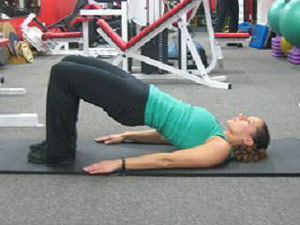
It is my hope that Dr. Wulf, or other researchers such as Dr. McGill, or even Nick Winkleman or myself, down the road, continue to research this area to determine if there are instances where internal attentional focus leads to better outcomes than external attentional focus. An example of a study that could be performed would be to take a group of individuals with poor hip extension mechanics during a glute bridge or prone hip extension pattern. One group would be cued to use the glutes and revolve around the hip joint while keeping the core stable, whereas the other group would be given external cues. After 8 sessions or so, kinematics could be reassessed to determine which group saw better improvements in lumbopelvic-hip complex mechanics during hip extension activities.
Conclusion
The way I see it, “If it ain’t broke, don’t fix it.” I, and many other trainers and coaches, am seeing incredible results by cueing the glutes. Other internal cues such as “knees out” and “chest up” have been so beneficial in my personal training practice that I can hardly fathom not employing them. For this reason, I’m going to stick with my utilization of internal cues. If quality studies emerge down the road showing that my hypothesis is incorrect, then I’ll change my mind. But my hypothesis is that internal cueing trumps external cueing for the situations described above.
Nice article, Bret. I think it’s good that concepts such as these are also being evaluated scientifically instead of saying ‘it’s all experience’ or ‘trust your gut’.
I personally also vary my clients’cues based on my perception of his/her motor control. Some people are naturally good at sports and can simply be cued to ‘stand up’ in the bottom position of a squat, whereas others need many internal cues. Females also generally need more internal cues.
Thanks Menno! Great to hear from you. I originally included a point about individual variation and how cues should be tailored according to the uniqueness of the client, but I took it out. Reading over these responses makes me wish I kept it in as many coaches are saying the same thing. Cheers!
Boom.
Sam your article was very good my friend!
Hi Bret
Great info as usual!
Here is my 2 cents worth (lol for what it is worth)
When the system is working optimally – then external focus is needed to maximise performance
Let me explain with an example
We are training and i ask you to try and hit an new 1RM in the squat
On your first attempt I allow you to have full psychological preparation and 100% focus on the outcome
On your second attempt (another day if needed) i still allow you to have full psychological preparation prior to the lift -but when performing the lift i shift your cognitive focus away from the task outcome ie i get you to say the alphabet backwards
Which attempt is most likely to yield the best outcome?
I think it would be fair to say you would hit a greater 1RM in the first attempt
Why?
Because anything that shifts your cognitive focus away from the task at hand or performance outcome – will limit your ability to perform optimally
I know this is a crude example – but it helps illustrate the point
But what about when the system is not working optimally?
Or
What about if the client/athlete doesnt demonstrate optimal technique?
In this case we must correct – then redirect
When we correct – internal focus can often play a big part
Once correction has taken place – we can then redirect – that is redirect their focus externally and on perfrmance outcomes
Is it really this black and white in the real world?
Sorry but No 🙂
The one thing i have learnt in my 20 years experience working in both the rehabiliation and strength and conditioning models is
‘One mans medicine is another mans poison’
A method of training that offers positive transference to the target lift and/or sport skill for one athlete – may offer negative or no transference to the next
There are no black and white approaches to training
When dealing with something as complex as a biological system – there can be only GREY!
So with that said
If you choose to try an external focus approach with one client – but it just doesnt seem to be improving results – Dont be afraid to try something different and go for an internal focus approach
You never know – it may just work for THAT client – despite what the overall consensus in the reseach may suggest
Let reseach and expert opinion guide you – but never lead you 🙂
Thanks for another awesome thought proving blog Bret!
oops forgot to delete the ‘With that said’ at the bottom – so please ignore
lol it isnt an attempt to close with an ‘authoritive’ tone 🙂
I edited your “with that said” out. I agree Mark and I actually had something similar to this in the original draft but took it out for no good reason. Should have left it in.
The only thing I’d like to add is that even the best powerlifters don’t shift completely to external focuses as they’re always watching their workout partners’ form like hawks and internally cueing accordingly (knees out, chest up, sit back, squeeze the glutes, weight on the heels [which is actually an external cue], etc.). I’m sure Oly weightlifting coaches provide internal feedback all the time. So if they need internal reminders, chances are so do we and our less efficient athletes and clients we train!
So it should always be a blended approach IMO. Cheers!
Great article, Bret! Why do you say that “weight on the heels” is actually an external cue? Would, “DRIVE through your heels” then be in internal cue?
Thanks,
Danny
Danny, my understanding is that they’d both be external, since you’re focusing the learner’s attention toward the movement’s effect on the environment (see Wulf’s definition in the post). Sometime’s it’s hard to decipher between the two…and I could be wrong here.
Gets tricky here, huh?
I would suggest “Drive through your heels” is an internal cue, while “DRIVE your heels THROUGH the floor”, or maybe even better, “BREAK the floor” to be external cues.
You could possibly precede the movement with several dorsiflexed, hip and knee extension heel stomps on the floor. Pound the heel into the ground. Sense the power that can translate through your heel, and hips. Now file that away, as we immediately transition into the movement.
I think the more dynamic the call to action the more primal, and thus, accessible the motor message.
Intention.
(Apologies if I’m butting in..:)
Derrick – quite butting in you a-hole! Ha, just playin’! Thanks for your input.
Sometimes I (maybe we as humans) think I make my head spin for no reason. Regardless of whether it is an internal/external cue, I agree with much of what you wrote in your article Bret… internal cues DEFINITELY help!
Ha ha!! Concur on all points, D..
Certainly, the best cue is the one that works, be it internal, external, allegorical, hypothetical, philosophical, metaphysical, sci-fi..
Wait, what?! 🙂
P.S> Only half kidding. Pavel had an analogy of the bullet that spirals out of the chamber that somehow in my fevered brain really illuminated how torque at the shoulder and hip is needed and utilized for powerful movement.
You get some of this type of imagery in martial arts, too. Whatever gets you there!
Thanks for the blog post. I recently completed my master’s research on this topic with Dr. Jared Porter down at SIU-Carbondale. If you ever get the chance to chat with him it will be worth your time. I just thought I’d add in a few papers on the topic that your readers may find worthwhile that have looked at things outside of or accuracy or power when it comes to focus of attention:
Makaruk H., Porter J.M., Czaplicki A., Sadowski J.,and Sacewicz T.(2012).The role of attentional focus in plyometric training.
J Sports Med Phys Fitness. 52,319-27.
Marchant, D.C., Greig, M., Bullough, J., and Hitchen, D., (2011). Instructions to adopt an external focus enhance muscular endurance. Research Quarterly for Exercise and Sport, 82,466-473.
Shücker, L., Hagemann, N., Strauss, B., & Völker, K. (2009). The effect of attentional focus on running economy. Journal of Sport Sciences, 27, 1241-1248.
Zentgraf, K. & Munzert, J., (2009). Effect of attentional-focus instructions. Psychology of Sport and Exercise, 10, 520-525.
Thanks again,
Like
Thank you Will! I’d never heard of Southern Illinois Carbondale and had to look it up. I appreciate the links, and I’d love to hear your take on things if you have a moment.
Understandable that SIU-C didn’t ring a bell for you. It was not on my radar until grad school came into the picture, but I knew I wanted to work with Jared because of the practical things he looks at in motor learning, and off I went. In fact, one of my fellow grad students is headed to UNLV to work w/Dr. Wuld for his doctorate.
As for my thoughts and feelings on the matter. Coaches/Practitioners should use what they know and have confidence in. I became interested in this because when I worked with the athletes at Wisconsin- La Crosse for my undergrad work it seemed like every worker we had different cues, for instruction and feedback. I figured there was no way it could be good for our athletes to be hearing different cues every time they came into the weight room. With that said I think the biggest thing a practitioner can be is consistent regardless of using internal or external cues.
For myself, whenever I can find an appropriate external cue I do my best to use it. It isn’t always the easiest, and sometimes you really have to manipulate your environment so you have something nearby that can bring out what you want to see (i.e. During an RDL hinge/push back to the wall. For a knee position in squat, push out/open out to the safety pins). I would also like to think we can all agree that as your explaining these cues we demo it because with that beginning mover it is important to demonstrate then let them replicate.
With that I think, based on research an internal focus can have a place in rehab and hypertrophy because on the increase that has been found in EMG activity with an internal foci. I even think David Marchant has mentioned that idea in certain studies he has completed.
Another thing beneficial to remember is the difference of instruction and feedback with all of this focus of attention business. We know with research that external usually wins when it is used for instuctional purposes. However, with feeback if you are someone who prefers using internal, less is better. On the flip side, if you are someone using external more is better.
At this point, in that area of research I agree that there are things that still need to be studied, but I don’t think we are too far away from focus of attention studies that really start to encompass important kinematic data so we can start seeing the whole picture.
Based on all of this information from research, and what is to come we should all do ourselves a big favor and make sure we are on top of the way we communicate with movers every bit as much as we care about what we have programmed for them to do. That way regardless of whether you prefer using internal or external foci for instruction or feedback you can use research to help guide you.
Great stuff Will! Thanks for your input, it’s appreciated. I agree with what you’ve written.
Performance Cueing =/= Novice or Corrective Cueing as internal movement variability is limited in the second group.
Robert Wilks (sometimes misspelled as WILKES), Australian Head Powerlifitng coach (IPF) studied internal v external in powerlifters v gymnasts for his Masters degree back in 1989. He found successful PL internally focused on just 2-3 cues before/during (eg. “stay tight, blast, hips thru’) a lift whereas gymnasts externally focused – they have a routine to perform, they are stringing together movements.
Great perspective. I think gymnastics coaches, or diving coaches, might be particularly qualified to address this whole cueing thing..
Once you are in the tunnel of movement..it’s a litte too late to pull out the instruction manual..:)
Interesting! I’m sure that certain sports and activities (including weight training) benefit more from internal attention whereas some of them would be optimized by a purely external approach.
Good stuff. You could argue that the lack of knowledge of what they are trying to do and feel is exactly the problem and external cueing will get many people to do things in the way in which they are accustomed to.
Well this is why I’d love to hear Dr. Wulf’s response. I’m sure that she could provide a compelling case for external cueing based on the brain, which parts and systems of the brain are activated, how the brain organizes the info, how it coordinates the motor learning response, etc.
This is not my area of expertise and I’m certain there is tons that I don’t know in this realm.
But I agree with you – external probably won’t facilitate dramatic changes like internal would unless the cuer was highly creative and skilled in coming up with good cues.
Awesome write bret! and thanks for sharing all your research. Really helpful!
Aloha
Coaching cues are like teaching computer science in Portuguese when your student only speaks Spanish. Yes, the languages are related, and yes they may vaguely grasp what you are saying. But the monumental complexity of human movement can quickly expose the limitations of thinking while moving.
What makes perfect kinesthetic sense to your brain may not translate accurately to your student’s brain. I believe that you must learn to speak in a SIMPLE movement language that THEY understand. You got to speak their language, or more accurately, their CNS’s language.
For example, tell me to “break the bar” while benching, and my elbows will torque far in front of the bar, and I will have tremendous pain in my triceps, and medial and lateral epicondyles.
Tell me to “brace my abs” when squatting, and I will actively flex my spine and round my lumbar.
Tell me to keep my shoulders down and back during a chin-up, and my rotator cuff will file a lawsuit as my rhomboids and lower traps pull the roof of my acromion down into my humeral head, acting as a bony cheese grater on my supraspinatus.
(SIDE RANT: For the love of all that is holy, once and for all: The scaps have to roll with the humeri. Otherwise innocent people die…
Okay I made that last part up..)
Tell me to shove my knees out on a squat, and two things can happen: 1. My sartorius will try to override my powerful adductor, and lose. Pes anserine tendonitis. Thanks. Or..
2. My glutes will stiffen as a unit, as I don’t know how to separate my glute medius, and glute maximus activation. The glute must eccentrically give, or you are not going to squat very deep.
Now you may think I’m complicating this. Not really. This is all real stuff, injuries, that I waded through in my quest to follow solid, decent conventional cues. Good cues. Not only did they not work for me, they got me injured. Reading Kenneth Jay’s article, (liked it!) I am a prime offender, of fault #1. I get TOO TIGHT. I literally lock myself up and make movement incredibly difficult, and painful. I over-stabilize. Kelly Starrett makes the distinction between peak tension, and working tension.
Anecdote: Helping an untrained friend learn to squat. Heavily dominant left leg (soccer), right leg just dive-bombs into valgus.
Nicole, shove your knees out.. Imperceptible change. Frustration building. Sit down between your knees. Anger mounts..
Finally, Nicole as you come out of your squat I want you to pivot to your right and walk over there.. Perfect form. Again..
Now this time, intend to walk over there, but stop yourself. Flawless. She now know what it feels like to torque the right hip on the way up from the squat.. She now has an internal groove, that her brain and CNS understand. Now, repetition..
Thanks for the discussion.
This is a very good point, and as a trainer I can TOTALLY relate. Every time I tell my girls, “knees out,” they take a wider stance. I now take the time to show them how knees tend to cave right at the transition from eccentric to concentric and I’ll demonstrate it to them and then have them practice (where I actively push their legs out to help them understand what “knees out” means). After this, the cue finally makes sense.
The same goes with “chest up,” some women will hyperextend at the thoracolumbar junction which is not what you want…you just want solid arches with no buckling in the lumbar or thoracic regions. After I demonstrate this and then get them to “feel” this on their own bodies, the cue makes sense.
So good internal cueing involves demonstration, rehearsal, practice, and teaching in order for it to be effective.
And good internal cueing requires experimentation to find the best cues per the individual.
For some client you might end up finding some silly cue that would be problematic for someone else but fits the individual perfectly.
Great post Bret, and nice arguments Derrick. Proves that while science is certainly driving the means of cueing, there still is an “art” that the best performance coaches employ. While some cues work for many people, not all cues work for everyone. I agree with Bret’s point of view 100% that internal cues are essential for effective glute activation. Working with many NHL hockey players, and amateur players, I see inactive, dominant quads, and anterior pelvic tilts all the time. To get them to use their glutes while skating is virtually impossible using exclusively external cues. They need to feel what it feels like in a low to no load glute activation movement first before applying their new found glory to their stride. Once there’s a learned activation, then we can apply it dynamically through external cues to get athletic reflexive movement.
Thanks Adam, glad to see I’m not alone in my intuition.
Thanks, Adam, and agreed. Forming the mind-muscle connection first REALLY helps when integrated into the larger movement pattern. You know who else agrees? Gluteal amnesia skeptic, Mark Rippetoe.
Consider an earlier extremely well reasoned piece Rip penned:
http://startingstrength.com/articles/active_hip_2_rippetoe.pdf
The latter part of pg. 4, and 5 is concerned with, dare I say, “spinal erector amnesia”. Rippetoe advises having a trainee who cannot form a MMC with their lumbar spine do prone Supermans until lactic acid builds up. This is recommended since according to Rip, “15% of his seminar attendees DO NOT HAVE VOLUNTARY CONTROL OVER THEIR SPINAL ERECTORS.”
This sounds suspiciously similar to the multiple posts on this site from trainers who can’t feel their glutes working on HT’s. This also seems to be at odds with his quotes from the article listed above where he discounts the notion of “gluteal amnesia”, and says just perform the movement with good form and the muscles have no choice but to fire…Hmmm..
Learned a lot from Rip, so no diss, a lot of his stuff I personally don’t go for, such as bar placement on the back, elbow placement in relation to the bar, looking down at the ground..blah, blah, blah..Point is I don’t see a big difference between awakening lumbar control/activation with Superman’s, and awakening glutes with bridges and thrusts, as Adam mentioned above.
Btw, your “clam up” exercise, which you blogged about recently is FANTASTIC as a Rippetoe, Superman-like modality, to pre-activate the hip of a valgus collapser. So if it’s only one knee collapsing, do the “clam up” on the affected hip only until it is on fire with lactic acid, and then, straight away, SQUAT..
Sorry that last paragraph was about BC’s ground based hip torquing exercise which is just ridiculously effective.. I just need to figure out a way to externally load it..
(I seem to be having a ‘manic’ day..:)
http://bretcontreras.com/2012/04/coo-new-glute-activation-drill-the-side-lying-clam-raise/
Haha! I love it Derrick. Caught Rip read-handed on this one. I agree with your synopsis.
Very intelligent and well-articulated discussion of the topic Bret. Motor learning is situation specific and needs to be evaluated in its proper context. There is no one-size-fits-all prescription.
Brad
Great to hear from you Bradley! Appreciate you reading this post.
Brett –
I hadn’t checked in on my website in a few days, and just did so and was surprised to see an uptick in views over the last few days, linked to your posting the link of Rip’s quote in my blog.
I am writing this before reading the entire article above, and have not read all of your articles on glute bridges and activation. And even though I work for Rip as a platform coach at his seminars, I am interested in your point of view on this, as you’re known to be thorough in your research and preparation for your articles.
So, above, you wrote: “Mark is a legend in our field but I disagree with what he wrote in this article. I see his point, but I could provide a much more elaborate and in-depth explanation based on my understanding of biomechanics and I don’t feel he’s painting the entire picture.”
Can you elaborate more on why you disagree? Or point me to an article you’ve already written that deals with this issue specifically? Or, if it’s directly dealt with in this article right here which I haven’t yet read, then you can tell me to stop being a lazy ass and read this one!
Look forward to hearing your POV.
Michael
Hey Micheal,
I’ve stumbled across some good research in the past few months. Some folks can rely mostly on the quadriceps to power them up in a squat, and the hips extensors don’t automatically receive an incredible load. This happens even when form appears legit.
There are a lot of factors that play into determining hip extension torque and even then there are a lot of factors that determine which hip extensors are producing the most force.
Will glute bridges and clams “save the day” and automatically help folks use their glutes more in a squat?
No, but for some folks, glute activation works miracles. I’m the one receiving these types of emails every day (since I’m the Self-Proclaimed “Glute-Guy” haha), and I’ve witnessed it in clients I’ve trained. It doesn’t happen with everyone, but some folks thrive with it.
So if Rip employed these tactics and abandoned them because he feels they didn’t work, then I give him some credit/leeway.
But if he’s just sticking to 1990’s methods because he doesn’t want to change, or if he’s just speculating since he never actually experimented with the methods, then I’m not in approval.
I have tons of respect for Rip, and he’s a damn legend in my book. Furthermore, I salute him for always focusing on the barbell basics and progressive overload.
Here are a few thoughts from what he wrote:
1. Motor pathways can be improved upon or eroded, and many need to build up those pathways for them to be effective. Practicing good form indeed helps, but sometimes activation exercises can get you there much quicker.
2. Agree that “glute amnesia” is misleading – people’s glutes are indeed firing, it’s just that they’re not firing sufficiently and their glutes are tiny and atrophied.
3. New research shows that you can indeed achieve higher glute contribution if you actively attempt to use the glutes in a squat. Whether this is beneficial or not remains to be seen, but it can be done. For the record I don’t think powerlifters should try this when lifting heavy or should even think “glutes” when they’ve already mastered the movement, but many beginners could possibly benefit from it.
4. I agree folks should read his excellent book.
Sorry to not go into more depth but I’m tired and it’s late! Hope you understand.
Cheers,
BC
My feeling is that often internal cues are required in the beginning to shake-off a lifetime of bad muscle recruitment habits. After this, external and more holistic cues can help. When I do chin ups now, for example, I focus only on the ‘feel’ of my body moving through space and that ‘nice’ solid sensation that comes from full body muscle activation. In the beginning though it was a different story: very much ‘Squeeze lats and drag them down, squeeze ass, squeeze abs, pull, focus on sinking the elbows down’, etc. and all this helped me get where I am today.
Great point Konrad.
Originally I was going to point out how some individuals who are learning new movements may struggle with internal cues, especially in the cases of an information “overload” with several of these cues. And, if this arises, use of a particular external cue may make more sense to the individual kinesthetically. But, through all the comments, individuality and using a ‘mixed approach’ of internal/external cues has been thoroughly discussed.
There is something else I was provoked to think of while I was reading through the comments. What interpretation do you Bret, or others out there, have regarding the notion that considering we are told the “inner unit” muscles, as Paul Chek and others call them, (or the collection of the inferior pelvic floor, anterior tranverse abdominus, superior diaphragm, posterior multifidus and erectors, and lateral obliques) function optimally as core stabilizers when being contracted sub-maximally. Why is this and then how do we tell someone who is squatting 500lbs to “tighten their abs” sub-maximally? In reality my point is that we don’t do this and probably would never dream of it. But why is there this prevailing inconsistency in the general philosophy? At least from the perspective I was taught and understand.
Great article Bret!
Tim,
I’ve reviewed a couple of articles in my Research-Review Service that called the “inner core unit” into question. Some good researchers have shot it down.
But I still use the terminology as I like the “cylinder” concept (though it really doesn’t work that way all the time), and I feel that IAP is developed in this manner (but outer core unit muscles help with IAP too).
I don’t agree that we need to cue folks to brace the abs very often. They naturally work as co-contractors and figure out the precise level of activation on their own, and research has shown that increasing activation of certain core muscles doesn’t increase stability.
Bret,
I am unfamiliar with this “cylinder” concept- where can I read more about it? And thanks, your reply makes a lot of sense.
Another cool article,
while I agree with you and will probably continue to use internal cues for low load work, I have to doubt if this is the right decision in the long term for our clients/patients in regards implicit learning.
For instance, every session we have to tell them to turn on their glutes then is effective learning taking place? Implicit learning takes longer to learn from the literature but is more sustainable. Is this better long term for our clients?
Theres never any question that internal cues improve learning but i think long term is it the right thing when explicit learning has been shown to be inferior to implicit learning.
Although on the other hand if we have taught our clients/patients using explicit learning in the first place then research shows that its ruined our opportunity to train implicit learning and so using external cues may not be as effective.
I dont know the answers to these questions but thinking out loud but it seems to me that new clients/patients untrained it is an opportunity to try external cues for the glutes to try improve implicit learning for the long term benefits of the client/patient.
Thanks,
Dave
Great question David! I agree – internal cueing can be reduced dramatically, but I think even advanced folks need reminders from time to time. We all tend to get sloppy in weight training – our knees my cave a bit, our backs may round a bit, our glutes may quit activating sufficiently and we allow our hammies to take over. Much of these reminders just reinforce good technique and build discipline. But the internal cues can certainly taper off considerably over time.
“I tested a female squatter who could full squat 185 and lunge with 50 lb dumbbells, and her mean glute activation was around 10% of MVC on each movement. She was relying on the quads to squat and lunge, and her form appeared excellent.”
I would be interested to know how you measured MVC, and to see a video of her form. When someone is in deep hip flexion (ie femur-back angle <90 degrees), they are also in deep knee flexion, and it is physically impossible for them to rise from "the hole" without using their glutes and hamstrings, ie their hip extensors. It's like trying to curl without using your biceps – you can do it, or at least minimise involvement, but you can't do it if you're using good form in the exercise.
Train movement, and the muscles will follow – because they have to. A squat where the quads were very dominant would become a two-part movement – first knee extension followed by a good morning. I know because I've seen it many times, happens a lot when the load gets heavy for the person. But a correctly-performed squat will use the glutes.
This does not mean that I think glute activation drills etc have no value. But I don't see how someone could have 10% MVC in their glutes on a properly-performed heavy squat.
Kyle,
First off I want to inform you that I can tell that you’re incredibly smart. For you to ask these questions is indicative of you being a superb thinker. I commend you for this.
Second, I can assure you that I was equally as surprised when I was testing this individual. I retested her several times to ensure it wasn’t in error.
And I’m sure you know this, but MVC for each muscle varies – for glutes it’s a quadruped hip extension position. I can also assure you that this individual’s form was great, though there’s much more to the story.
There’s a lot people need to learn about glute activation curves and torque calculations in squats with different combinations of form. I’ll elaborate on this in the future. – BC
Well I certainly hope you’ll elaborate on this in future, since it’s key to your whole “glute guy” thing. Otherwise the next guru you grill might have to be yourself. 😉
Could you expand on sets/reps for low-load glute activations/exercises that you’re now using, Bret?
Stephen, I’ve been doing tons of “pumpers” with my girls (and I’ve been doing them myself). Here’s an example:
Do 30 hip thrusts with a 50 lb dumbell, followed by a 10 sec isohold at the top ROM, followed by 20 bodyweight reps.
These are not done with full ROM, but only with the top 1/2 ROM so constant tension is kept on the glutes.
Another strategy is to do 100 nonstop bodyweight hip thrusts focusing on the top 50% ROM and trying to get some posterior pelvic tilt into the equation.
We’ve been doing a lot of finishers like this and the women love them. I love them too and I incorporate them on full body days where I emphasize the upper body and just want to throw in some remedial glute work. They burn like no other and I my glutes get so pumped I can’t achieve full hip extension when I walk around afterward.
Well done Bret! Couldn’t agree more with you on this concept!
Hi Bret,
Thanks again for sharing the link to your website.
It is not unusual for practitioners (e.g., physical therapists, athletic trainers) to show some “resistance.” I understand that it difficult to give up the idea that directing attention to body movements, or even muscles, is effective and necessary. After all, we all have learned motor skills with internal foci, and it “worked” (although not as well as we could have learned them, I would add). Also, for certain skills, it can be somewhat challenging to come up with external focus cues.
Yet, evidence for the benefits of adopting an external focus – in terms of both immediate performance and more long-term learning – is simply overwhelming. In about 80 studies that have been done so far, I have not seen any evidence for advantages of an internal focus. (I am currently putting the final touches on a paper in which I review the literature on attentional focus. It will be published in the International Review of Sport and Exercise Psychology.) Almost without exception, performers do significantly better with an external focus. This has been found for a wide range of skills, levels of expertise, age groups, people with motor disabilities, etc.
When people focus externally (i.e., on the desired movement effect or outcome), their movements are not only more effective (e.g., enhanced balance, accuracy), but they are also performed more efficiently. That is, the motor system somehow optimizes performance so that only the necessary motor units are recruited and co-contractions of agonists and antagonists are reduced. At the same time, they are able to generate greater maximum forces, or do more repetitions with the same weight, jump higher, run or swim faster! I could go on and on. But there is already a lot of literature out there, and more to come soon.
Thanks for the opportunity to comment on your blog.
Gabriele Wulf
Dr. Wulf, thanks so much for the comment. It’s definitely appreciated.
I have no doubt that there is overwhelming evidence in support of external attentional focus. I can see why it would be far superior for many purposes.
However, I’m wondering if the literature is balanced in terms of what types of studies have been conducted.
I imagine that most of the 80 studies conducted so far have examined performance, accuracy, coordination, etc.
Have any studies examined muscle hypertrophy, muscle activation, individual muscle forces, improving the relative contribution from a particular muscle during a movement over time, or improving technical form such as knee valgus in a squat or lumbar hyperextension during a back extension?
As I previously mentioned, my hypothesis would be that an internal attentional focus would outperform an external attentional focus in these instances. But I’m open-minded to being wrong.
I do agree with you (and it makes perfect sense) that with an external attentional focus, the motor system maps out the optimum motor units for the task, minimizes antagonist co-contractions, and this leads to improved performance, force production, 1RM, reps, velocity, acceleration, etc.
So for each and every study measuring those instances, I’d predict external attentional focus to outperform internal attentional focus.
I might film a video and discuss some of my thoughts as it’s easier to show when speaking. If so I’ll use the back extension as an example and I’ll post the link in this discussion.
Thanks again Gabriele, your body of work is commendable!
Bret
Hey Bret-
I did my PhD at LSU and Dr. Magill (one of the foremost motor learning experts in the world) was on my initial dissertation committee (although later changed because he moved and the emphasis changed). I also started my company, HPC, with one of his students, Dr. WIll Wu, who has since entered academia at CSLB. Dr. Jared Porter (mentioned above by Will Westphal) was in the same class at LSU and was one of HPC’s original team members. Of the 3, I’m currently the only one coaching but both stay strongly involved with the practical application of motor learning. In fact, I’m guessing your external cue reference to the standing long jump in the blog was due to Dr. Wu’s recent article in the JSCR on the matter. I tend to take a view similar to yours but thought you and your readers would appreciate this info from Dr. Wu:
“There is overwhelming evidence in support of an external focus of attention. The challenge is generating the correct external cue to address the movement deficiency. In terms of changing movement patterns, external is the route you want to take, though, there are benefits to an internal focus of attention within certain parameters that do not get discussed in the literature.
Based on the EMG studies, an internal focus of attention generates greater muscle activity. One could conclude that there are greater concentric/eccentric properties associated with an internal focus. So from a strength training perspective, this is something you may desire with particular points in your strength training.
The data that supports external cueing (and it’s overwhelming) typically has effects that are associated with economy — more output less work. For altering movement patterns this is good but is not necessarily the desired effect fort strength training.
Let me know if you need anything further explanation or assistance with this or would like to chat about it.”
Great stuff Mike. I appreciate the info. Dr. Wu’s comment is in line with my views.
For maximal muscle hypertrophy, muscle activation, changing relative contribution of synergistic muscle forces during tasks (such as increasing glute max contribution while decreasing hamstring contribution during hip extension), and improving form (such as elimination excessive forward lean in a squat), I’d imagine that internal cueing would reign supreme, but I’m open to being wrong.
I would like to see more studies along these lines conducted in the literature.
According to Dr. Wulf and Dr. Wu, there’s an overwhelming number of studies (over 80) in support of external attentional focus, but I wonder if they’re all examining the same types of studies (and there’s an “untapped” area of research that would show support for internal cueing).
I hope to see more of this down the road.
Please tell Dr. Wu “thanks” for the response.
Thanks so much for the great article and facilitating a lively discussion. As someone who has worked with clients over the last decade, I agree with your approach that cuing needs to be administered on a situational basis. Some of the factors that I take into account when deciding what cues to utilize:
The Client’s Skill Level
Is my client in the early stages of motor learning or is he more advanced? You touched on this by mentioning how beginners have very little mind-body understanding, thus using more internal cues. In fact, a male client of mine in his 70s had no relationship to his glutes while bridging and despite my best internal cues, I got him to contract those babies using an external cue I heard Dr. McGill use: “Crush a walnut with your butt cheeks.” Worked like a charm.
Speed of Movement
Because there is a reliable speed-accuracy trade-off I take that into account when cuing. The faster the client moves the greater the likelihood of a mechanical breakdown. Therefore, my initial cues may be externally-focused but, as the set progresses, I may shift to internal to counteract poor form.
Complexity of Movement
Fitt informs us of the complexity-accuracy trade-off. As a client begins with a simpler movement I may be able to get away with internal cuing (esp. with beginners) but the more layered and complex a motor skill becomes, the more external my cues become. It’s funny listening to a mediocre coach trying to teach a beginning tennis student a forehand. Typically, I’ll hear: “Turn your shoulders, cock the wrist, follow through over your opposite shoulder…” Naturally, the skill breaks down because of Fitt’s Law and the student gets really frustrated.
Level of Fatigue
As a client gets more fatigued during a set/training session, the form is more likely to be disrupted so I might have to shift from a more externally-based cuing approach to an internal one. I wonder, in all of the research done on the benefits of external cuing for skill acquisition and retention if the subjects were “fresh” to remove fatigue as a confounding factor. Meaning, external cues might be more effective in those subjects because they haven’t had to learn those skills while contending with the physiological and psychological effects of fatigue that our clients and athletes deal with during training.
The Client’s Learning Style
Some clients learn better with tactile, auditory, or visual information so, as coaches, we may have better results by more closely matching our instructions with the way our clients learn best. Rather than beating my head against the wall getting a client to “feel” his glutes during a bridge, the idea of crushing a walnut may provide a more effective cue for him because he is better at learning from and assimilating “visual” cues.
Your article stimulated a lot of ideas so thanks and sorry for the rambling.
Bret,
Having gotten the chance to spend 4+ months with Mr. Winkelman at Athletes Performance I think there is another path that should not be overlooked. That is no cue. Now although I fulling understand the research is conclusive like you previously mention that external cues work better we have to be careful this does not lead of over coaching. The concept Nick gave was the best cue is the one you don’t have to give, with the idea of let the exercise do the talking and the athlete do the walking. This plays directly into RNT (Resisted Neuromuscular Training). An example of this would be the valgus during a squat but instead of cueing, we simply put a mini band around the knees or using a 1/4in super band when teaching a single leg RDL. No cues are necessary and I would hypothesize the glutes fire at a higher percentage and motor learning happens faster as the entire focus is on the movement. Now obviously we can’t use RNT and alternative/corrective exercises for everything but using less cues/no cues may be a third route in creating better movement quality, would you not agree?
Carolyn brought up an interesting point about the client’s “Learning Style”. It is obvious that almost all the studies report better performance following external cues but these results are mostly based on overall group averages. Since coaches and personal trainers are often giving cues individually in one-on-one environments it would be beneficial to know if there are individuals that respond better to internal vs external cues. In Dr. Kyle Lohse dissertation work he found some individuals did perform better when given the internal cues.
Nideffer constructed a psychometric instrument (TAIS, 1976) to measure individual’s optimal learning learning styles and it included sub scales for the direction (internal/external) and bandwidth (narrow/broad) assessment on an individualized basis. It seems that studies on attentional focus and athletic motor performance have largely ignored the bandwidth problem instead experimenting and manipulating just the direction.Baghurst, Thierry, and Holder (2004) utilized Nideffer’s instrument to determine if individuals with a more internally directed attentional personality would perform better under conditions offering a more internalized environment. Van Schoyck, Stephen, and Grasha developed a sport specific version of Nideffer’s test for tennis and found it to be a better indicator of attentional style than Nideffer’s non-sport specific version. They didn’t actually test the players ability to perform sport skills under different attentional cues.
I would like to see if an instrument similar to that could be used by practitioners as a pre-screening device to determine what type of cuing is likely to work best on an individual athlete/client. Additionally I would like to see more reporting in these Focus of Attention studies (and all sports science research really) to better differentiate between interventions that are likely to have no effect on any athletes vs those that will have no effect on some or even many but a considerable effect for others, effectively uncovering methods that have anatural responders/non-responders effect.
The research by Gabrielle Wulf on Attentional focus and Motor Learning has generated a lot of interest especially because its implications extend beyond just the medical communities and can be applied to sports and fitness training as well. Capitalising on the latest research about using specific techniques to improve learning and incorporating them into their teaching strategies could give personal trainers a definite edge over the others who have not yet graduated from the traditional styles of imparting training. These proven techniques, if used correctly by personal trainers could make a huge impact on client performance and be just the force that drives your personal training business to greater success. More of my thoughts in my blogpost http://lovefitnesseducation.com/2013/01/08/the-art-of-coaching-techniques-to-optimise-motor-learning/
Thanks for the article. Did not have time to read through all the comments so apologies if covered in discussion but wanted to add Richard Schmidt to the list in this category. He did cite Wulf’s work in his textbook on Motor learning.
PS will give you cred when I put your work into my hands on at PB this summer.
Hope all is well.
John
I’m now not positive the place you’re getting your info, however great topic.
I needs to spend a while studying much more or working out more.
Thanks for magnificent info I used to be
searching for this info for my mission.
Hi Bret,
I just found my way to you blog and I have to say it´s great.
Well written with great info.
Before I continue I have to say that I´m not a trainer I just love working out.
I understand that having contact with my glutes is very important but the problem is that when I try to “contact” my glutes, squeezing them when deadlifting or squating my lower back hurts.
It´s only when I get in contact with my core and forget about the glutes that it feels good. The funny thing is that I seldom feel anything in my glutes after squating/deadlfting I instead feel it in my abb´s.
What is your take on this?
You maybe have on answer to that somewhere in the blog but I haven´t got thru all of you post yet 😉
Best regards
Rafael
Btw I bought your Advanced Techniques in Glutei Maximi Strengthening. It´s gone be an interesting read 🙂