
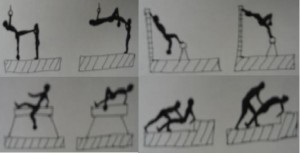
This comes from page 64 of my glute eBook, Advanced Techniques in Glutei Maximi Strengthening. I thought my readers who have not yet purchased the eBook would find this interesting. Mel was years ahead of his time. The question is, what are you doing in your strength training to increase your horizontal force production in the hips? [hint, hint: hip thrusts!] Note that the pictures below (which I redrew from Supertraining) are the beginnings of the hip thrust evolution.
And probably the best analysis of load vector comes from the great Mel Siff in his legendary book Supertraining. Here are a series of quotes from Siff:
“In some events, such as swimming, inertia plays a major role in the entire process, unlike in running, where the specificity of movement depends on horizontal thrust and the vertical oscillation of the athlete’s center of gravity.”[i]
“To fulfill the criteria of correspondence with respect to the amplitude and direction of movement, it is advisable to select the exact starting position and posture of the athlete, as well as to calculate the direction of action of the forces associated with the working links of the system and the additional load. The line of action of the applied external resistance and of the loaded movement as a whole must also be taken into account.”
“For example, in middle-distance running, skiing and skating, a knapsack full of sand or a weight belt are sometimes used as resistance. However, the muscles which bear the load are those which resist the weight of the body. This can increase the ability to cope with vertical loading and develop general strength-endurance, but does not strengthen those muscles which propel the body horizontally.”
“Similarly, a skater may execute jumps on one leg on the floor or from a bench. These exercises strengthen the leg muscles supporting the body and the static-endurance of the back muscles, but do not fully imitate the working of the muscles for the push-off, where the force is directed backward.”
“Skaters should use another method or resisted movement by changing the direction in which the force of resistance is acting. [Figure showing three different towing methods; 1) towing a human, 2) towing a weighted sled, and 3) towing a sled with a human sitting on it while skating] These methods to a large extent match the training exercise to the dynamics of the sport specific actions.”[ii]
“The strength exercise should not only reproduce the full amplitude of the movement but also the specific direction of resistance to the pull of the muscles.”[iii]
Siff then explains how sport typically involves simultaneous coordinated tension of muscle groups, such as the simultaneous flexion and extension at the two hip joints in running, where the angular movement of one leg enhances the push-off movement of the other. [He depicts the following exercises, which he credits to Verkhoshansky in 1977, to illustrate complex exercises for simultaneous strengthening of the hip flexors and extensors, and knee extensors.][iv]
[i] Siff, Mel. Supertraining. 5th Ed. Supertraining Institute, 2003: 138.
[ii] Siff, Mel. Supertraining. 5th Ed. Supertraining Institute, 2003: 241-242.
[iii] Siff, Mel. Supertraining. 5th Ed. Supertraining Institute, 2003: 244.
[iv] Siff, Mel. Supertraining. 5th Ed. Supertraining Institute, 2003: 242.

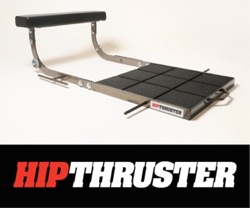
Bret, is it just me or do some of those pictures look like sex positions? Hahaha
Haha! Definitely not just you. That’s why I call them, “Hip Thrusts.”
When we did hip thrusts back in the 90s, we called them the sexual exercise because we used training partners as load. I’m serious it never occurred to our coach to use barbells. And it never occurred to us to ask him why not. I guess inadequate training rather than genetics are to blame I never even broke the 11 seconds barrier and eventually moved to 400 hurdles.
Thanks for the comment Dimitrije. Hilarious! When I was writing my eBook, I didn’t want to take credit for something I didn’t create, so I searched for an entire week on Google for any images or videos on barbell bridging. I went through pages and pages of sites and searched many different combinations of terms. The first word could be glute, pelvic, supine, hip, or floor. The second term could be bridge, lift, raise, thrust, press, push-up. Then of course you could have three term combos as well. So I searched everything – glute thrust, supine bridge, pelvic raise, hip press, supine hip lift, glute push-up, etc. and never came up with any pictures or videos of coaches employing barbell resistance. You’d think someone would have thought of it before me. I’m sure someone did…just that they never published their methods. I’d love to give credit where credit is due so if I ever find out that someone was doing them before me I’ll write a tribute to them. Crazy!
Bret,
As an FYI, Verkhoshansky reviewed these same illustrated exercises during my time studying in the USSR. Former USSR weightlifter and Coach, Gregorio Goldstein also reviewed these same exercises with S&C Coach Johnny Parker and I during the time we spent with him here in the U.S.. Both of these men felt there was value with the performance of these exercises (when deemed appropriate) during the training of athletes.
Rob Panariello
Rob, once again your personal stories fascinate me. One of these days I’m going to make it over to NY and meet up with you and pick your brain! Thanks as always, Bret
you’re always welcome here in NY Bret.
Rob
Hi Bret,
I learned these principles from supertraining as well and have seen great results with sprinters from doing walking lunges w/sled dragging. A Masters sprinter, I worked with cut his 400 from 1m 27s to 67s the first year and then to 63s the second year. I will take to as heavy as 5 steps per leg. Also works well for tennis players.
I had the fortune of hearing MR Siff speak at the 2001 NSCA Conference and I definately consider him one of the smartest people on training, who has walked this planet.
Karsten
Thanks Karsten. I have a similar exercise in my arsenal…..it’s a weighted vest step up with a band pulling you rearward. I position the bench under something like a smith machine so I can hold onto the barbell for stability. Then I step down and back for the eccentric, and then up and forward with a knee drive for the concentric. Great mixture of axial and anteroposterior loading. I definitely agree about Siff…perhaps the smartest ever. -BC
Great post and too bad Mel wasn’t here to give a 2011 state of the union address.
Doesn’t this call into question the directional specificity of slideboard work?
Any chance you could post a video of the step up?
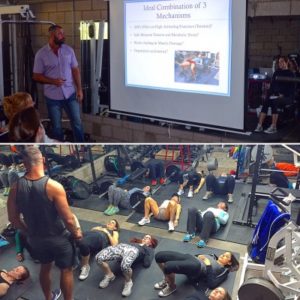
Rich – I gave a presentation a year and a half ago in Kansas City on good vectors versus bad vectors. I believe that the slideboard is huge! The forces are much more lateral in comparison to a side lunge. I have the step up video but I need to figure out how to insert it into a post as I never uploaded it to Youtube. Cheers, BC
I too has the pleasure of working with Mel Siff on a two-day workshop he presented in Australia, many years ago. Definitely a smart man (who loved jumping up into a desk in a snatch-catch position!) with a very dynamic lecturing style. And as he did his PhD on the original Proprioceptive Neuromuscular Facilitation handbook, we had plenty to talk about, too.
Reading this post, the comments, and having just watched the four Werner Gunter preparation clips has really made me think about our own group’s approach to designing programs, both for ourselves and the people we work with. Thanks sincerely, Bret.
You didn’t “create” these unfortunately. That’s like someone saying they created the squat. Love your work but it’s a bit pretentious to say you created the hip thrust/glute bridge by putting a barbell on your hip. Shits was done for years before you “created” it. Again, love what you put out and research in this field. Just “meh” to your comment
Z, then surely with so many strength coaches, personal trainers, and lifters employing barbell hip thrusts and barbell glute bridges, there would be at least one picture or video clip demonstrating it. I challenge you to find this evidence. I searched every possible combination of terms I could think of (supine, pelvic, glute, hamstring, hip, floor, etc. for the first term, and bridge, raise, lift, thrust, push-up, etc. for the second term). In fact, I spent an entire week searching Google and came up empty-handed. If I found evidence that another coach was employing it, I would write a blogpost crediting them. But I have yet to find anything. If you have any evidence of this, please share. I’m sure other coaches did in fact employ bbht’s and bbgb’s in their training, but it appears that nobody ever documented it or photographed/videoed it. I’m very open to being wrong, but I’ve done my homework. I’m well aware that I was not the first person to ever do resisted bridging, but I’m definitely the first person to heavily promote its use in S&C.
You are the booty man, for sure. I give you all the credit for hitting the research hard in this specific area and development of the field in said area. I guess jack lalanne invented jumping jacks as well, but ok…really? Nothing special there in my books, just a coining of said term. Thanks