
This is a new idea I just thought up, and I’m hoping that I can get a bunch of coaches and trainers to offer their take on the topics each week. If I get a good turn-out in terms of responses, then I’ll keep it going. If not, then I’ll squash it.
Topic #1: What Type of Squat Should Athletes Perform?
Last year, in my graduate Biomechanics course, we closely examined the forces and stresses involved in squat depth. It was exciting to learn the exact biomechanical reasons as to why different depths stressed various structures more so than others. Rather than reinvent the wheel, I want my readers to read this article entitled The Biomechanics of Squat Depth by my buddy Brad Shoenfeld. If you want to read more on this topic, then read this article by Jason Shea.
The typical lifter can vary his or her workout from session to session, week to week, month to month, etc. However, in the world of Strength & Conditioning, many coaches tend to pick one style of squat and stick with it. For example, Louie Simmons likes the box squat, Dan John likes the front squat, and in The Charlie Francis Training System, Charlie Franics seemed to be very fond of the half squat (though I’ve seen interviews where he says he states that he preferred squatting past parallel so I’m uncertain as to which style he used more often).
Considerations
There are many different things to consider when squatting. Here are some considerations:
Type of Loading (barbell, safety squat bar, cambered bar, goblet, etc.)
Bar Placement (high bar, low bar, racked position, Zercher position, etc.)
Depth (quarter, half, parallel, full)
Stance Width (narrow, medium, wide)
Other Considerations (start position ie: Anderson squat, implements ie: box squat, hassock squat, manta ray, front squat harness, foot flare, accommodating resistance ie: bands, chains, weight releasers, foot wear ie: Chuck Taylors, Oly shoes, etc.)
Goals
Bodybuilders tend to perform high bar narrow stance half squats (most say they squat rock bottom, but video analysis paints a different picture). Powerlifters tend to perform low bar sumo stance parallel squats. Olympic lifters tend to perform high bar narrow stance full squats. It all depends on the goals of the lifter. In my own training, and my training of others, I’m usually focusing on trying to create the optimally functioning individual so they don’t break down years later.
My Take
For myself and the majority of my clients, I prefer the following configuration:
Barbell, High or low bar position, full depth, narrow or medium stance.
Here is my rationale:
1. Safety
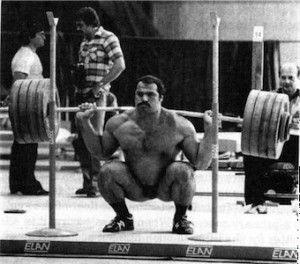
Olympic squats have been executed safely for many years by Olympic lifters. They employ much higher frequencies, loads, and volumes than typical athletes, yet they’re able to keep squatting year in, year out and they don’t break down like you’d imagine. If they’re able to do this, then a few sets of full squats 2-3 times per week won’t for typical athletes will not be problematic. I’ve always used the full squat with my clients and knee or back pain has almost never been an issue.
The full squat is self-limiting. Newbies have found that they can often load up a barbell with 3-4 plates and shift their weight forward, bend mostly at the knees, and quarter squat the weight. If they tried this with a full squat they’d be stapled to the floor. Full squats keep you honest!
2. Superior Athleticism
I don’t know about you, but when I conjure up the term “athleticism,” I think of things like mobility and flexibility, joint stability, and motor control and coordination, in addition to strength, power, speed, and agility.
When you get new clients or athletes, often times they can’t full squat well. They rise up onto their toes, they lean forward excessively, or their knees cave inward. This is due to issues with mobility, stability, or motor control. You have two options in this case. The first is to just have them half squat and get them much stronger in this range. The second is to figure out why they can’t full squat and fix them so they are able to get strong at full squatting. This takes more effort, patience, and consistency, but the rewards are well worth it in the end.
If someone buries a 405 lb full squat and hoists it up with perfect form, then you know they have excellent ankle dorsiflexion, hip flexion, thoracic extension, glute activation, and core stability. That’s a lot of good information!!!
Your Turn
Now is your turn. What type of squat do you prefer, and what’s your rationale?
Great article, Bret. As usual. : )
I use two primary squats in my current training – high bar, feet a little wider than shoulder width, toes flared a little, just breaking parallel squat. I use that one for max strength work.
I also use a close(r) stance, high bar, full squat. Full squats feel so much more natural for me. And like you mentioned, there’s no guessing with the depth of a full squat; I like that.
I actually just went back to using the first method because I may compete in another Powerlifting meet, and so it’s in my best interest to get good at lifting the most weight possible in that lift. I cannot, however, use a lower bar position. It’s very uncomfortable and doesn’t go well with a longer torso; at least not for me. : )
I like this article for the sole reason you focus on different types of squats and aren’t rooting for just one. Indeed, I switch between parallel (1/2 ROM) and full range squats. Both compliment each other nicely.
I’ve also been playing around with the overhead squat – at which i suck shit at, by throwing in into the mix of my current routine. Makes you respect the Olympic lifters even more man, let me tell ya.
And I have to agree with you on the knee/back problems. In fact, a currently client I’m working with, her minor knee problem actually went away after 5 weeks of higher reps, low load full range squats. Imagine that.
Of course, proper hamstring/glute work (props to you there) was thrown in.
I like both the front squat and the box squat. Brett, if I can ask you a question: I’m 6’8″ and am finally getting stronger at squatting after a couple of years experimenting with my leverages.
Do you test out any specific tweaks in the squat for your taller clients? Thanks!
Maybe it’s the RKC in me, but I lean heavily on the goblet squat and double KB front squat. Granted I have a self-imposed limitation of equipment (I train people outside in parks and at playgrounds), but these two squats are uniquely suited to my clientele for the following reasons:
1. Less intimidating. In San Francisco, where a 12 mile run is “leg day,” people are still afraid of iron. It’s a lot easier to convince a triathlete and mother of 3 to hold 40kg in her hands than place 90lbs on her back or on a big, scary bar.
2. Easy to teach. Thanks to the insights of Dan John (google it), the goblet squat is a cinch to teach. At first, i teach it as a stretch and a breathing exercise, so by the time there’s a weight in their hands, everyone goes all the way down (yes, you still have to sneak iron into some people’s lives).
3. Easy to ditch. But lifts first? Drop the weight. Lose intra-abdominal pressure? Drop the weight. Knees cross the plane of the toe? Drop the weight. I can enforce perfect reps with little more than a “thud.”
4. (Some) Self-Correction. For all the reasons Dan John and friends love the barbell FS, the Double KB FS is great with the added feedback of the kettlebell rack position. With a double KB rack, the importance of good thoracic extention, scapular retraction, and lat engagement is reinforced even more without me even queuing it. If any of that isn’t happening at rock-bottom, the bells fall forward and dump. Same thing if the butt go up first or the chest dips.
5. Big (psychological) gains. My bells go up in 4kg increments so there’s no doubt in a client’s mind when they improve.
I know there are lots of limitations to these two squats (grip strength, loading, teaching the dreaded KB clean) but they have helped me convince a lot of skeptical clients about the joys of strength and the benefits of lifting heavy. I have clients that I train under the bar too, but the earned the right to be there with the Double Kettlebell Front Squat.
I just had a thought, do you find that double KB squats are limited by upper back strength?
If so, what do you do to achieve higher volume for the legs?
If not, what advice do you have for those that feel they are limited by upper back strength giving out before their legs?
Nick, yes I do. A lot of my clients (as I think we could all attest to) are very weak in that department. They spend a lot of time with a single bell before they move to the much more demanding double. Double KB Squats also provide a nice supplement to direct upper back work, especially since it requires scapular retraction while focusing on other movement. And I cycle them with a lot of single-leg work (split squat progressions, pistol box squats, etc.) to take care of the leg volume. In fact, in a 12 week cycle, my clients will probably see more unilateral leg work in the last 6 wks than bilateral (depending on their goals, etc.) since I feel that is more beneficial to total body fitness in the long term.
Of course, my clientele is mostly interested in long-term health and short-term hotness. Goals in your area may vary.
You did not mention my favorite, the Overhead Squat. I mainly use OHS, deadlifts along with barbell hip thrusts & glute ham raises for my lower body.
I primarily use 2 squat stances. a low bar, wider stance “power” squat for heavy work (+85%). but i find i can rep out better with narrower shoulder width, with a narrow grip.
i find i have trouble hitting depth with wider stance, where i can get pretty darn low with narrow.
I definitely prefer the full squat. There’s no other way to do it. I don’t do half-pull-ups or half-benches, either. So why do half-squats or just squat to parallel?
It’d be great if you could show two videos and distinguish between the two kind of squats – powerlifting and Olympic lifting. The differences in bar position, stance and hip movements make for some explaining
I read a great one liner from Charles Poliquin somewhere: (paraphrased) “If you can’t squat rock bottom with a bar across your back, you are in the rehabilitative stages of training”.
This doesn’t mean you have to squat in this style, but with all the above benefits, and the great squatting strength of weightlifters, I tend to favour the high bar, moderate/narrow stance with a relatively upright torso. Just feels most natural, most athletic and least stressful on the body, particularly the shoulders and hips.
I do full squats with stance slightly wider then hips n toes out.
My legs response much better to full squats then to parallel squats.
I love the bulgarian split squat and step up. I’ll rotate these two variations on 4 or 8 week cycles for about 10 months of the year. Single leg work is usually better than 2 legs. As a sprints coach this is important as we run with 1 leg in contact with the ground. You can also lift more on 1 leg than you can on 2 legs (per leg), see mike boyle’s “death of squatting video”.
As a football (soccer) coach also, a mix of uni-lateral and bi-lateral work is important. With sprinters/runners, i only do squat movements once or twice a week, depending on time of the year. I think there are more critical exercises that just have to be in there, and i don’t like spending more than 45 minutes in the gym, especially after a 1.5 hour track/plyo workout. Going to paralell is important, if they can’t go paralell they shouldn’t be loading up the bar, assuming they’re not injured.
Another reason why i love the squat variations is because you can go right down to 1RM, whereas on other lifts it’s best to stay in the 2-5 range. CNS development is what it’s all about here! what do you think?
I use high bar, shoulder width style squat. Pretty much the same style that Rippetoe teaches, toes and knees out and aligned with each other. I don’t have the flexibility to do true ATG squat. When I videotape myself it looks like my hips are just a little bit below parallel. Although while squatting it feels like I’m doing ATG squat, because I have gone as far I as can go with my lower back staying firm.
Big Ups to Poliquin. He is one of the few coaches who can get guys strong and lift properly. The corrective geeks simply can’t get guys strong. Look at all the KB guys, get a bar lift heavy and lift right, and go play with your swings at home.
I like all kinds of squats. IMHO, the answer is “It depends”.
I’m with Boris… Why not use ALL squatting variations. I mean if you consider yourself an athlete, or train athletes, then all squat variations can be trained for max weight, reps or rehab. Does a BB decide how he is going to jump in the middle of a game? Does a soccer player decide how to cut before a match? Unless there is something preventing a certain of squat – injury, etc – then incorporate them all. In a month of training, I will have hit at least 4 different variations of squats at least twice, for ME, DE, Reps or Rehab. Rotate them all… be an athlete.
Well, no surprise here, but I am in favor of Front squats and Oly back squats.
I start everyone with front squats to teach the proper mechanics. You just can’t cheat a front squat. Once they can get LOW with good form, and a good weight, then (and only then) do I offer up the Olympic back squat as a possibility. We try it out, if they can do so without feeling pain in the low back or knees, then we stick with it. If not, only front squats.
I’ve got many many athletes who front squat exclusively (including some Oly lifters).
Since I think of the squat as being a quad/glute exercise (when done right), I’m not sure the choice of front or back makes a lot of difference when we’re comparing an Oly version of the back squat to the front squat.
BTW, I avoid ALL other types of back squatting, especially box squats, which I feel are just a magical way of compressing the spine from both ends. If I want to hammer the posterior chain (mainly hammies), I’d rather use exercises that are made precisely for that purpose, and are better at it: RDL’s, deadlifts, etc.
[OH, I just got my Hampton bar pad in the mail! Time to start experimenting with heavy hip thrusts … speaking of the posterior …]
@Nick E,
I agree with Charles P. If you can’t at least comfortably get into the position of a good Oly back squat with a bar on your back … you need work.
Goblet squats are my preference, going all the way down to the heels. The first reason is that since the load is held in the hands more of the body is engaged, in fact everything, “toe tips to finger tips.” You lift less weight, but whole body functional training is my thing.
Second reason is the practical reason that a dumbell or kettlebell can be squatted anywhere in the gym, so if it’s crowded the workout can keep going whether or not there’s a bar or rack open. The weight can even be moved between sets if someone steals the space.
I personally also do pistols, but don’t have a client at that stage yet.
In my own training I prefer a low-bar back squat with medium stance, toes pointed more forward than I would teach most people. I have made this adjustment only in the last couple months, as I find it allows me to utilise more leg strength and a more “tight” feeling at the bottom.
As for my clients, everyone squats to as near full depth as I can get them; from my 50+ lady with a titanium ankle replacement doing air squats to a raised box, to my 17yo young man who is training for a football scholarship. I am a big believer in the rationale (Rip lays out in Starting Strength) that full depth is the only way to fully recruit hamstrings.
I use Goblet squats as an intermediate movement to transition from air squats to back squats. I find this especially helpful in clients with long femurs or big bottoms.
As for new trainees who cannot squat with good depth, I take as long as is necessary to improve their mobility and movement patterns before loading – sometimes weeks.
The athletes that I work with use the type of squat that I believe fits them the best.
The rational for this is that as they are athletes squatting is a general training means. This would not apply to powerlifters where squatting would be a specific training means or weightlifters where squatting would be a special training means.
Allowing the athlete to adopt the type of squat that fits them the best often results in better compliance and better strength gains.
As vern states “Fit don’t force”
There are however a numbers of caveats to this. Firstly whatever type of squat is selected depth and technique is consistent as there is no place for extra load at the expense of depth as this is merely fools gold. Once consistency is established the squat may then be progressed.
The type of squat selected is not purely the easy option and an excuse to get around coaching the exercise.
80 per cent of my clients can’t squat all the way down with a bar on their back – with whatever stance they have wherever the bar is. 60 percent can’t full squat even without a bar with good form. A wide stance makes them increase the ROM a bit. I normally start them with box squats/low bar and gradually work my way to shorter boxes and high bar to get to a full squat.
Squatting ass to grass is normally not a problem in this part of the world (Pakistan) but my clients have lost it and they are normally the elite in the capital. I make them understand that being able to squat full means mobility is back to “normal” toe to head.
Squatting all the way down is something we have forgotten how to do. If you want to maximize weight lifted and parallel squat you still need to learn to full squat. When I get a client full squat with a bar and little more than shoulder with stance with toes slightly flared I know they can do any other exercise “better”.
However if my client is too old, too tall, has a serious injury or problem or is not there to build “athleticism” I often keep the ROM little and weights more on the anterior side of the body.
If they “can” full squats, they should full squat.
I think that when you choose one form and exclude of others you stand to lose some very powerful tools. I think it comes down to goals and the current needs/abilities of the person who is training.
I don’t personally use Zercher squats with any of my clients and I don’t like quarter squats for my client base either. However, I would be very slow to rank one form of squat over another for all people. I guess you’d have to be more specific as to the person or population being trained.
After all, every coach these days is talking about not giving out “cookie cutter” routines. If this is truly the case, they’d best be asking for more information before making recommendations.
Great post. After working with you, I prefer low bar, full range, medium stance (did I get the order right? You are going to go all-Starbucks on me, are you?) squats regardless of the load. It works best for my long torso and anterior pelvic tilt. I’ve actually never tried box squats…
Lately my favorite squat is front squat. I know it’s more knee than hip, but I just love doing them. And it looks killer when I load 150lbs on there. Okay, so maybe I like it just for simple aesthetics.
I look forward to front squat training sessions all the time . . . Not only is the front squat my preferred variation, it’s also my favorite exercise all together!
By the way, I’m sure you feel just as badass performing 150lb. reps as it looks!
For me no doubts ,olympic back squat! I see too much carryover of it to vertical jumping.
Front squats, all the way down.
I personally find this has the greatest carryover for my fighters.
Bulgarian spilt squats are also a favorite and often are better for athletes that don;t have the mobility to full squat. A few split squat sessions and all of a sudden their front squat improves in technique, weight and depth.
I also use kettle bell front squats, free standing ir to a below paralell box. The extra core work needed to hold the bells is a boon to anyone.
I agree with Mark Young. There are unique benefits to each, therefore I don’t necessarily leave any particular variation out. As Mark mentioned, the goal (and capability) of the client will determine which we spend the most time on.
For someone new to squatting, quite often here is the progression I use…
-1 KB Goblet Box Squat
-2 KB Goblet Box Squat
-KB Goblet Squat (this may come after the BB box squat)
-BB Box Squat
-Front Squat
-Back Squats and their variations (bar position, feet position, etc)
The box helps people learn how to sit back and I’ve found that quite often the security of having something under their butt helps out until it becomes “second nature.” Of course, some people don’t need this many progressions until it is back squat time, but as a general template, the above progression has worked well.
Danny
John Shea’s quote from Mark Rippetoe about half squats seems off to me – Rip says “The knees are disproportionately subjected to anterior stress, since the lack of depth does not engage the hamstrings and activate their posterior balancing effect.” But the other article notes that “Maximum hamstrings activity tends to occur between 10 to 70 degrees of flexion.” – which I would assume means the hamstrings work their hardest to balance out the forces applied to the knees during the half squat.
I used to squat to just about paralell but reduced my weights to go ATG. Now I am back to where I was but much deeper. I hear people say “watch him squat, thats low” it makes it worth while.
I want to start off by saying that a topic of the week is a great idea to get discussion going from great coaches on common topics.
That said, I like to use variation in my own training as well as with my clients.
For most clients I begin with box and goblet variations and once proficient I will begin to teach other variations and rotate with their programs. Keep in mind I am not working with athletes in which I would have a different approach.
I competed in Olympic Lifting in college and have just switched over to Powerlifting so my squat has had to evolve. I still prefer to train the front squat and overhead squat but when training to compete I switch to low bar, feet slightly wider than shoulder width.
As long as the numbers are going up and form is good I don’t see any one variation that is better than another. It always depends.
Yo Bret!
I always enjoy reading your stuff because you’re very objective and informative in your approach. As for my squat variation preference, I’m a big fan of front squats (ass just below knees depth). However, I never completely rule out the others, as they have their time and place, too (as you mentioned).
@everyone else who responded to this post: Lots of great comments here! Keep up the good work in getting stronger at your preferred squats!
-Eric
In addition to the comments made, if appropriate to utilize with a client/athlete, the squat exercise allows for the following:
1. Exercise Variation – it is well known that one of the best methods for continued improvement is the body’s adaptation to various stimuli’s of stress. Squat variation not only includes the different type of squat exercise that may be performed, but the speed of exercise performance as well.
2. Exercises with a bi-lateral stance and use of a barbell – a bi-lateral stance allows for both greater stability and optimal exercise performance contribution from a greater number of muscle groups (the entire body) when compared to single legwork. Barbells allow for the application of greater loads when compared to load capacity of kettle bells and dumbbells. This is certainly not to say that single legwork or that the use of kettle bells and dumbbells are not appropriate. Just stating an advantage to this topic of the squat exercise.
3. Load – To follow-up with the above statement regarding load, load is very important for strength and power adaptation. Higher (yet appropriate) loads result in higher stress and greater adaptation for enhanced performance. Greater loads not only have a greater effect on strength development but will allow for the difficult recruitment of the largest high threshold fast twitch glycolytic motor unit, enhance both “stiffness” and the series elastic component (SEC) resulting in improved speed and power activity performance.
4. Exercise depth – the squat allows for full ROM exercise depth, which is important for a number of reasons. (a) Full ROM allows for the distribution of force through the entire joint surface area. (b) Various joint positions (ROM) during squat exercise performance will place emphasis on the contribution of various muscle groups during exercise performance. Low depth is required for maximum contribution of the quadricep muscles as well as these changing increased exercise angles allow for the increased muscle activity contribution of the adductors of the lower extremities to act as extensors. The contributions of the adductors at a low depth position will result in increases in strength (adaptation to stress), which may assist to reduce adductor strain type injuries during athletic competition where this type of injury may be common.
Goblet, wide stance, full range, toes pointed out. Feels safer for my back personally and easier to teach cliets. Sure, u can’t load up as much but for general fitness clients, it’s good. Helps keep u upright also. I do back squats at times and Zercher squats too. Just have to personally watch my back. Front squats are too damn uncomfortable for my wrists. I don’t like them but I know they are effective.
Hi guys, I have tried and trained with almost every type of squat mostly olimpic and front but recently and after suffering from patellar tendinosis I started using louie simmons box squats sitting way back so the shins are past perpendicular. With this type of squat I have no knee pain and can squat every week while with the others Im always in pain comming out of the hole.
Recently I read an article of louie about squats and form and he pointed out that the pwerlifting style with a wider stance and sitting really back was superior to the olympic in a sense that you do not work at end range of joints and thats why there are no old olympic weightlifters , “there are no more joints”.
I dont know much about powerlifting o olylifting, but this line kind of make sense to me. We see a lot of aged powerlifters squat pretty decent weights but I cannot remenber and old olylifter.
What do you think about this? Does it make sense to you to??
-MATIBU
For patellar tendinosis try pressing your thumbs around at the very top of your calves and behind the knee while sitting. You should find tender knots back there which can be released with firm but careful pressure. Along with orthotics for high arches, this has eased years of pain for me and I can squat again. Other trouble spots you can apply pressure to are the VMO and VL. With the VL/IT band I recommend rolling on a PVC pipe. Make sure no one’s watching though. It’s unusual and you may get arrested.
Thanks Trev Im already rolling on a pvc pipe but never heard about what of the tender knots oon the calves, vmo, vl, and also about the high arches.
Could you gine more information please??
Bret, very interesting topic you chose for discussion!
@all : I love the overhead squat and have no problems what so ever with flexibility or other such issues, but I have one problem and have been unable to solve it, so I ask you to please let me know whether you guys have any ideas and tips that might help me, thanks in advance!
I always get light-headed when doing OHSs, no matter what breathing pattern I use, no matter how many reps per set I perform (and adjust the load accordingly), nothing seems to help unfortunately. Have you experienced this and/or know of ways to conquer this demon? 🙂
Never done a bb box squat! Love front squats, regular and wide stance- learned from you (I think?!) That early morning squats are safer to fsq than back squat… So I do front squats less than an hour after getting out of bed. Also dig one leg very low (6-8 inches off ground) box squats. Would love to do fulllll pistols but not quite there yet. Some day. 🙂
Allie – watch these for pistol performance:
1. http://www.youtube.com/watch?v=qBwwREw4ijs
2. http://www.youtube.com/watch?v=xZd_Fj8am0o&feature=related
3. http://www.youtube.com/watch?v=-TPPXIE75F4&feature=related
More importantly, or at least imo, what are the differences between all these squats, in terms of what they specifically do for the body..? For example, which type of squat targets the glutes better..?
Hanna – Zercher squat is best for glute activation. But you have to do it right. I’ll try to do a video on form soon!
Hey Bret, thanks for responding! I’m def. gonna look into the Zercher squat and it would be great if you could post a video. I’ll be on the look-out. 🙂
I took my flip camera to the gym today and I did them, but the gym was so darn crowded (first week of school for the college kids and they get a free week of membership) so I couldn’t do it. Maybe I’ll figure something else out. I haven’t done an instructional video in a while…need to keep on those.
Thanks for the effort (even if not fruitful). Would def. love to see more instrucional videos – from you. Keeping the right form makes it or breaks it, literally! 🙂
Great reply Rob.
As far as single leg work being more specific to activities such as sprinting, isn’t the sprinting itself specific enough? Won’t bilateral activities have a nice, general, balancing out effect? It appears that the good sprint coaches simply choose to have bilateral and unilateral exercises in their training inventory.
Rich,
To my knowledge that is not true. I have reviewed some of the research and have spoken to many researchers who were ex-weightlifters or still lift and still train athletes, as well as specialize in this area of research. There is no evidence that directly correlates single leg work to specifically enhance single leg activity and bi-lateral leg work to enhance bi-lateral leg activity. If anyone on this site knows of such research that exists please inform me of it as I would be very interested.
What occurs is that the strength, power and speed we develop in the weight room are not sport specific. The repetitive practice of the sport specific skills that occurs during the practice setting and athletic competition transfers these weight room gains to the sports specific skill as we are using the same nervous system of the body to perform make these gains as well as transfer them to the specific sport skill. This is one reason why I favor bi-lateral leg work over single leg work (though I do perform single leg work when appropriate) due to the fact that heavier loads and higher performance (bar) speeds may be safely executed on 2 legs when compared to a single leg stance. Thus these enhanced gains may then be transferred to the sports specific skill with practice of the specific skill over time. So yes, in my opinion sprinting is not only enough but the only way to transfer these weight room gains for enhanced sprinting.
Single leg training to enhance single leg sprinting makes sense just like PRP injects (taking the best of blood and injecting it into an area) make sense to both promote and accelerate healing. The fact is that most of the research out there doesn’t support that PRP injections are of significant benefit. Training with a single leg to enhance running, PRP injections to enhance healing, both make sense, neither have the research to prove it. All opinion, no fact (to my knowledge and in my own opinion.
However, let’s for a moment your statement is true and thus look at this scenario. Since most sports, with the exception of track and field sprinting and some field events require the athlete to start, stop and change direction. When deceleration occurs and the athlete is changing direction is the planting of the foot and single leg position directly in line with the body’s center of gravity, or is the foot placement and leg position lateral to the bodies COG in preparation to change direction, as in the foot/leg/hip position when performing a bi-lateral leg exercise? So with regard to the athlete’s requirements of performance of most sports is foot/leg/hip position more specific with bi-lateral or single leg exercise performance?
Yours or anyone’s thoughts?
Rob, I was just having this same chat with a strength coach here at AUT and proposed the same points. For these reasons I feel that both unilateral and bilateral exercises should be used for sprint speed and agility gains, but bilateral is probably best if you had to go with one or the other (assuming the athletes are sprinting and doing plyos and agility drills). If the athlete has poor single leg stability, which could be characterized by weak upper glute max, glute med, glute min, hip rotators, adductors, etc. (or just uncoordination due to unfamiliarity), then working on single leg exercises will provide the biggest bang for your buck. However, once proficiency is reached, then a return to a higher proportion of bilateral exercises is warranted in my opinion.
You are the man Rob!
Bret,
To be perfectly clear, my comments are specifically pertaining to training in the weightroom as the topic at hand is the squat exercise. My opinion does differ in regard to plyo’s, etc…
I hope all is going well at AUT.
Rob,
I agree with your comments, particularly with regards to transfer and heavier loads being used in bilateral exercises. I also agree that just because one is performing a single leg exercise it doesn’t imply that it will have a greater carryover to sport. I think we’re saying the same thing, only you do a much better job! Regarding bilateral exercise and balancing out, sometimes I wonder if prescribing too much unilateral work, through a combination of sprints, weights, or jumps, can have a detrimental effect? As Bret has alluded to, I think knowing what to prescribe and when to prescribe it can be an art in and of itself.
Rich,
To be clear my posts are specific to the performance training of athletes and their work in the weight room (since we are speaking about the squat). I am not involved in personal training. There is nothing wrong with personal training, it’s just not part of my business model.
I couldn’t agree with you more as program design is, in my opinion an” art within itself”. Especially when adding various different training components together i.e. weight room + plyo’s + running. To be clear I am not against unilateral work in the weight room. You certainly can enhance physical qualities with unilateral work. The question is where do you get the best “bang for your buck” with the limited time you available for you in the weight room, with emphasis of single leg or bi-lateral leg work? For many reasons, some which I’ve posted, when appropriate, I prefer bi-lateral leg work in the weight room.
I’ve never looked at it as prescribing too much single leg work. I look at what I’m trying to accomplish strength vs. power vs. speed, how I’m going to put it all together, and what is the best exercise selection and programming (that the athlete can safely tolerate) to accomplish this task to result in the enhanced athletic performance of my athlete.
Bret,
I love all squat variations!! many of my clients are so de-conditioned when we start I almost always find myself using the same progression.
Goblet Squat (Big thanks to Dan John for this one)
Split Squat – RFESplit Squat with goblet
BB Front Squat
Progress only when each exercise can be performed with parallel depth
I then tend to alternate between the RFESS and front squats. I like the extra load on the erectors with goblet and front squat especially when working with general populations. I find it a sneaky way of getting anti flexion work and hip mobility into the session without them knowing.
For any athletes I alternate between front and back squats as my main working sets and use RFESS or deficit lunges anything that opens up the hips as unilateral work. I find the extra load you can use in back squats transfer into anything that involves ground reaction forces the most.
So given the choice of just one I’d probably go for front squats. Less strain on the back and a heavy front squat leads to a kick ass back squat and more confidence in the clean. Find it doesn’t always work the other way round just because it’s easier to cheat in back squat and people always cheat ha.(call me cynical).
Great topic
Rob and Bret,
Thanks for sharing your thoughts. Similar to the two of you, I’m also a proponent of using both bilateral and unilateral. I think the art of program design, as in Bret’s comments about when unilateral work may be preferred, is something that needs to be discussed more on sites such as these.
Late to the party here, I know, but a few thoughts..
1. I have very few clients do back squats, as I find it has less carryover to everyday life than bodyweight, then goblet, then sandbag (first in front, then on one shoulder) squats.
2. For front squats, can’t beat a Safety Bar worn backwards. H/t Diesel Gym.
3. Everyone who squats, back or front, should use a Safety Squat bar; man, why not use something comfortable? It’s a legs/hip exercise, not a test of trap pain endurance.
4. Why every gym doesn’t have a Jumpstretch band squat station, I sure don’t get. You can do speed/lactic acid work in total safety, the client knows that they’re in no danger, nothing can drop on them, and it’s good to have that pole set in the wall for the people that flat-out can’t squat, period, at first.
BTW, much better to make your own squat station with some plywood and plumbing pipe, it ends up much studier than the one Jumpstretch sells.
Bret, guys, thanks for excellent article and comments.
For me a very useful and interesting topic to discuss would be a recommended squat style and squat progression to work around and recover after an injury. In my personal case, after the acute phase of trochanteric bursitis back in November and conservative treatment (anti-inflammatories and rest, including 3 months off-squats and heavy leg training) with little results , now I’m trying to train around the trauma. I’ve found that goblet squats and front squats with a wider stance work best to avoid the pain and discomfort on the outer side of the hip. Load is about 50% of pre-trauma max for 7-8 reps, with very slow eccentric phase and smooth (not explosive) transition to concentric at the bottom. After reading Bret’s comment about the Zercher squat, will probably include also this variation, as I’ve noticed that the good glute activation helps alleviate stiffness around the injured area. Unilateral work is definitely no good – after any experiment with lunges or Bulgarian split squats even with bodyweight the things get worse for at least 2-3 days.
Do you have any experience with similar situations and what would you recommend?
I’m sorry if you consider this comment off-topic.
I look forward to more discussions like this one. Great work Bret – as usual.
The apex of squats are the Olympic high bar and front squats. If a person is able to squat CORRECTLY in these positions they develop the best functional strength, flexibility, muscular development, and posture. A good example is how high bar deep squats transfer straight over to a person’s vertical jump. Sure, I may be able to box or low bar parallel 475lbs for a max, but would max a high bar around 400lbs; this ratio or max difference is because box squats/low bar has a shorter range of motion, making them much easier exercises like comparing deficit deadlifts to raised block deadlifts. In my opinion a just to parallel or power squat is a lazy squat that should be left to competitive power lifters, people too tall to squat low or ego squatters. Also quad development is maximized when using the high bar and especially the front (development of the vastus medialis or tear drop are examples or byproducts of low, high bar squatting that aren’t developed the same when low bar is primarily used). I find it best to squat twice a week alternating between high bar and front ( obviously front squatting with a lighter %). Also one should consider deadlifting once a week with proper form and quad/glute activation to keep correct muscular balance in the largest muscle groups in the body{quad/glute/ham}.
Another important point that no one has touched on is the importance of proper shoes for squatting such as olympic weightlifting shoes like romaleos, do wins, adipowers, or barefoot or chuck taylors. Raised heel olympic shoes are the ultimate, I won’t overhead squat or snatch without them.
I had a double para-umbilical (above the belly button) hernia during a front squat maximum I’d done many times at 335 last February, foolishly trying the Bulgarian squat system without drug enhancement; which required a rough surgery. So squatting too frequently is very rare but is possible. Honestly I think it wasn’t the frequency of the squats that got me but the frequency of the maximum weight squats. The squat is in my opinion the greatest exercise of all, with so many benefits such as functional strength, total body strength/muscular development, healthy hormonal levels, and all around man moving power. Live and learn and for God’s sake keep squatting.
I’ve tried various types of squats over the years. I’ve found that Olympic style Ass to Grass squats have the most carryover to athletic activities.
The Olympic squat mimics the natural squatting motion of a young child – a child breaks at the knees and squats directly down between the thighs.
I’ve tried box squatting for several years but I’ve found that the athletic carryover is not there and that when one goes back to regular squats, that you’ve actually lost squatting strength.
Box squats should be used as an auxilary movement to stimulate and strengthen the posterior chain muscles but not as a main power/strength movement liek Louis Simmons suggests.
The original Westside crew were using several squatting styles to strengthen their overall squatting movement.
If you research the original Culver City Westside methods, guys like George Frenn, who were track athletes as well as powerlifters, did free squats as their primary power/strength exercise. They used the Box squats on a 2nd squat day because it allowed them to train their legs with reduced the soreness, so that it wouldn’t affect their Track Throws Training.
And they utilized a high and low box squat scheme – they would use a high box squat almost like a partial squat, using maximally heavy weights – almost like training their nervous systems to acclimate to heavier loads. Then they would lower the weights and change to a low box, which was below parallel/rock bottom and learn to overcome inertia at the lowest position.
What I find is interesting is that, the early power-lifters all had massive overall builds. I believe that this is because many originally came from the Olympic lifting ranks and had a base of Squats, cleans and overhead presses. As the lifting gear has taken over powerlifting, the physiques of the lifters have gotten less impressive. I believe that this is because gear use prevents the strengthening of the support musculature – they depending on their gear to act as stabilizers and that reduces the muscle involvement and stimulation.
I’ve seen the Louis Simmons Westside videos and I’m struck at how unsymmetrical these guys bodies look as compared to the early powerlifters like Doug Young, Bill Kazmaier, Marv Phillips. The new guys lift heavier weights but they’ve shortened the movements to sometimes less than 6-8 inches.
i do think that some of Louis Simmons’ training techniques are very effective such as the conjugate periodization structure, the accommodating resistance using bands and chains and the development of the reverse hyper machine. I disagree with Simmons on the supremacy of box squats to the free squats, the super-wide squatting techniques that have no athletic caryyover, the reliance on lifting gear and Simmons’ dislike of explosive Olympic lifting movements for power development.
@ Carl, I really enjoyed your comments. I think your thoughts summed up my feelings on the matter, but I didn’t have the complete research to back it up. When it comes to athleticism, explosiveness, and vertical jump height (with everything else being equal) I think you’ve hit the nail on the head. The carry over from deep full ROM squats – front and back – are the best for athletes. According to Charles Poliquin, “Trainees who do a lot of box squats are often abnormally tight in the piriformis muscle” Even though Louie Simmons was innovative and brilliant, wasn’t a lot of his focus was on training power lifters?
Great article Bret. I always enjoy reading what you share.