
Episode two is in the books! On this episode, Jon and Bret get together to discuss new studies on neuromuscular differences between males and females, new research analyzing Usain Bolt’s sprint biomechanics, as well as our critical analysis of the claim “stop squatting!”
Click Here to Download or Just to Listen
Click here to subscribe to the show and download directly from iTunes!

Here are the Show Notes and Times
- Intro – 0:00 – 4:32
- Listener feedback – 4:32 – 14:12
- Jon study of the week – 14:12 – 20:55
- Bret study of the week – 20:55 – 32:32
- Topic of the week: To Squat or Not to Squat – 32:32 – 40:45
- 3 Primary Studies of Interest – 40:45 – 50:51
- How does form break down in a squat, and what is the limiting transducer? – 50:51 – 1:01:32
- How does form break down in a RFESS, and what is the limiting transducer? 1:01:32 – 1:04:42
- Which is therefore more “inherently dangerous?” – 1:04:42 – 1:14:26
- Is there a bilateral deficit in the squat pattern? 1:14:26 – 1:20:45
- Which exercise places more loading on the joints and muscles? – 1:20:45 – 1:23:37
- Which exercise leads to greater performance effects? 1:23:37 – 1:24:54
- What is Boyle’s take and what factors influence his opinion? 1:24:54 – 1:30:05
- Does this then apply to all trainers/coaches/lifters? – 1:30:05 – 1:35:42
- Could anything be done to circumvent Boyle’s issues with the squat? – 1:35:42 – 1:40:12
- Conclusions, impressions, and future research that could be conducted to help settle this discussion? 1:40:12 – 1:47:37
- Discussion for next episode – 1:47:37 – 1:50:17
Here are the Notes to the 3 Primary Studies Mentioned
McCurdy et al. (2005). The effects of short-term unilateral and bilateral lower-body resistance training on measures of strength and power. Journal of Strength & Conditioning Research. 19(1)9-15.
- 23 men and 16 women, age 18-24, had basic weight training experience, hadn’t trained lower body in at least a year
- 8 weeks, 2 days/wk
- Bilateral group: squats, front squats, bilateral plyos (pogo jumps, countermovement vertical jumps)
- Unilateral group: RFESS, lunges, step ups, unilateral plyos
- No upper body or core training
- Progressed from 3 sets of 15 at 50% of predicted 1RM to 6 sets of 5 at 87%
- Interesting note: Another study showed that lunge involves 75% loading on front leg
- Authors predicted unilateral would transfer well to bilateral but not vice versa; they were wrong
- Not much difference in bilateral and unilateral gains, vertical jump, and power
- Unilateral group gained more on unilateral vertical jump
McCurdy et al. (2010). Comparison of lower extremity EMG between the 2-leg squat and modified single-leg squat in female athletes. Journal of Sports Rehabilitation. 19, 57-70.
- 11 female athletes
- 85% of 3RM used as resistance for squat and RFESS (12” box, on toes)
- Interesting note: 85% of system loading was on front leg
- RFESS – around 48% more mean glute med and 24% more peak glute med
- RFESS – around 48% more mean hammy and 72% more peak hammy (biceps femoris)
- RFESS – around 48% less mean quad and 29% less peak quad (rectus femoris)
Jones et al. (2012). Effects of unilateral and bilateral lower-body heavy resistance exercise on muscle activity and testosterone responses. Journal of Strength & Conditioning Research. 26(4)1094-10.
- 10 male athletes
- 10RM loads (around 255 lbs for squat and 110 lbs for RFESS)
- RFESS – slightly less vastus lateralis, biceps femoris, and erector spinae, slightly more glute max
- Workload during 4 sets of RFESS was 42% of that of the squat (64% if bodymass is considered)
- Testosterone output higher following RFESS at 6 time-points
Here are the Links to Jon and Bret’s Study of the Week
Spinal Motor Control Differences Between the Sexes
Spring Mass Characteristics of the Fastest Men on Earth
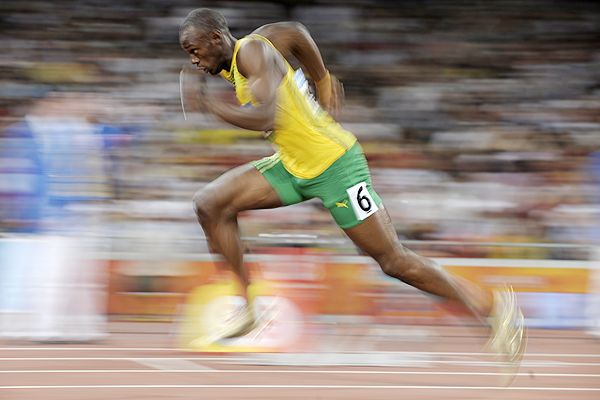

“Even though Bolt achieved the greatest velocity (12.3 m.s – 1) over the 60-80 m split compared to his competitors, his estimated vertical stiffness (355.8 kN.m – 1) and leg stiffness (21.0 kN.m – 1) were significantly lower than his competitors.”
This is absolutely massive news.
Big thankyou to MJ Taylor,& R Beneke.
“This reduction in stiffness is a consequence of Bolt’s longer contact time (0.091 s)”.
Hmmmmm…
Glad you like it Andy!
Will Hopkins likes Magnitude-based inferences. This way you can tell how confident your are you intervention will have a positive or negative effect and how large that effect will be. Will writes about it here http://www.sportsci.org/jour/05/ambwgh.htm
Awesome Wesley! Thanks man.
One consideration is contact length versus air time and contact time. Taking longer strides versus more powerful strides are two different matters.
Good call Carl.
Do you know how CL is calculated? Is it simply the horizontal distance of the COM covered during GC?
All I can find is this post on Jimson Lee’s site: http://speedendurance.com/2011/03/25/velocity-contact-length-ground-contact-time/
But I know that Jon Goodman speaks of this calculation often.
Loving the podcasts, Bret. Extremely interesting stuff, professionally covered!
Thanks Keith! I appreciate that.
Here’s an article Bondarchuk’s methods that isn’t fake.
http://www.mbingisser.com/wp-content/uploads/2010/06/SimplifyingBondarchuk.pdf
Ironically I downloaded that two weeks ago – loved it. Do you know if the article I referenced in the podcast is legit?
Hey Brett,
Is this: http://www.youtube.com/watch?v=dwf_cv8A4zk still your preferred method of doing Bulgarian split squats? Or have you changed your technique on them in the last couple of years? I’d be curious to see you do a video breaking the exercise down in more detail as well; that is, assuming you haven’t already and I missed it somewhere.
Yes it is! But I’d use this instead: http://store.sorinex.com/One_Leg_Squat_Stand_p/ols-1.htm
I do have a specific way of teaching them, which I should film sometime. Good call!
Bret,
Lifting compliments sport, especially team sports that focus on tactical and skill development. The irony is the proponents of RFESS use the overhead squat regularly to screen athletes. If they are going for “threes” why are they poor squatters? Shouldn’t all of the corrective exercises make them awesome at going ATG with 315 (1.5- 2 x bodyweight) after all of the RFESS work? Crickets!
Testosterone levels and testosterone action is not the same. I can starve a rat in a lab and it’s GH will rise but that doesn’t say that the animal is anabolic! Again, when I see 43 inch verts coming from these facilities, paired with 4.1 combine performances I will be buying the one leg squat stands by the dozens. I well rounded program will include a balance of exercises, so I don’t get why such an affinity to the exercises.
hey BC, I wanted to write in to your new podcast with Fass but couldn’t find a contact email or page. I figured I’d email you here. The squat podcast was great! I thought I’d send a couple questions to you that perhaps you could address on the next one as a bit of follow-up:
If one were to replace the backsquat in their lifting program with the RFESS wouldn’t that require approximately twice as much time in the gym? I mean, whatever your programming might be, when doing the RFESS each leg has to be worked and rested the same as the other so I just mean logistically, realistically, in application, it would indeed require a bit more time in the gym – unless I’m misunderstanding something. Am I wrong?
Have you ever, in a longer term program, swapped out the squat with the RFESS? What were your results? As reference: I started my lifting with Ripp’s starting strength straight up 3xweekly linear progression. That worked just as people say for me. Once I really started stalling on things I switched to Wendler 5/3/1. I’m 8 cycles in and having great success with that. I’m doing the Boring-but-big version of Wendler’s program. Anyway, the point is that the meat and potatoes of my time in the gym are still the big four: backsquat, dead, bench, and overhead. While I’m not going to ditch my backsquat right away I was intrigued by your podcast and thought I’d see if you thought there were a way to essentially swap the squat for the RFESS in this type of programming (btw, I’m doing the wendler 4xweekly: that means one big lift per day for four days, so I only squat once per week, dead once per week, bench once per week, and press once per week)
Thanks a lot.
-ben
Another thing to consider: Are you ever going to train that last 30-degrees ROM, terminal flexion of the knee joint, if not with squats, possibly with a high step up? It is very hard to do so with a RFESS, unless you elevate both feet, and do them speed skater lunge style. What I’m saying is, will your ass ever make contact with your calves?
I have found that exposing your quad to this last ROM is very helpful for VMO development, hypertrophy, as well as overall knee health.
Granted, a lot of lifters never make it there squatting either. I still think the best exercise for total leg development is a trap bar DL from a high deficit, enough to where you are in a full squat position at the bottom. To me, this seems to mimic the primal squatting pattern that we all learned first: squatting in order to stand up and learn to walk.
Great, balanced podcast, BC and Jon. (Long, but great! 🙂
Anyway I can download these to put onto my iPod?
Yes, we have this on iTunes! Check the link above.
Hi Bret,
I’ve quite a strong interest in evidence-based decision making and although I also have an interest in fitness and exercise I don’t have very much knowledge in it. I’m really enjoying listening to your podcast.
I studied biomedical engineering at university, so I have some knowledge of physics and calculus, and when I heard you say “power is force times velocity” (at 23:47) my first instinct was to work this out for myself.
The closest I could get to that was this equation:
P = Fv + s*dF/dt
Assuming I haven’t made a silly mistake somewhere (I’ve gone over my working and although I’m a bit rusty at the moment I think it’s all right) that would mean that in order to use P = Fv as a workable equation you’d need to assume that Fv >> s*dF/dt.
I’m having a bit of a hard time wrapping my head around each of these terms. Is that just an assumption that’s commonly accepted in the context of these sorts of movements? Do you have any extra insights that might help me understand it?
Thanks a lot,
Mark
Even though Hannas comment is over 2 years old, I wanted to leave a reply for future readers:
Power is defined as P=W/t (W=work, t=time)
Work is defined as W=F*s (F=Force, s=distance)
This is obviously simplified (for example, it assumes that the same force is applied in the same direction over the time etc.)
P=W/t with W=F*s gives us P=F*s/t
s is the distance the mass has traveled because of the force and s/t gives us the average velocity v (v=s/t).
Therefore: P=F*v
As said before, this is a simplification and especially when it comes to strength training one would have to consider the joints (where things like torque would come into play), whereas this formula only works in one dimension. Still, with these simplifications/assumptions, it’s true.
After thinking about it more and discussing it with a friend, I think I’ve figured it out. For *instantaneous* power (i.e. assuming s = 0) the equation will simplify out to just P = Fv