
Hi Bret, I’m a huge fan of yours and love the evidence-based approach! Quick ABC (Ask Bret Contreras) question for you – whenever I do standing military press it hurts my lower back. Why does this happen, and what can I do to prevent it from occurring? – Santino
Thanks Santino!
Your low back most likely hurts when you perform military presses because you are hyperextending your lumbar spine during the movement.
Most trainers would tell you that you need to work on your core stability and would prescribe a bunch of planks and the like. This usually does absolutely nothing to solve the problem.
Bad lifting form is usually due to one of four things:
- Poor mechanics (usually motor-control and coordination related, but is also heavily influenced by anatomy/anthropometry)
- Poor joint mobility
- Poor joint stability
- Fatigue
Assuming you have proper mobility and stability in the various joints, then it’s just a matter of learning proper form. Watch this hilarious video from Martin Rooney which shows how to perform the military press properly (he discusses this from 1:45 to 3:25 and it’s actually one of the best quick videos on the military press):
You may be able to just work on your form and fix your issues. Make sure you try all of the things Martin mentions, including:
- Narrow grip (triceps on the lats while tensed)
- Tight core and legs (abs and glutes are tensed) * this is important!
- Bar goes straight overhead (head goes forward after bar passes)
- Feel the delts AND traps (to upwardly rotate the scapulae) working
- No excessive leaning back
If this works for you, congratulations!!!
If not, then here are some things that might be going on:
- You may have poor shoulder flexion mobility (ability to raise the arms up all the way) and are leaning back (substituting lumbar hyperextension) to compensate
- You may have poor thoracic extension (upper back extension) and are leaning back to compensate
If one of these are the case, then you need to work on bringing up your shoulder flexion or thoracic extension mobility, and then you need to blend the newfound gains in mobility into your motor programs. Your body will still want to use the same form it’s always used even though you’ve gained mobility, so you have to rewrite your movement patterns. A 2-4 month flexibility program may therefore be in order along with a gradual reintroduction to the movement.
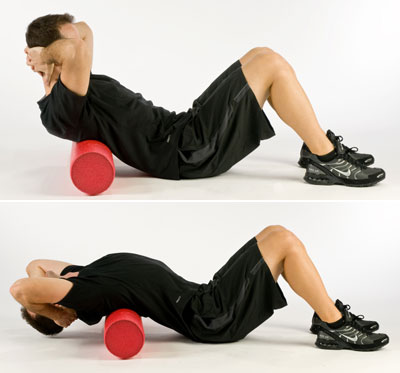
One of several good thoracic extension mobility drills
You may also have poor stability, but it’s usually not a lack of core (ab/oblique/erector) strength, it’s just poor patterning. It’s worth mentioning that many folks are very resilient to hyperextension and experience no pain with the military press even if they lean excessively (I’ve notice the same thing with hip thrusts and back extensions). Other folks are able to master military press form relatively quickly from simply practicing the form with lighter weight while squeezing the abs/glutes and focusing on remaining relatively upright to prevent lumbar hyperextension.
Some folks start overarching the back only when the loads get heavier. If you fall into this category, you might be able to get away with military pressing with solely lighter loads (for example, sets of 10 reps or higher). Refrain from going heavier, refrain from going near failure (keep a couple of reps in the tank to avoid encouraging excessive lean), and always try to remain as upright as possible.
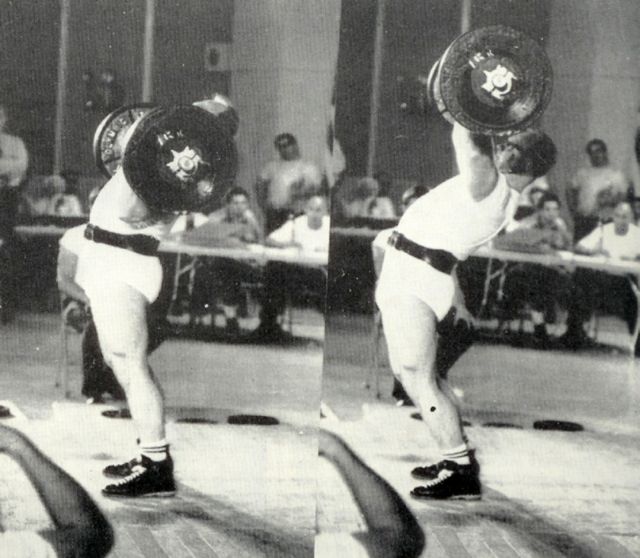
Not everyone hurts their low backs with the military press, once upon a time this was an Olympic lift and many lifter’s backs could endure this type of form, but it’s much better to remain upright
Let’s say that you’ve tried all of these things and you still experience back pain while military pressing. Don’t be depressed. Some folks simply don’t have the body structures to safely perform the military press. The slightest deviation from neutral spine irritates their lumbosacral regions, and some have tremendous trouble avoiding lumbar hyperextension with the military press. This could be due to their strength curves – perhaps they’re just so dramatically stronger in the incline press ROM and therefore they always inherently resort to leaning back to mimic the incline pressing motion when the loads get heavy.
If this is the case, do not fret! There are still plenty of options for you. You can still see if the following lifts work for you:
- Standing dumbbell overhead press
- Seated barbell overhead press
- Seated dumbbell overhead press
If you go with the seated variations, please make sure that you choose a bench that doesn’t pin your scapulae together. You’ll need a lower-height military bench for this as the taller are usually problematic in this regard.
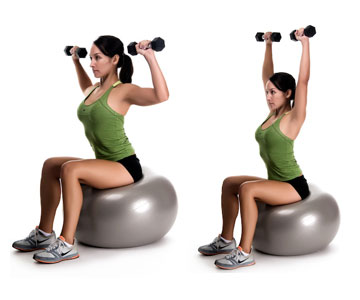
This can still hurt the back – notice the excessive arching? I prefer a bench with a back to it when performing these to reduce loading on the spine and provide stability

The high military bench can pin the scapulae together and cause shoulder issues

This bench height is better, but an even shorter bench relative to the lifter is ideal IMO
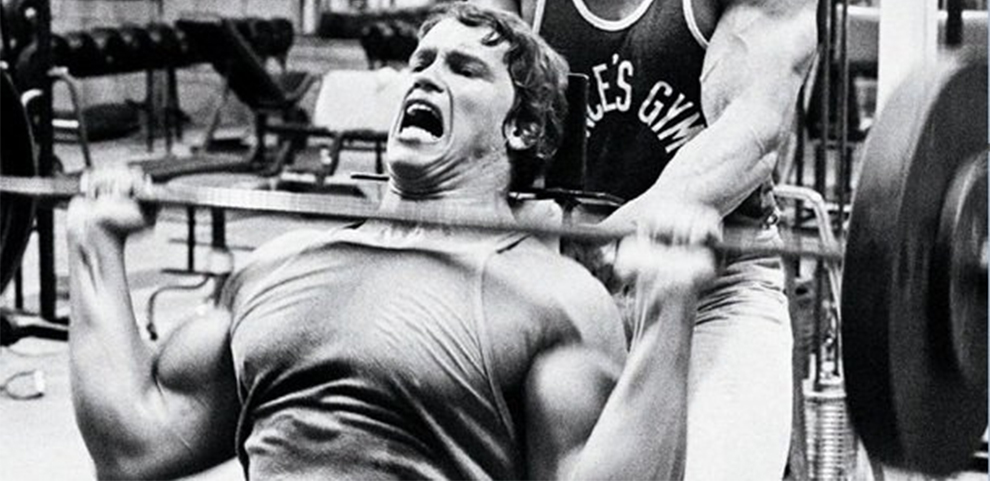
Don’t underestimate the seated barbell overhead press – many bodybuilders prefer this variation.
I have one more variation that I want to introduce to you. It’s something that I’ve found very beneficial – the Anderson half-kneeling overhead press:
I’ve found this to be a pretty good alternative for folks who always experience low back pain from performing military press yet still want to perform a movement that they feel gives more “bang for their buck” and enhances functional stability. It’s done out of the rack in the half-kneeling position, which requires sound levels of hip stability (the adductors and abductors on the front leg are getting stimulated in hip flexion, while the adductors and abductors on the rear leg are getting stimulated from a neutral hip position). Make sure to squeeze the glute on the rear leg. Some folks (like me) don’t see much of a drop-off in strength when moving to this variation, however others have to move down in weight drastically until they gain coordination.
I hope that answers your question, and best of luck!

This post is extremely timely for me. You are fantastic! Amazing work. I wish you could train me!
Sweet. Experienced lower back pain yesterday due to this. Some nice little cues to try out. Much appreciated bret
Chris
Seems like using that high bench would be very helpful in compressing those vulnerable shoulder blades and helping them stay packed down nice and tight during the overhead press.
Then just drag it over to the lat pulldown machine, and crush your shoulder blades into it as you pull down.
Frankly, I want that bench permanently affixed to my thorax at all times, in case I need to climb a rope, or reach up into the cupboard to access my supplements. Dammit, I want my shoulder blades safely packed down 24 hours a day! LOL!
(Wait…you’re suggesting that the scaps do need to be free to move in coordination with the arms?! Hold on just a darn minute! 🙂
Btw, Martin Rooney and I are roughly the same size and press roughly the same (body)weight. He is using a technique that stays in supination and is almost all anterior delt. I prefer to roll the elbows under the bar far more than he does, “Arnold press” style.
This is a technique that I gravitated to because my lateral delts are stronger than my anterior delts. So to use them requires an internal rotation of the humeri, which in my mind is a natural movement pattern, like throwing a punch. It’s also the way strength legend Bill Starr teaches the press:
http://billstarrr.blogspot.de/2012/01/press-part1-by-bill-starr.html
Says Bill:
“Your elbows will be down and close to your body – not tucked in tightly but more close than away.”
“As it climbs up past the top of your head, push your head through the gap you’ve created, and at the same time turn your elbows outward and guide the bar slightly backward.”
Turning the elbows outward is exactly what I do, the elbow moving from in close to out and under the bar is internal rotation of the humerus, and it is akin to cocking your fist in a neutral posture and turning the wrist over as you strike.
Again, neither right, nor wrong, just another example of how different biomechanics and strength curves will affect techniques.
Good stuff, Bret.
Excellent stuff Derrick! Was thinking about the same thing. Appreciate the Bill Starr link as well.
Thanks, Bret. I love articles like this that really look under the rock. Kudos!
And here’s one more cue that may be helpful to low back pain suffering overhead pressers:
Visualize pushing YOURSELF THROUGH THE FLOOR, rather than pushing the weight upwards.
You will automatically get SUPER tight throughout the glutes and core, as you try to turn your body into a vertical nail.
As always, individual mileage may vary, nothing works for everybody. But sometimes it’s just one piece of imagery that streamlines the whole motor pattern.
I found every part of this article to be useful–all of these cues need to used by anyone who wants to improve their military press while protecting the lower back. However, there is a glaring issue that you touched on but could use some extra emphasis–pride. Most males, especially the younger ones, want to convince themselves or others that they are stronger than they really are. When you try to press a weight that is too heavy for you, the body instinctively turns the exercise into a standing incline press. Regardless of the rep range you are training, suck up your pride and use the appropriate weight. In reality, this statement applies to EVERY lift done by a self coached young male.
Nice article….when I squat, I feel that my right leg is taking a greater load than the left….after squatting my left knee hurts for sometime after which its normal again my form is near perfect..please throw some light on this..thanks.
Great article. I wrote all about the same issue at my site. http://fitnesspainfree.com/?p=2923 It’s not something we typically think about but pressing can really end up hurting your lower back.
Hi Bret,
Really resourceful post, so thanks for that. I just wanted to add that doing some basic yoga stretches before and after a workout really help in stabilizing and realigning the bones in the lower back. Working on your alignment using a basic wall stretch while bent over and holding a wall is a great way of ‘resetting’ your back.
Alana
Your Rooney link gave me some horrible spoof video of some guys at Rutgers pretending to do sissy workouts!? it was pretty bad. Then it changed into a video for Annie Thorisdottir. Weird.
Oops. So I realized that I was too impatient with the silly part and forwarded through the actual lesson. Still it’s weird that the video turned into Annie Thorisdottir when the other one was done!
Hello guys,
I work my shoulders and do benches. Recently I lifted 160 onto my shoulders doing shoulder press “dumbell overhead press” according to this site. I am fine usually but after a 2 week break because of work and school I came back and done it. I hurt the back of my shoulder. This causes pain when I move and when I sleep I can barely turn without have too much pain. It happened to me before, but I would recover within 2 days or less.
This time it haven’t recovered for a week. I would like to know how I can approach it before going to the doctor. It is slowly, very slowly getting better, but I would like to speed the process if possible.
It usually is a muscle that also messes with my spine. It is either a muscle, or tendon, or a ligament. Not sure
Good content. I recently got back in a gym and feel like a felon when I’m crouched in the corner chalking my hands so I can grip the warped bars with no knurling left.