
Glute imbalances are very common – much more common than you’d imagine. Out of all of the email inquiries I receive from my readers pertaining to the glutes, the topic of imbalances comes up the most often. If you comb the web, you won’t find much good material on this topic. In fact, a Google search of the term “glute imbalance” yielded several links on the front page to threads from some of the most popular strength & conditioning forums – yet no comprehensive answers could be found. The reason why strength & conditioning experts shy away from this topic is because the answer is complicated. In this article I will first discuss the reasons why you may have a gluteal imbalance, and then I’ll discuss potential solutions.
Causes of Gluteal Imbalances
1. Asymmetrical Human-Nature
By nature, we are asymmetrical beings. Our anatomy itself can be asymmetrical, for example right to left pelvic and hip asymmetries and leg length discrepancies are common. However, of perhaps greater importance is that our daily movement is markedly asymmetrical in nature. We tend to shift to one side when standing for prolonged periods, and we develop comfortable, asymmetrical patterns for common daily tasks.

In sports, it’s natural to rely predominantly on one side during a particular pattern. For example, when we kick, most right-handed individuals will plant off of their left leg and kick with their right leg. For this reason, most right-handed individuals are actually more stable on their left leg and therefore are initially better on their left leg compared to their right leg when learning single leg exercises. In rotational sports, most athletes swing or throw from the same side, which uses the rear glute to a much greater degree than the front glute. It comes as no surprise then that one glute or region of the glute might be stronger and more coordinated than the other.
Therefore, non-significant gluteal imbalances should not necessarily be thought of as dysfunctional, they might just be a natural consequence of life. Significant imbalances of approximately 15% or more, however, should be actively targeted for correction.

2. Inactivity
When considering the human body, we know that some muscles are more prone to inhibition than others, and the glutes are one of these “easily-inhibited” muscles. Several decades ago, physical therapists such as Vladimir Janda noticed that the glutes are quite prone to inhibition, and in the last decade strength coaches for professional teams began to notice that their athletes’ glutes were not functioning optimally.

There are a few reasons why the glutes could shut down. Neural and mechanical inhibition involving opposing muscles can interfere with gluteal activation. For example, tight or shortened hip flexors may lead to what’s been coined “reciprocal inhibition” of the gluteals. There may even be inhibitory consequences to excessive sitting, as compression slows down vascular function and interferes with nerve function. We’ll learn below that pain inhibits muscle contractility and is a major player in glute inhibition. Moreover, gluteal inhibition can negatively impact posture, and poor posture can further inhibit the glutes, thereby creating a downward spiral in gluteal function.
However, probably the biggest reason why the glutes shut down is due to inactivity. If you fail to consistently activate a muscle, and you fail to regularly activate a muscle to high levels of capacity, it will inevitably quit working properly.
If you study electromyography (EMG), you learn that many muscles get highly activated from common, everyday movements. For example, the quads get highly activated every time you stand up from a chair, pick a box up from off the ground, or climb stairs. The erectors are highly activated when bending over to move furniture or perform yard work. The triceps receive sufficient stimulation when posting up to get up from a prone position or to push open a heavy door. The calves are highly activated when climbing stairs, and the abdominals are highly activated when sitting up from a lying position.
However, the gluteus maximus fails to achieve high levels of activation during each of the aforementioned everyday movements. In fact, the nervous system only activates the glutes to around 10% of maximum capacity during the sit-to-stand, especially in the manner in which most sedentary individuals rise from a chair, and gluteus maximus activation is even less during gait at normal walking speeds. Only heavy or explosive movement such as squatting, deadlifting, lunging, hip thrusting, jumping, running, and swinging highly activate the gluteus maximus. The problem is that most people fail to perform any of these activities on a regular basis in the modern-day world.
If we were to examine the muscle density achieved via maximum voluntary isometric contraction (MVIC) of 100 sedentary individuals, it is likely that 95 of them would be able to produce significant tension in their quadriceps, calves, abdominals, and triceps musculature, to name a few. However, perhaps only 33 of these individuals would be able to achieve high levels of tension in their gluteus maximus. This is why strength coaches and physical therapists alike have gravitated toward prescribing simple, low-load glute-activation drills to their athletes and patients. They are seeking to counteract the natural tendency of the glutes to shut-down and to teach the glutes to fire fast and hard when needed during functional movement.
3. Pain, Prior Injury, and Structural Issues
I mentioned above that pain is a huge inhibitor of the gluteus maximus. This is a big deal. Research shows that the glutes can become inhibited with just about any lower body or spinal injury. How many of you readers have stubbed your toe? This inhibits the glutes. How many of you have sprained an ankle? Glute inhibition. Hurt your knee or your hip? Pulled a groin or hammy? Fell on your tailbone? Experienced sciatica? Tweaked your low back? All of these injuries decrease glute activation. Is this a bad thing?
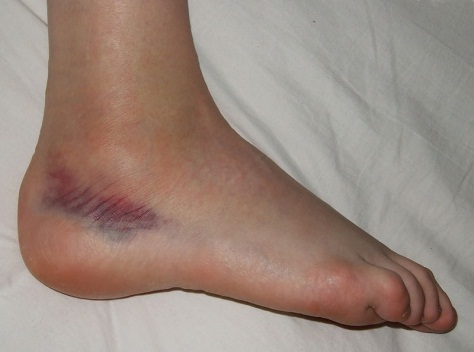
Not exactly. The glutes are major propulsion muscles. They produce powerful locomotion. Inhibiting the glutes will cause an individual to slow down so they can heal. Back in the day, you would not have survived long if you were forced to hobble around for the rest of your life due to injury. So from an evolutionary survival standpoint, this is a wise strategy.
The problem is that the glutes don’t necessarily turn back on automatically. They must be reactivated, restrengthened, and recoordinated back into every day movement and activity. How many people sprain their ankle, and upon healing, perform glute activation drills and utilize a progressive approach to reintegrate their glute into functional, high-force, and high-velocity movement? The overwhelming majority do not.
Following injury, most folks simply keep on keepin’ on, and their movement patterns suffer. Rather than experiencing proper glute function during movement, they rely on other muscles to get the job done. This is why you see pelvises dropping to the side and knees collapsing inward during gait, backs rounding over during lifting tasks, and an over-reliance on the hamstrings for hip extension. The body is resilient and will find a way to prevail, and people can become very fit despite using the wrong muscles or displaying faulty movement patterns. Next time you go for an early morning drive, pay attention to the joggers. You’ll notice that not many of them appear athletic or possess good running posture. Sadly, most look like they’re “speed-limping.” But even advanced athletes often have faulty glute function. One study examining strongmen showed that the best heavily incorporated the glutes during lifting tasks, whereas the less-skilled relied predominantly on the back musculature.
Finally, we must consider morphological structural issues that could contribute to diminished glute function. To list some examples, let’s say that you have lost the natural arch in your right foot, or you have bone spurs in right hip, or you have scoliosis, or you have excessive anterior pelvic tilt, or you damaged the lateral meniscus in your right knee. Each of these could create glute inhibition. To confuse matters, some of these could have been caused by glute inhibition (remember the downward spiral I referred to earlier?). So structural changes can cause or be caused by gluteal inhibition.

But don’t be alarmed – these conditions don’t guarantee glute dysfunction. An athlete could possess any one of these maladies and yet still possess sound-functioning glutes. In fact, perhaps the best pound-for-pound deadlifter in powerlifting history had severe scoliosis, and a majority of sprinters have “excessive” anterior pelvic tilt.
Solutions for Restoring Gluteal Imbalance
As we noted above, glute imbalances can be caused by dysfunction brought upon by pain or inactivity and are therefore a “dysfunctional consequence.” However, they can also be caused by everyday life and sports and are therefore a “functional consequence.”

I do not know why YOUR glutes are imbalanced. Let’s say that we had a consultation and I learned your entire athletic and injury history – at best I could only speculate as to why you have a glute imbalance. Maybe when you were in high school you hurt your left knee, which caused your left glute to shut-down, and since you never rehabilitated properly, your body memorized sub-optimal movement patterns and has been relying on faulty motor control ever since. Maybe in your twenties you quit playing sports and quit going to the gym and pretty much sat on the couch for 3 years. During this time, perhaps you rarely used your glutes, and the only times you did anything that used the glutes to any substantial degree, you relied predominantly on the left leg, causing the right glute to shut down while keeping the left strong. Maybe your favorite sport was highly asymmetrical and you swung a club or threw right handed, strengthening your right glute to a much greater degree than your left.
Whatever the case is, it usually doesn’t matter as the solution is often the same. During the “re-education” process, it’s important to have proper perspective. You might have been walking around with a gluteal imbalance for over a decade, therefore it’s going to take some time to rewire your motor circuitry. If it takes a few months for the problem to normalize, so be it. Each session you’ll be a little bit closer to your goal so be patient. Also recall that we want to strengthen the “neuromuscular” unit. There’s a neural and muscular component to fixing the issue. Right now your dysfunctional glute is weak and doesn’t want to activate. You need to get it easily-excitable through neural reeducation, and then you can focus on increasing strength and hypertrophy.
Wait for Pain to Subside
When pain exists during movement, the brain is trying to shut down the glutes, so this is not a good time to try to be teaching the glutes “motor learning.” There simply will not be much learning going on in the gluteal motor. So wait until pain subsides to start attempting to fix the dysfunctional glute.
Assuming pain is gone, there are six strategies that you may choose to employ. Depending on your situation, you may want to stick to just some of the strategies, or you may employ all six simultaneously. It all depends on your situation. Here are the six strategies:
1. Isometric Contractions for the Weaker Glute
The first thing you want to do in order to try to fix a gluteal imbalance is perform a bunch of extra work for the weaker glute. What you need to do is establish a solid mind-muscle connection (MMC) with the dysfunctional glute. One great way of going about this is to perform isometric contractions. Here is a good series to perform on a daily basis:
- 10 sets of 3-second maximum contractions with the weaker glute from a standing position
- 10 sets of 3-second maximum contractions with the weaker glute from a seated position
- 10 sets of 3-second maximum contractions with the weaker glute from a prone position
* Rest 5 seconds in between isoholds
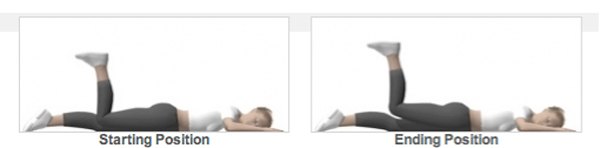
You can do these isometrics anywhere as they don’t require equipment. In fact, you can even do them while you’re at work. It’s unlikely that anybody will notice, unless the person is staring right at your butt. Don’t be afraid to perform these multiple times throughout the day.
2. Low-Load Dynamic Drills for the Weaker Glute
In addition to the isometric contractions, you want to perform a variety of dynamic movements for the weaker glute so you target all the glute fibers through their multiple roles. The goal is to choose very simple exercises that aren’t challenging. This way, you can steer the neural flow to the gluteus maximus and prevent it from flowing excessively to the hamstrings or other synergists. You do not want to go to failure when performing sets of these exercises. Five to seven days per week, you want to perform a 5-10-minute motor-learning routine for the weaker glute consisting of:
- 2 sets of 10-20 reps of side lying abductions with the weaker leg
- 2 sets of 10-20 reps of side lying clams with the weaker leg
- 2 sets of 10-20 reps of quadruped hip extensions with the weaker leg
- 2 sets of 10-20 reps of single leg glute bridges with the weaker leg
* Rest 30 seconds between sets
* Perform the exercises in circuit fashion; first the abduction, then the clam, then the quadruped, then the bridge, then repeat
* Don’t do any of these drills for the stronger leg/glute
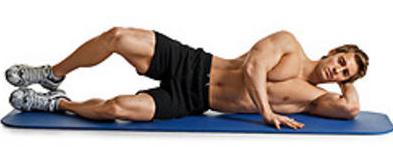
Remember, the focus is on quality muscle contractions. You want to feel these movements as much as possible in the gluteus maximus of the dysfunctional side. Tinker around with your form and figure out how to maximize gluteal recruitment during these movements. Positioning for maximum gluteal recruitment varies from person to person so I can’t give you the exact recipe here – you need to figure it out for your body. Don’t add load in the form of bands or ankle weights, don’t perform more challenging variations, and don’t perform more than 20 repetitions. You’re not going for progressive overload – you’re aiming for gluteal reeducation.
3. Low-to-Medium-Load Symmetrical Bilateral Movements
You don’t need to completely shy away from squatting, deadlifting, hip thrusting, or back extensions. Just don’t worry about load for a while and instead focus on symmetrical movement and feeling the glute muscles work equally on each side. You’re going to be blending your newfound increased glute activation into your motor programs for each movement, so this is an important element to your success.
In fact, strengthening the glute alone will not solve your issue. Your neural circuitry has been wired for asymmetrical movement patterns and muscle recruitment. It has built a “motor engram,” or a memorized movement pattern, and you’re trying to rewire the circuitry. You need to learn to activate the weaker glute, you need it to be stronger, and you need to build up its hypertrophy, and you’ll do this by hammering the weaker side. But this alone will not provide a complete fix.
You still need to learn to perform bilateral movements properly. Every repetition of squats, deadlifts, hip thrusts, and back extensions you perform with perfect symmetry while feeling the weaker glute activate properly is a PLUS. Every repetition of squats and deadlifts you perform that is not symmetrical in movement and activation is a MINUS. It’s up to you to learn your loading threshold and stick to loads that allow for proper motor programming. For some, this equates to bodyweight loading, and for others, 70% of 1RM might be okay. However, even if your imbalance is not that significant, you definitely want to shy away from anything above 90% of 1RM for at least a month.
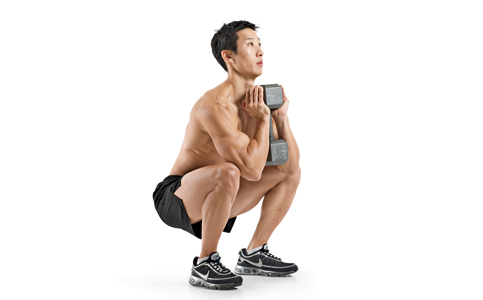
When you go too heavy, your body WILL find the path of least resistance in order to get the job done. One of your glutes is weaker than the other and if you push the envelope your body will work around it by using other muscles and contorting the body (i.e.: shifting to one side, rotating at the hips). So please remember: good reps take you forward; bad reps take you backward and cause stagnation!
Gradually increase loading over the course of several months. If you ramp up too soon, you won’t progress as you’ll just confuse the weaker glute and prevent reintegration. You may wish to start off with easier variations such as goblet squats and RDLs. Take your time and be patient.
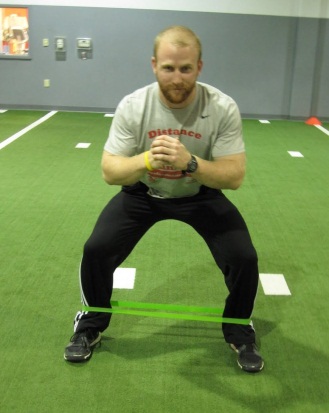
4. Bilateral Movements with Resistance Bands Around the Knees, Ankles, or Feet
Bodyweight squatting and bridging patterns with resistance bands around the knees are very effective for gluteal reeducation and should be performed during warm-ups. In addition, various types of band walks can and should be performed. These have different names, such as x-band walks, sumo walks, and monster walks. I recommend placing bands around the mid-feet and performing both crouched and upright walking movements. I also recommend performing these walks both forward and backward as well as from side to side. Just pick a couple of these band exercises each session and perform 2 sets of each during the warm-up. Again, don’t go for PR’s and progressive overload, go for activation. Think QUALITY, not QUANTITY.
5. Single Leg Movements and Core Stability Drills
Here’s the deal. You don’t want your strong leg to get weaker, and you don’t want the glutes, hamstrings, adductors, and quads on the good leg to shrivel up. What you do want is for the glute on the weaker side to catch up as quickly as possible so it matches that of the stronger side. Performing low-to-medium load bilateral movements will prevent the hip and thigh muscles on the dominant side from experiencing significant atrophy, and you won’t lose appreciable amounts of strength either. So let that give you peace of mind.
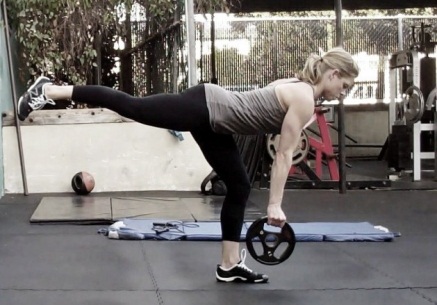
However, you can still perform some traditional single leg work (think Bulgarian split squats, step ups, reverse lunges, single leg RDLs, single leg hip thrusts, and single leg back extensions) or core stability work (think Pallof presses, side planks, and band hip rotations) with two caveats:
- Don’t go too heavy to the point where you no longer feel the weaker glute doing the brunt of the work. If you can’t accomplish this with bodyweight loading, then don’t do them – they’re too advanced for you and will prevent you from progressing. Assuming you do feel these movements working the weaker glute properly, then you can indeed incorporate them into your programming, but the set stops the second form breaks down or the second you stop feeling the glute doing the work.
- Do twice the volume for the weaker side compared to the stronger side. If you do 10 reps for the weaker side, stick to 5 reps for the stronger side. This will also prevent strength and hypertrophy losses for the dominant side while allowing the weaker glute to catch up.
If you play an asymmetrical sport that’s in season, I advise you to not do any work for the dominant side as it’s getting plenty of work during the sport and practices themselves.
6. Self-Myofascial Release (SMR) and Static and Dynamic Stretches
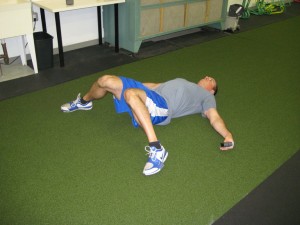
It is very important for your hip mobility to be symmetrical. You should test your hip flexibility for each leg in all possible directions. You want to test your hip flexion, hip extension, hip abduction, hip adduction, hip internal rotation, and hip external rotation flexibility for each hip. If you have a marked asymmetry in any of the motions, then you should attempt to restore balance as quickly as possible. While the strengthening movements can help with this goal, some SMR and stretching is synergistic and will expedite the process. Often you will find that hip rotation imbalances exist (external or internal). If so, you will benefit from performing a combination of foam rolling, static stretches, and dynamic stretches to help achieve balanced flexibility. Stick to 5 minutes of SMR and flexibility work for the affected side.
Automaticity is the Goal
Your goal is to eventually reach automaticity and quit having to “think glutes” all day long. Sure, any good lifter has to remind him or herself to squeeze the glutes on maximal hip extension exercises such as when locking out a deadlift. But both of your glutes should fire automatically when you extend the hip (or conduct any other movement that relies on the glutes). Within six-months of gluteal reeducation, you should be able to balance out your strength and movement patterns – hopefully even quicker.
You eventually want to be able to perform high-load movements such as maximal squats and deadlifts and explosive movements such as jump squats, power cleans, kettlebell swings, plyos, and sprints, with symmetrical and properly functioning gluteals. As you progress in your gluteal reeducation you will begin to ramp up in loading and perform more challenging exercises. As this occurs, you will begin to wean yourself off of isometric contractions and low-load glute activation drills. For less-serious cases of glute imbalances, this process might take 4 weeks. For more serious glute imbalances, the process could take 3-6 months. It’s impossible to tell. Just be consistent and diligent and you should be able to restore proper function.
Conclusion
I hope that this article has shed some light on gluteal imbalances and provided you with solutions to your problem. In summary:
- Don’t train in pain
- Perform lots of extra work for the weaker glute in the form of isometric and low-load dynamic glute activation drills
- Perform lighter bilateral movements such as squats and deadlifts with perfect symmetry
- Utilize resistance bands placed around the feet, ankles, or knees to perform squats, bridges, and various walking movements
- Perform extra volume for the weaker leg when busting out single leg and core stability work such as lunges, single leg RDLs, side planks and Pallof presses, and
- Perform SMR and flexibility work if you have hip flexibility imbalances.
Always think quality over quantity, and focus intensively on reprogramming the weaker glute and developing a proper MMC. In time, you should be able to solve your problem, reach automaticity, and possess a balanced booty.

Thanks for an awesome article. This has answered all the questions I didn’t even know I had! You’re truly the best. Thank you for always sharing your knowledge.
Thanks Jenny!
Ditto, what Jenny said. Great article. Learned quite a bit. Thank you!
Fantastic article! Been searching for ways to correct this imbalance and had so much trouble finding proper information. I just wanted to ask though, are there any self-tests I can do to determine which glute is the dominant one? I don’t want to end off doing additional training on the already strong glute. My right leg measures about 1 inch nigger around the thigh than my left leg so based on the idea that the weaker glute and leg would experience atrophy would that suggest it is my left glute which is weak. I am however right handed but I have been very inactive for several years. Any help would be greatly appreciated, Thanks.
I’m usually not the type of person that corrects people’s misspellings and grammar mistakes, but there is one GLARING misspelling in your paragraph. In the middle of the paragraph, you misspelled “bigger” in a very oblivious way.
So what if you are not normally the one to do that…but you did. I guess you have to start somewhere. Good luck on the start of your journey to be annoying.
Kyle, hmmm maybe your use of the word “oblivious” should be corrected to “obvious” …. the moral of the story is ….
asides, I the article is great and very helpful! thanks
Did you guys read the mistake he was talking about? I think in this case the person may want to know and edit it…
Spotted it right off, gave person who commented on it benefit of the doubt that they were using oblivious intentionally. For the love of god someone edit that.
Stronger thigh muscles can be compensating for weak glutes which is a possibility.
Hey man, i been adressing my glute imbalance but as a result my body has grown disportionate in favor of it, will doing leg press to get bigger quads interfere with the process of fixing my imbalance ? or it wont as long as i stay within my threshold with good form? please reply much appreicated by a expert on this topic
Hi I was wondering cud u help me I have thightness in my hamstrings the whole time. Sore hips and hip flexers tight also sore ribs and chest when pressed on And I have really sharp pain in my upper groin when i lift my leg or knee up just where my leg meets my lower body. I had MRI done nothin showed up I’ve being having Physio also muscle gets loosend up and then thigh the following day. It’s goin on about 6 months now. If you could help I be grateful. I’ve done my right ankle ligaments a few times if its any help. Email me back if you can shed a bit of light on it for me. Thanks.
Im having exactly the same problem! Sharp pain in upper groin. Please help!
I don’t know what your budget is like, but a high quality sports massage can go a long way to fixing these issues. As a licensed massage therapist myself, I’ve helped hundreds of competitors, lifters, amateur and professional, clear those kinds of issues up. I’m not talking about a fluffy relaxing massage. I’m talking a thorough mauling. It’ll be intense, and you’ll be doing a ton of deep breathing, but it will really pay off.
I do pre- and post-workout routines, massage and passive-stretch, that maximize muscle readiness and muscle recovery. Find a therapist with real experience and knowledge, you’ll be amazed at the difference.
Hi Bret,
Great post, but I have a question. I’m italian so I didn’t understand all you said. For isometric contractions, have I to rest 5 sec between every sets or between every exercise? thank you so much
I am a 60 yr old male.i made a mistake and rode for 20 miles wearing jeans on a mountain bike,and my butt hurts in 1 spot on each side.,i have bought 2 massagers,and ice and do some stretches,bot i also have had a few bad falls on the ice,and am going today for xray on right hip.so what can i do for relief,i ce and rub but nothing,please if you have any tips,help me.thankyou.
Hi Bret I’m Jason,could you do these exercises with a mild form of sciatica or do you simply have to get shut of the sciatica before performing these exercises?
thanks good article
Great article and super helpful . . . thank you for the useful information!
I’m a little late to this discussion but I’ve noticed my higher glutes strong but my lower glutes weak. How do I correct these. Are there any youtube videos that can show me some exercises.
Brett I had a hip replacement 12 months ago and did a lot on single leg work prior to and post surgery. Obviously the efficacy on my glutes on either side was considerably different. In strategy 2 you advise to only work the weak side. I found that by doing both sides I was able to develop both my neural and muscular patterns in a manner that brought them closer together. My thinking was that the brain learns how both sides work. I have found that is to also work with my scapulae work? Your thoughts?
Hi Phil, great question.
The suggestions I’ve laid out do include working the dominant limb – just with a focus on symmetry (and when doing single limb movements, doing more volume with the weaker leg).
As to whether you’d bring them closer together by doing equal volume with both sides – I don’t think you would. My hypothesis would be that you’d reach symmetry quicker by doing more for the weaker side, but there is no research that I’ve found on this topic. But there are tons of studies showing a crossover effect with working one limb, which is why many coaches promote training the good side when injured. But in the case of this article, there is no injury/pain, and now it’s rehab time. Again, nice question.
Thanks man.
I would like to know what to do to activate muscle when I have problems even doing leg clams on the weak side. ?
hey bret,can you cure the glute imbalance by sprinting?
Great article Brett. Are 2-5 all things you should do from the start or is there a logical progression to apply, i.e., 2, 4, 5, 3?
Thanks Dan. The answer is, “it depends.” I purposely avoided this in the article as many are ready for each method, but some should only perform several of the methods. The typical personal training client might be ready for each, but the the physical therapy client may not. It all depends how dysfunctional the lifter is… Sorry to not be of more help but this is a complicated topic that’s hard to describe precisely.
I broke my left leg some time ago and now my glutes are completely different sizes, the right side is bigger but I broke my left leg, how do I know which is the weaker side?
Can’t wait to start these as I am very self conscious about the size difference.
Thank you for writing such an in-depth article. I had an injury last year that wreck havoc to my left side. This explains a lot as to why I don’t have symmetry on both sides and why my left side is lagging. Now that you’ve provided the necessary exercises to work on, I’m confident that I will get the symmetry back.
Okay, you just busted out the premium content. Wow! Comprehensive, brilliant writeup, Bret! I get the sense that you could have gone even much further, your mastery is off the charts.
Had a thought on #3, and “feeling the glutes working evenly” as you perform bilateral movements. How does the expression go? “You can’t trust your feelings.”
Incorporating the weaker glute (WG) back into the bilateral movement pattern can be tricky since the proprioceptive feedback loop has been skewed as well. The CNS drive to the stronger glute may be so well grooved from millions of ambulatory and postural “reps”, and (still) switched on so much higher than the weaker glute, that trying to match the sensation of effort/activation from side to side can be very confusing.
If you’ve been doing it wrong forever, doing it right now feels wrong, if that makes sense.
For example, say dominant glute (DG) has been firing at a 90% level, and weaker glute (WG) has been firing at only a 50% level. In order to get the newly strengthening WG firing at a symmetrical 90% it may feel like “overkill” to the lifter. They may feel like they are ONLY firing the WG; it may actually FEEL falsely asymmetrical, as though the DG is not firing at all.
I would compare it to a lifter who just gets his cast removed following a broken arm. When he initially performs barbell curls, he may only “feel” the injured arm working, because it is contracting so hard to keep up with the healthy arm. Meanwhile the healthy arm may feel like it is simply gliding.
It’s a new, awkward relationship from side to side. This is where your video feedback technique is gold. You show the lifter what is really happening, which may not correspond with what they “feel” is happening. As you said, perfect practice makes perfect, and with improved strength/activation, the feedback loop integrity gets restored.
(This kind of relates back to that old internal vs. external cues discussion, but especially when correcting asymmetries, internal cues can be tricky at first.)
Great, great stuff, BC.
Good stuff Derrick. I can relate well since I tore my biceps a while back as you recall. Crazy thing – even though my right bicep was way weaker following surgery, I was perfectly symmetrical from years of training experience. My nervous system was so coordinated that it wouldn’t let the weaker bicep impair symmetry – though obviously I was unable to train very heavy at first. So I can see your rationale, but my rationale differs from yours (of course I agree with you that the video feedback is gold though).
Here’s the theory:
If bilateral training is symmetrical, maximal loads cannot be used, and the weak side works slightly harder (because it’s weaker), thereby obtaining a better hypertrophy/strength stimulus.
The strong side doesn’t work as hard (because it’s stronger), thereby not obtaining a hypertrophy/strength stimulus, so it detrains slightly (or simply maintains).
This happens until the weaker side catches up, as at some point they’ll become equal due to the weaker side firing at a higher % of MVC and the weaker side firing at a lower % of MVC.
As soon as they’re equal, all the interventions are dropped, and from hereon out both sides always receive the same stimulus and are therefore symmetry is always maintained.
Now, this relies on many assumptions, for example that movement and activity is symmetrical during daily life, etc.
Remember Karli? Using the techniques employed above, I very quickly restored symmetry with her glutes (there was a huge imbalance up front) and even enabled proper squat (with no knee valgus). However, when she stopped training with me, her dysfunction came back. What is causing this? Asymmetrical activity? Of some complicated neurological mechanism?
At any rate, the important thing is that she did achieve symmetry and rid her imbalance.
Over the years, lots of my clients have had glute imbalances to varying degrees. I’m okay with some of it as it often cures itself through normal training methods. But some require these interventions.
My physio friends deal with this situation more often than I do. As usual, your comments are always appreciated.
Your patient and thoughtful responses are appreciated, BC! Our rationales are not different. We are just potentially taking one different side street on the way to the same address.
Trust me, I’m completely on board with your prescription. Activate the weak link, crush it with volume, and using perfect rep low load re-patterning to work the WG back into the bilateral mix. And there is no question that under high loads, the body unconsciously reverts back to the old pattern to “get ‘er done”.
The only area where we may see it a tad differently, is whether during that process of re-integrating the bilateral moves, you can trust the “feeling of equal effort”, to accurately reflect equal contribution. Ideally, yes, we would like to have a solid equal MMC between the two glutes, and for that feeling to match the objective reality of the movement.
Yet sometimes there remains a pesky, lingering discrepancy between CNS perception and movement reality. This may be part of what happened with Karli, if she was no longer under your objective eye. As with everything, this will vary from athlete to athlete.
For example, there are times where I have mistakenly loaded up a bar to squat with an extra 10-15 lbs. on my dominant left side, and didn’t even notice until I changed the weight. How did I not feel it? It felt like an even left to right contribution! And from my CNS’s point of view, it WAS an equal contribution; an equal RELATIVE MVC % contribution.
In this case, the CNS is grading muscular effort/activation on a curve. In a perfect world, we want it to grade straight across, equal contribution based on load lifted, not on perception of load lifted. Over time, the two grading systems will hopefully merge into one accurate feedback loop. (Thought as a former teacher, you might relate to that analogy!)
Anyway, same rationale, I would probably just lean on video far more to keep reinforcing the “new normal”. If the feeling matches the tape, that’s icing on the cake, but an asymmetry developed for some reason, and that faulty program will always be lurking on the hard drive somewhere.
RE: Karli, Maybe she came to a point of “conscious competence” with the corrections, but never graduated to “unconscious competence”, or “automatic”. And old habits die very, very hard. It’s exhausting to have to keep thinking while moving!
Pt.2: Trying to think outside the box here:
As you know I’m a fan of neuromuscular reactive training variations, loading the form flaw and forcing the body to react to it. This is the technique you list in point #4 with the bands around the knees.
I like to use it with a weighted hip belt to solve APT, and neck chain to solve thoracic kyphosis, or groove T-extension for various movements.
Suppose you were to asymmetrically load the flaw in the repatterning bilateral movements. By this, I mean overload the weak glute side of the bar by 2.5 to 5-lbs., and have the athlete perform the movement slowly with no compensatory lean. Maybe it would force them into an activation correction?
Never tried this, just brainstorming here…
In the first draft, I included RNT techniques (I bought some Cook bands long ago), but I decided to take it out. When I learned about it years ago, I accepted it without question. These days, I’m much more critical. I can rationalize that this may not be the optimal tool for restoring balance.
Why? Would be hard to describe. Usually one joint needs fixing. With the bands, you’re getting different GRFs and 3D torques up and down the entire kinetic chain. That’s worth thinking about!
But I’m talking about bands…what you described might indeed be of value (but could be “un-ideal” due to the same issues mentioned above, albeit not to such an extent).
Great discussion!
Agree, agree, agree.
Awesome discussion, thanks for posting this guys. It’s above and beyond the typical info I’ve received from several physio’s on this topic. Excuse the late reply but I wanted to thank you guys!
Self correction is tricky, like Derrick says, the perceived effort may be different from actual effort. Video is a good measuring tool.
I have a huge imbalance due to a congenital abnormality. My T1 vertebrae is extended out and down so it grew down to fuse my SI joint to my spine. It’s rare so I’ve had a hard time knowing what to do or what the actual impact is or will be. I will try the suggestions you have and thanks for the info. I’m extremely self conscious about it.
Hi Bret,
Another fantastic article.
Just wondering what you use to assess Glute strength imbalances and to what degree there is an imbalance (e.g. Right Gluteal 15% weaker than left).
You mentioned assessing hip mobility by looking at hip flexion/extension ROM etc. But was wondering what you use to assess strength imbalances.
Thanks, keep up the great work!
Great question Matt.
Here is what’s difficult – how do you measure glute strength when the hammies/adductors can compensate? For instance, hip extension strength can be equal on both sides, but this doesn’t mean that glute strength is equal as one side could involve greater ham/adductor firing. The same can be said for other glute actions (hip abd, hip ext rot) as they all have synergists.
So you want to use 4 measures:
1. Ask – clients/patients are usually keen regarding their bodies, and they’re aware of their imbalances. They’re often able to tell you if one side is firing harder than the other.
2. Palpation – poke and prod both glutes during quadruped hip extension, single leg glute bridges, side lying clams, side lying abductions. See if equal tension exists in the glutes for the same movements. Also see if hypertrophy is equal in both sides. Poke upper and lower glutes as they function uniquely.
3. Strength – this isn’t easy without a dynamometer because single leg movements are tricky as there can be compensation (see point number 3) – so make sure the movements are same in form from one side to the next. See if the same reps can be performed from right to left, and pick movements that are challenging (not low load high rep things like single leg abductions). For example, single leg box squats, Bulgarian split squats, reverse lunges, skater squats, single leg hip thrusts, and single leg back extensions can all be used.
4. Symmetrical movement – “true” single leg movements are ideal here (pistols and single leg RDLs) as stability from the other leg isn’t provided. Are the movements symmetrical? Does one hip rotate internally while the other remains more neutral? Also look at bilateral movements – squats in particular. Do they shift to one side?
These are 4 different ways you can assess glute balance. Hope that helps! – BC
As someone who’s dealt with non-firing and imbalanced glutes, you can often figure out what’s weaker by paying attention to quality of contraction when you take the muscle through different movements. If one feels fuzzier than the other when you contract you probably have firing and imbalance issues going on.
Folks also need to ensure joint and myofascial pathologies are cleared first before doing these movements. Additionally, pending of the duration of preexisting causes, the neuroplastic changes that have occurred as well as arthrogenic inhibition has to be managed and reversed. Caution needs to be taken in self MRT to not cause further damage and improper self diagnosis of imbalances and variances in mobility in affected joints.
Good stuff Justin! Ironically I just read an article discussing arthrogenic inhibition, but I don’t have experience in this area.
And for reasons you mentioned, this was a very complex topic to try to tackle (but I feel that a strength coach is in a better position than a physio to address this topic – main and simple reason being that we tend to set the bar much higher and have greater expectations…no knock on you as you’re a rare guy who understands both).
I’m of the opinion that proper movement can usually fix things as long as regressions/progressions are utilized properly. Manual and manipulative therapy is of course valuable, but 1) many therapists don’t truly know what they’re doing in terms of manual therapy, and 2) many therapists just focus on manual therapy without also incorporating movement-based solutions, so the problem rears its ugly head down the road (as we’ve discussed).
I’m sure that there are several ways to “skin a cat,” but it would therefore be important to not do more harm than good in regards to SMR and to also find a solid physio that knows his/her stuff (like you)!
I’ve been OCD about bilateral symmetry since day one, but until now, I had yet to find anyone who has ever addressed this topic with such depth and insight. Thank you for the peace of mind this gives! (<<< From a performance AND rehabilitation perspective.) The knowledge feels empowering. I know glutes are your specialty, but you should consider doing a follow up piece on scapular/gleno-humeral symmetry. …Question! When ever I low-bar back squat above 85%, I tend to shift to the left side (in the frontal plane); while rotating to the right side (in the transverse plane). What do you think this means in terms of the muscular activation patterns, when comparing both sides?
I believe that this usually means that your left glute is stronger. You shift to the left to place more loading on it for hip extension. But not necessarily – if one side exhibits valgus collapse then you may seem to veer off in that direction, or if there are hip external rotation strength imbalances then you could “push” yourself toward the weaker side. Hard to tell without palpation/EMG/isolation-testing, etc.
Hey bret nice article. One of my knees collapses inward whilst going down stairs and single leg squatting. I’ve been doing a lot of the stuff you have advised in this article but not in any sort of structure. It seems to be getting better just very slow and progressive. I’ve lived with a ruptured acl for 3 1/2 years before getting reconstruction 3 months ago so still rehabbing this. My question is there any cues/exercises/techniques you would give me for this particular scenario? I understand that you don’t know my whole history and this is a complex issue. But I would appreciate any guidance as this (knees bending inward) is something that has happened since as far as I remember and was most likely the cause of the rupture.
Thank you so much for this! I’ve been focusing on these tips since I read your article on Get glutes, and there’s hope – but I’m also a bit frustrated. Feels like I will be doing bodyweight “rehab” stuff for six months to fix my weaker glute! After my latest workouts I don’t feel at all tired, and for an endorphin junkie like me that is tough 🙁
However, I do realise that if I want to work with heavier weights in the future, I will have to fix the imbalances now or there may be trouble down the line.
Anyways, thank you again! Found your site just two weeks ago and it’s a whole new (glute) world for me 🙂
Hi Bret, First of all I am grateful to you for sharing your knowledge with everyone. I am experiencing immense difficulty sitting cross legged which I need to do for a certain meditation practice I have recently adopted. How can I fix this problem. Looking forward to your response and some solution to my difficulty. Thank you…
Hi Bret,
Thankyou for such an informative article. I have an imbalance with my left glute..very frustrating as now one glute is now larger and firmer than the other one 🙁 I will focus on the tips given in this article and hopefully see an improvement. Wish you lived in the UK so I could hire you! I love heavy barbell work, but very frustrating when you cannot feel it in your glutes.
Great article Bret! Love the applicability of it all, and I can’t wait to begin using this with my athlete’s and my own training immediately!
Awesome glute guy
Bret says… “and gluteus maximus activation is even less during gait at normal walking speeds.”
“In fact, the muscles – quadriceps, gastrocnemius, soleus, anterior tibialis, GLUTEUS MAXIMUS, and hip abductors – are not active during the pushoff phase in running & sprinting. They only become active just before foot-down to prepare the body for impact with the ground.”
Bret says… “The glutes are major propulsion muscles. They produce powerful locomotion.”
Andy says… Huh?.
Andy says… Why is it sprinters place so much emphasis on glutes?.
Andy,
I have a slideshow for sprinting that I’m going to bust out this year showing all the different studies that examine EMG during sprint running – it’s important to see the big picture.
Further, some studies show that the glute max is the most important muscle for absorbing braking forces, which is hyooge. And just because they (and other muscles) shut-off mid-stance doesn’t mean that they’re not critical for speed – what happens during first half of stance is more important than what happens during the last half of stance, and glute max (and other muscles) show big spike surrounding this phase.
There is also future research that will emerge which sheds some light on this topic (I have insider knowledge). Also, look at muscle development in sprinters and where they feel sprinting. Last, look at studies showing speed increases from glute exercises (squats, power cleans, etc.). So think big picture here.
Hey man, in the process of fixing my glute imbalance my body has goten reallyy disportionate in favor of my hips and glutes, will doing leg press help pack some size on my quads without interfering with the process of fixing my imbalance ? as long as I stay below my threshold with good form?
please reply
Hey will doing all these drills for ONLY the left side be good for the ”rededuaction” or be bad cause it will cause another imbalance on the legs???
Can you post a link to the “slideshow for sprinting” you referenced above? Thanks!
Awesome stuff here Bret. It couldn’t be more timely for my current situation. My left glutes have been falling significantly behind over the past few months, almost a year actually, due to some nasty trigger points wreaking havoc throughout my entire left hip complex. Now that I’ve got the myofascial pain syndrome under control, its time to rebuild that left glute complex. I’ve got full confidence that the work that you’ve outlined above should do an excellent job of retraining my rear end. Thanks again for this info and keep up the great work!
Great article!! The only question I have is how do I determine which glute is the weak one? My right hip is higher than my left. Any help would be appreciated.
Brilliant article….So much helpful info as usual…I had the same question as Brian W….how can I tell the weak one…is it because when doing I am doing the hip thrust my one side sometimes goes up before the other side…I had to go back to the beginning with my squats in order to get the ugly out…I guess its back to the beginning for my thrusts…new year new start new glutes….thanks
Brett, I am having pain in my left hip since quite a long time like 10months. The MRI report is clear, says nothing. Doc says its just a hip strain but the pain is not just going. I am doing few stretches like knee to chest and half sit ups for abs.
what do u suggest?
Can you use a Swiss ball instead of a bench to support the upper body during the hip thrust exercise?
Brett, my 13 year old has mild scoliosis. I notice especially with barbell squats that her butt travels to the right. Should she stick to single leg leg work? Or is this just how a squat will look on her?
Good stuff, Bret, really hit this on the nail addressing and fixing leg imbalance. Here is my story (for what’s it worth): my physical therapist ran tests on my leg imbalance and determined my weaker leg was it fact weaker due to tight hip flexors and a weak gluteus medius. He measured each leg to see if there was any length discrepency and there was none (1/2 a inch which is somewhat normal) I noted I had “Hip Anteversion” when I was younger and it gradually corrected it self as I became an adult, whether or not that had anything to do with the condition he wasn’t sure. He also didn’t rule out, a structural issue, perhaps my femor is slightly rotated on my weaker leg but the only way to find out is to take x-rays.
So I started out doing the suggested exercises and really stretching out my hip flexors/psoas on my weaker leg. Doing more reps on the weaker leg to get it stronger or at par with the other leg. Tuning in on the mind muscle connection so both glutes are evenly engaged. And after awhile it was successful, both glutes were firing and both equally sore the next day. Currently, the weaker leg is now stronger then the other all of a sudden but that’s a good thing and most importantly I’ve fixed my leg imbalance. Like anything else, it’s work in progress!
Really REALLY GOOD article Bret!
Thanks Bret! This information was very timely. I just started training a cyclist who has very weak glutes. Thank you for your attention to detail and thorough explanations.
Bret:
Great articles. Your research benefits millions of people. I am very inspired by your work. Keep going.
Take care of my family and doing something useful is my goal for 2013.
My left side is very weak and my left knee turn inside when I squat down. I have been practice your method of squat down, i.e., very deep. I will sure add the methods in this article too. Is there anything else I can do regard my left knee go inside. Thanks,
Hi Bret,
Great post as usual! I’m currently working with a girl who has inhibited glutes. At about 125lbs she can squat and deadlift about 170 and 185. Bret, I would never even have a clue how to actually fix this if it weren’t for your material, I would just think she needed to squat and deadlift more. It has taken me a while to bring her back to the necessary primitive activation movements. It’s deceiving with athletic people how far back you sometimes have to take them. Going from squats and deads to weighted glute bridges to non weighted glute bridges to the Cook hip lift to things like fire hydrants and side-lying leg abduction. With the glute bridging, she kept feeling more fatigue in her low back than glutes so I figured I needed to take her to an even more primitive activation movement. I was finally assessing her in a prone position the other day to see if she had the control to even fire one glute at a time. She could fire her right individually but when trying to fire her left she would fire her right as well. I passively stretched her right hip flexors to inhibit that glute and had her work on activating her left glute. (She actually has lengthened hip flexors so I had to really “crank” her to inhibit the right glute.) After doing this she was able to activate her left glute individually in the prone position.
I have imbalanced muscles on my whole right leg from down to my calf all the way to my glute due to knee surgery I had years ago. All the joints that control them Ankle (Calf), Knee (Quad), and Hip (Glute) hurt so I neglected to use them. Should I focus on rehabbing and build the Knee first since it was the problem in the first placed that caused all my imbalanceness or should I just start from the top up form the glute?
Great post. It deepened my commitment to the techniques Raleigh, NC trainer Matt Wellersdick has me engaging, especially the Single Leg Movements and Core Stability Drills. I have right-side dysfunction. The reduced load work is less fun but still intense. Yesterday’s single leg cable deadlifts (not sure what he called these) made me sweat and grimace.
Hi bret, ive been in contact with you before about this exact issue. I have a left glute that was very difficult to fire. It would so somewhat bilaterally but always with a compensatory increase in extension in left lumbar erector. I know you aren’t a huge fan of cook hip lift and I haven’t been either. I found I could barely break the floor on the left side. I also worked out that I had a anterior tilted left pelvis relative to right. Long story short I flew out to Ifast to see bill Hartman. The assessment concluded what I thought (as well as a lot of other stuff!). Bill and mike (Robertson ) incorporate a lot of PRI stuff and after 3 days ive seen a huge improvement in rom and activation of left glute (and reduction in back pain which is he primary reason for the trip). PRI stuff just makes sense. One exercise I think could be a useful side of the puzzle is the 90/90 hip shift. I won’t describe it but it involves putting the more tilted left side into a position of slight posterior tilt whilst activating left hammy and oblique (aimed to bring the hip to more neutel position). This and a lot of breathing stuff, unilateral core exercises and general good programming has led to a big improvement in something I struggled with for years! Apologies for he essay. Have you looked into PRI stuff much? You also posted a study supported spiro tiger resisted breathing for posture improvements which has a nice symmetry with the recent trendin diaphragmatic breathe training with forceful exhalation. I can tell you that stuff incorporated with some exercises I’ve been given get me right where I need strength (low abs obliques and deeeeeep in my stomach). Compounds the effectiveness of loaded carries also. ENOUGH FROM ME! Haha. Would be Iinterested in hearing your opinion. Thanks!
Thanks a lot Bret. I can see and feel a size difference between my glutes. The right glute is weaker and smaller. My right knee hurts more often than the left. My left hip usually hurts more than the righ. In this great guide you mention symmetry of the hips “You want to test your hip flexion, hip extension, hip abduction, hip adduction, hip internal rotation, and hip external rotation flexibility for each hip…” How do I perform those checks you mention? Thank you very much if you or someone else can point me in the right direction. I currently cannot pay for a physician or trainer to help me with these, and pain is stopping me. Cheers!
Thanks so much for this Bret. Very useful. I am a personal trainer and with my own body I struggle with a much weaker set of glute medius/minor than my glute max. My adductors are much stronger than my abductors and although I can donkey kick 90lbs with each leg (sort of like your single leg prone pendulum move) and can deadlift 185×5 reps three times with proper form, I struggle with single leg RDLs (I’ve worked my way up to 3 sets of 5-7 with a 12kg kettlebell) and Russian Split Squats off a bench (passing a 10-12kg KB between the lead leg as I come up and down). What exercises would you recommend I work in? What can I read to improve my understanding/knowledge?
Bret,
Hopefully you look back at this. I have a question concerning hamstring imbalances. In high school I tore my hamstring quite badly and should have had surgery, due to the situation I was in that didn’t happen nor did any physical therapy. I had to relearn how to run and as a result up to this point in life, 15 years later, my right hamstring is significantly weaker and shaped differently due to the mass of scar tissue. My body has compensated fairly well and most people have no idea that there is any issue, but I feel it myself. Do you know what I can do to work on fixing this issue? I wasn’t sure how to apply your glute imbalance article to the hamstring.
Thanks,
Max
Here goes… Great stuff try to attack this diligently this month.
Great article.
Studying a MSc In Strength and Conditioning at the moment and your a great source of ideas. Im doing a Biomechanics essay at the minute around single leg lifts and shear on knee. Can you point me to any good sources?
Hi bret,
I dont think you have covered this but how do people such as myself activate the non active glute when the hamstring wants to take over or cramp up on single leg glute bridges and quadruped hip extensions.
Would a way of trying to correct this be trying to stretch the hamstrings prior to trying to activate the glutes? im 19 years old with back and left knee issues (cause the left glute isnt firing) please answer id appreciate it.
Excellent stuff Bret. Managing it all after an injury is especially important, I’m glad you talk about that. The healing process can be so delicate.
Thank you for this article. I am wondering though if this will work for me as when i was a little kid the doctor cut out about 50% of my left glute due to infection and malpractice without my parents knowledge at the time. Now I am 29 and after life long problems/military injuries related to right glute I realised there is a major imbalance in my glute. My right glute lifts 90% weight. My left leg (cut out glute parts) uses mostly the knee/hamstrings. I will try your exercises and hopefully it gives me some relief .
Bret – you rock man! I hereby declare you the Glute King!
My glutes are way off from years of sports and military activities. Because of it I have developed major back and knee issues. Chiropractors, athletic physical therapists, and sports physiologists haven’t been able to help much. Following your recommendations has made more of an impact in one week than 3 months of the other stuff.
Really appreciate all your work and help!
AP
I second this… I went through 3 physios who had me go medium to high load straight away
Hi Bret!
I have exactly what you mentioned: unresponsive glutes on one side. Mostly due to improper training (I sprained my ankle on the left side and excessively trained that side for 8 weeks, causing the right to be completely neglected). Now the right side is suffering greatly. I see it in my walking and even more in running. I’m trying to find ways to wake up the right side and strengthen it so that I can do more bilateral movements like squats and deadlifts..and get back to running correctly.
What advice do you have for someone with significant weakness, that my QL muscle kicks in immediately with any strength exercise? The clams are ok, but I get little range and only a few reps. Like you said, quality over quality! and of course consistency.
Thanks! I too, hope to reach symmetry one day and sooner than later
ok wow thanks!!! I was told I have a bulging disk in my low back and I would have periods of awful sciatica for more than a week. I finally went to a pt and he said I my left cheek is atrophied. I’ve been working out and feel so much stronger but now I can really feel that my left side is so WEAK!! when running my body does work hard on my right and i can feel that side getting sore in a good way but not the left. i will start doing extra work on the left thank you for the suggestions!! I hope that I can fix this issue.
wonderful article I have been trying to improve my walking for four years both glutes extremely painful I can manage about seven minutes only my physio gave me exercise six months ago it helps a little could or would you advise me which would be best chiropractor ortho or private physio therapy my doctor just wants me to take very strong pain killers but I do not want to damage my organs. I am seventy and was very active till 62 I visit gym 4 times a week can only do 20 mins exercise bike 15 mins weight strengthining physio said muscle inbalance but I do not sit around on my butt. also sacroillitis do you have a dvd I could purchase thank you for this article
Is it possible to have a strong right leg, weak left glute? and weaker left leg but stronger left glute?
I think I’m trying to identify the same thing.
All my life I’ve only just realised I sit on one side more, lie on one side more, everything on one side more. yet the stronger side is the glute that I can’t contract…
I did an ultramarathon last year and absolutely ruined my knee, but it all came back to this problem with my left glute (even though the left glute is the one I can contract).
After going through 3 physios who after 4 months each didn’t see progress, right at the end of my last session (could no longer afford) he mentioned that it could be the order in which my brain uses the muscles. i.e. back, glute then leg…. in some people it can be messed up like glute, back then leg, or leg back then glute…. this order has to be corrected by doing all the low load dynamic drills in this article.
I’ve only just started to commit to this idea now! it’s shocking though… can’t do these exercises if you’re doing other things i.e. running and biking. i have to bike a long way into work everyday and I worry that it probably is affecting any progress.
Please suggest me how to follow above mentioned six steps.
I met with an accident before 3 years, i had a knee injury(Right leg) at that time, i didn’t do any workouts after i recovered from that injury.
Now, my right glu is inactive.
Thanks so much for this article! I’ve worked out with a high level trainer for the past 2 years. Although I’ve had good results, something still wasn’t right. I could feel with my hands that my left glute was quite a bit bigger than the right. Playing sports I could definitely tell the right side was very weak. Working out on the lower body I would overcompensate with the left side… Thankfully I stumbled across this site and have been doing the following:
2 sets of 10-20 reps of side lying abductions with the weaker leg
2 sets of 10-20 reps of side lying clams with the weaker leg
2 sets of 10-20 reps of quadruped hip extensions with the weaker leg
2 sets of 10-20 reps of single leg glute bridges with the weaker leg
As well as single leg workout days instead of my usual double leg squats, deadlifts etc. It’s been a week and I can already feel my right glute firing all the time doing different movements! Simple but extremely effective! Great to have my right side back!!! Looking forward to life with both glutes 😀
Thanks again!
^
Been at it a month and I’m seeing tremendous results! So glad I found this page. I bought the “Strong Curves” book for my Mom and I started training her today.
Thanks again for the wealth of knowledge and unbiased information.
Bret, AWESOME article. You answered a question I have had going on 1 yr now. That even Drs couldnt answer. Which is, can a back injury affect leg strength… My legs are ridiculously hard to get to grow and be strong. I have had coaches say, “I don’t know what it is with your legs… For the amount of time you’ve put into them they should be much stronger than they are.” My question for you is this, you said you shouldn’t train in pain. Well my friend I don’t believe that is possible for me. I train with a tiny bit to a moderate amount of pain almost every time I do squats and deadlifts. I had laser spine surgery a few yrs ago at 26 yrs old. So I can feel a tiny bit of pain almost all day. But I have never let it stop me from doing Crossfit. So is it possible to get my legs to grow stronger even though I have pain? I can’t wait for the pain to go away because I just don’t think it ever will.
Hi Bret,
I am currently training for a marathon (Detroit, October 2013) and my recurrent left side issues are back. Without fail, each marathon season, any time something hurts, it’s on my left side! I have had IT band issues, ankle issues, hip pain, and even lower back discomfort on the left. I just wish I could clone my right side! I can usually rest, use a roller, stretch, etc, to keep the discomfort at bay, but I am very hopeful that by strenthening my left glute, I can alleviate further complications. I ran a 12 last Sunday and that seemed to be the cause this time around. Thanks for the article, and any additional advice would be greatly appreciated. Also, I do yoga and that seems to help, but is hard to fit in with a rigorous running schedule. Thanks again!
Thank you so much for this article. I was constantly remarking to my former coach that I couldn’t feel my left glute the way I could my right one on bridges. Given my past medical history, your explanation makes perfect sense. Now I know how I can get things “back in line” and get on with my training without doing further harm. Thank your ladies in the SC facebook group for directing me to this link. Your answer made my Monday!
Great book, by the way. I’ll devote part of my exercise time and time during the day to working on the exercises suggested here and re-balance my workout to get that left glute of mine the attention it needs.
Hi Bret! Ive noticed that the right side of my pelvis is higher than the left side. Im a long distance runner and my left leg has suffered shin splints, minor achillies injuries, ankle and foot problems, hamstring strain and hip aches. My right leg rarely suffers! How do I know which side has the stronger glutes???
Hi Bret,Most of the time i find my myself limping without knowing it. and felt my right leg is weak each time i moved or walk. recently l have been experiencing a bit of pain on my right hips and lve never had an accident or whatsoever.
Please what could be the problem.
From Germany.
hi bret i do weight training and my right glute is growing bigger then my left one as well as my legs would any of this exercises you mention help with gettting my glutes to grow equal.
Hi,
Loved the article, thanks. I’ve lately realized that weak glutes have been contributing to my lower back problems over the years. The interesting thing I’ve found during this process is that by strengthening my glutes my upper back problems have fixed themselves as well. When standing simply turning the glutes on seems to correct the posture, level the hips and pull the shoulders back into line. I’ve had trouble with rounded shoulders and head slumping forward for years and I’ve been everywhere and read everything. Nobody has mentioned that weak or ineffective glutes could be the problem to my upper back problems. I thought I would try to spread the message as there is still so much we don’t know and I thought I’d start here.
Again, thanks!
I have been experiencing tight calf muscles for two years and no amount of stretching, even used orthotics is helping. I wonder if my tight calf muscles are coming from not switching my gluts on properly? I do a lot of cycling. Poor glut activation is a common problem it seems with most women.
I am experiencing tight, painful calf muscles every time I run or do any climbing. This has been going on for two years and no one seems to be able to help. I do lots of stretching and have had orthotics. I am wondering if it could be through not activating my gluts properly? I also do a lot of cycling. Your articles are so good.
Hi Bret,
Just wondering where the ~15% figure came from. Any research to substantiate that number?
Many thanks in advance,
Lee
Thanks for the great article! Helped me a ton already. Now I’m able to fix the problem which caused a major injury earlier this year. Always knew about the imbalances in my glutes/legs but never really addressed them.
Hi Bret. I ran on a treadmill for a couple of years trying to lose about 20 pounds, and I pushed myself really hard at times, sometimes running 5 days a week for 45 minutes. Once, I did 30 weekdays in a row. I enjoy running.
Now, I feel my glutes are spastic, and I’ve been having lower back pain for quite some time. We’ve been chasing symptons, and have come to the conclusion that I have anterior pelvic tild due to weak glutes (also involving hip rotators and such). Other symptoms include pelvic pain, sciatia, and an impropper planting of my right foot, not to mention noticing my right leg is slightly longer.
I enjoy going to the gym…are there any machines that I should look for, so that I can stop running, and start strengthening my glutes. Also, how many times a week should I work on my glutes….everyday?…once a week? I tend to push myself in whatever I do…I need this back pain to go away!
Any suggestions welcome, other than what I have read in this article.
Thanks
Jon
Hi Bret. Great article.
Have you ever coached someone who’s weaker glute is on their stronger leg? If so, is the protocol any different from what you have outlined? Also, how should I proceed to strengthen my weaker glute (which is on my stronger leg -my left), if hip extension movements produce more tightness in my upper glutes (medius?) and a nasty pain in my medial hamstrings? This tightness/ pain often interferes with my ability to get a good tight contraction in my glute max. Any advice would be great.
-Peter
Just landed on this website via Goolge. I rarely leave feedback on blogs, but I have to say that this article is excellent. I’ve been doing months of research around issues with hamstrings, glutes, balance, etc, but this article has summarised everything (and then some) in one place. Gym instructors tend to have people work through pain and in my case I would over-compensate with my stronger leg. I can’t wait to get started on re-balancing! Do you have any thoughts on the proper use of foot function (i.e. vibrams and barefeet) whilst exercising and the impact on the glutes (if there is any impact)?
This article was soooooo informative…my left glute feels like its non-existent and I didn’t even realize that it may have atrophied. I researched glutes because I wanted to strengthen both but after reading this I realize that I have also been experiencing glute imbalance. Thank you for this wonderful article and keep up the good work.
I had foot surgery on my right side and my butt on my right is bigger but I like it..what can I do to get the other side the same?
Hello…
Found your article and it was helpful. Thanks! I am 4 months out of a right hip scope. its my second which was unsucessful. my gluts shut down and were at 80% atrophy and the fatty tissue was wasting too. Have u ever heard of this? i had a nerve conduction test which showed no sign of nerve damage. I am questioning this as I am 4 months in pt to rebuild my glut imbalance and the pt says i will need at least 5 more months. it is very disheartening. The padding and cushion of what was once there is so thin that when i lay down the nerves are compressed and ache and throb. Have u ever seen anyone with this much imbalance recover? i am doing these exercises u have listed religiously for 4 months and have only about 20% of incease. Maybe it is just that slow. i really want this nerve pain to go away. I am even considering a nerve block. These muscles shut down though i was still active doing 6 massages a day 5-6 days a week. perhaps as u mentioned it was due to the pain and protection of the joint. still this has changed my life and hoping to recover. Christy age 41
PLEASE HELP ME! I just figured that my left foot works alot better than my right. When i was a kid i fell hard on my knee cap on the pavement and recived a scar and im thinking might have anything with it to do. Anyways i feel that when i try to move my right foot that i have pain and issues in the kneecap and i hear this click sound every time i move it. Same happens if i try to do squats that it comes this click sound when im down. I feel i walk so wierd and it looks like my right knee cap is alot sharper and turned alot more to the right than my left. Please help me i have no idea what im gonna do! im 18 years old.
I have the oddest imbalance and can’t figure out how to fix it. The upper portion of my glute max is muscular, the lower portion is practically non-existent. Bret, what do you suggest? Thanks
Hi Bret, since I know you like to do research, here is a question I have been looking into and you may have some feedback on . We talk about imbalances between right and left but how about the proper balance between glut max and glut med on the same leg? Should glut max be stronger in relation to glut med? Do we get problems if glut med is stronger in relation to glut max? I am a PT and have had hip surgeries so approach rehab a little different than most. I can give you more details on that if you want to email me.
Thanks.
HI,
When I do squats in front of mirror I see that my right glute is an inch or so lower than my left glute. Since I am into horse-riding that means my right side will be putting more pressure on the horse’s back than the left side. What do you think the problem is and how can I rectify it.
Thanks.
Hi Brett
Excellent article, I am a gymnast and I have been following your site for a while. I have worked on my glutes so much and they feel really good….they are pretty much all i feel when doing squats, deadlifts and movements like straddles and hyper extensions. I have been told by the physio that my hamstrings hardly fire when they test me for glute firing patterns and that my glutes are over active!?!?…..is this possible?? I don’t get back pain but the physio says my lower back does tense up with my glutes. She thinks the ideal glute firing is that the hamstrings should come on a split second before the glutes.
My questions are:
1. What is the correct firing pattern of the glutes/hamstrings/ spinal erectors??
2. If my glutes are as they say ‘overactive’ how would i get my hamstrings to play more of a part?
3. I feel it has helped me a great deal because my glutes literally take the bulk of my extension and i notice massive increases in my plyo jumps and tumbling. It als has helped me increase flexibility to the hamstrings because they are apparently ‘underworked’
what do you think brett????
thanks for your time and i look forward to your reply
regards
Andrew
Thank you for this article! I thought I was a freak for 15 years after a spiral fracture of my right femur with a horse riding fall. Been working out without fail everyday for the last 9 months and still can not lift myself off a bench with single leg and worst of all my right butt cheek is so much smaller now!
I can not thank you enough – starting first thing tomorrow.
Kindest
Hayley
Excellent article.
Is their any evidence, articles, or links that may suggest that a LLD can lead to glute medius weakness?
Is it possible that an anatomical leg length discrepancy can lead unilateral glute medius weakness? More specifically, glute medius weakness on the same side of the short leg? If no articles, or evidence can be found your opinion is highly valuable.
Thanks,
Keep up the good work
What if the stronger leg has the weakest glute and vice versa? Would the exercises still work?
Hi there-
I have an excessive anterior pelvic tilt caused by femoral acetabular impingement in both hips not allowing a full 180° turnout in ballet as a child and teen-ie, the bum stuck out because the leg wouldn’t turn out fully in the socket. I am now in my late 40’s and am facing either a hip arthroscopy and/or replacement. The hip impinges badly on the left with significant daily pain, edema,, tendinopathy etc but with minimal degeneration. There is significant degeneration, boney cysts, tears in the labrum on the right but no hip pain. I have constant glute pain on the right for which I do various seated glute stretches with some relief. This is worse on the right than the left during the day (as I think I rely on the right side due to the pain on the left) but on the right, there is a ridge of muscle in my back that hurts so much the moment I lie down at night which is relieved by lying on and massaging against a baseball in bed. The ridge”knocks” so loudly during massage the whole bed resounds! My hip impingement problems prohibit the lying type of stretch. I can’t do any exercise as pain causes me to stop. I used to walk everywhere. Stretching is the only relief.
I am not sure having read your article whether glute imbalance caused or was caused by the pelvic tilt which causes significant pain in my lower back if I stand for long periods of time. Surgeons are also unsure if I was born with the cam-type of femoral enlargement or whether it occurred later. I have had relief with chiropractic treatment which I know decreased the tilt significantly after some months. However, my previous orthopaedic surgeon requested I stop treatment.
My question is: would treating the hip surgically help in treating the glute tightness and the pelvic tilt? I fear that “muscle memory” would still remain even if the hip is replaced. I want to resume chiropractic treatment which I know helped but muscle tightness caused the practitioner’s efforts during an adjustment to be completely ineffective. She couldn’t budge my back at all towards the end as everything was so tight.
I feel stuck as most exercises involve pressure on knees and hips which I can’t manage. I can’t aid in relieving one aspect as the treatment relies on something else behaving optimally which it isn’t. Any advice would be appreciated. I am on 50mg of Diclofenac daily which my doctor advises increasing to 100mg which I don’t want to do. I have also had physiotherapy on what was originally diagnosed years ago to be tight psoas on the right. However as the practitioner refused to look at the x-rays and MRI’s and treated what he diagnosed simply as incorrect gait, I fear he inadvertently caused pressure on the left hip problems (which I think I had been protecting myself against by walking incorrectly) as I did not experience any impingement pain on the left until after treatment with him.
Many thanks for your time.-I know this is a lot to take in!
Helena
I had dinner the other night with an orthopedic surgeon who is one of the pioneers of hip impingement arthroscopic surgery. He mentioned that the surgery is quite successful although he has hip impingement himself and knows he will be facing the surgery in the future. He mentioned that he has tried a device that is worn on his thigh that reduces hip and knee pain called the Ten7. He mentioned that he received quite a bit of relief from the device and will be trying them on patients in his practice
Hi Dean-
I have a TENS unit and am yet to find the right spot for it. I have only used it while lying in bed so may experiment wearing it and carrying it around with me. Regarding arthroscopic surgery, I am with one of the few surgeons in Oz who know how to/still do hip arthroscopies. Thing is, an arthroscopy isn’t performed if there is any degeneration and degeneration has begun on that left side in the last 2 years since the prev MRI so it looks like a replacement is in order..Apparently my prev surgeon of 2yrs ago knows how to do arthroscopies but didn’t give me one as, as he put it, I “could be the one in ten that gets an infection” so I blame him fully for the degeneration that has started. This could’ve been avoided if surgeons had acted sooner. My current surgeon is (according to him) the only pioneer of a type of hip replacement on Australia whereby rather than going in from behind by cutting through the muscles, he instead goes in from above, parting the muscles instead. Should be interesting!
Thanks for your comments-I will get my TENS out and give it another shot.
Cheers,
Helena
Great article. I went to my physio about a knee issue that I thought was a result of plantar fasciitis. It turns out that as a result of carrying the plantar fasciitis off and on for a number of years I’ve managed to switch my glutes off down one side and my other muscles are overcompensating for it and causing the knee issue (with back problems in the post sometime down the line so I was told). I train 3-4 times a week in the gym as well as running so I was really surprised that I managed so long without injury. I’m starting to rebuild the one side so having this as a reference to go alongside my physio’s advice is brilliant. Thank you.
Fantastic article Bret! After years of back and glute pain I worked hard to turn off by overactive glutes and strenghten my core. This solved by back pain, but I now have bilateral knee problems and although the left glute is the weaker I need to retrain both my glutes to reactivate whilst still maintaining my core strength. I wonder if I’ll ever get everything working properly.
I feel as if I also need to work the outer ankle area somehow to correct the overpronating that’s developed or will this correct itself when the knees no longer collapse in?
This is an awesome article. Thank you so much for sharing this information. Needed this greatly!!!!
I’m late to the show, but this is exactly what I’ve been looking for. After 8 years of rowing (a super asymmetrical sport) when I was younger, I’ve begun to notice a more prominent asymmetry in my glutes due to rowing on one side for most of the 8 years. I’ve been frustrating trying to get my right side up to the level of my left glute. Can’t wait to try these suggestions. Thanks.
Great article! I am curious how u tell which glut is dominant. I know I have an imbalance bc I’ve gotten to the stage where all of my pants are tight in the right hand side and loose on the left (aside from the injury and imbalance this creates it’s driving mr absolutely crazy). I also have permanent knots in my left my hamstring and the side of my hip. All of this would suggest that the left is weaker. But after reading your article I realized that in all standing I place all if my weight on the left side. Perhaps this doesn’t engage the glut? This said, I wouldn’t mind if both legs were the size of left. I guess I have to activate the left, then worry about their respective sizes..
I had a right hip replacement nine years ago. I had a very bad Trendenelburg after surgery. I went to PT for what seems like forever. I had the left hip replaced two years later.
So my focus changed. I continued seeing an Orthropedic surgeon because I’m still limping. I thought it was a problem with my leg knee. I do have osteoarthritis in my both knees. I have an extremely difficult time going up and down stairs.
I, finally, made an appointment with a psychiatrist at U of M in Ann Arbor and he examined me and told me, I have still have a compensated Trendelenburg gait on my right side. He said when you are in pain after the surgery, the muscles stop firing.
Just like you did.
There has been improvement but it’s still there. He advised to go to PT which I will. But I don’t hold out much hope that the limp will go away completely. It is very disheartening to think it’s still there after nine years. And I’m not too happy that my Orthropedic surgeon didn’t catch this.
He was not the surgeon who did my surgeries. He retired.
The article was very interesting and I’ve done all those exercises in the past.
Also, I’m 59 years old.
Not working in pain makes sense…but what SHOULD you do when pain is present? Right now I have some mild pain/discomfort at the top of my right hamstring–right at the insertion point to the glutes, but also moving into the right hip–and I think weak, inactivated glutes muscles may be a contributing factor. Can I do foam rolling, etc. to speed up the healing, or do I need to just rest?
Thank you for posting this! Following a devastating spinal cord injury, surgery, and post surgical infection I’ve realized my right side was never truly rehabilitated and my new trainer has pointed out that my right glute is totally not firing which explains all the ankle and knee pain and why my right leg gets tired biking, why my balance is poor on my right leg etc. I don’t know if I can fully rehab from all the nerve damage but this looks like a good road map to start.
Best article I’ve ever read about glute imbalance!! Very impressed! Great work!
Hey Brett,
You’re the first person I’ve found who addresses this issue. Thanks for all of the advice. This may be normal but it doesn’t feel normal. I’m unable to contract my left glute functionally. When I try glute bridges, I only feel work in the hamstring attachment. Same with lunges. I feel a contraction in my right glute but on the left side, I feel my hamstrings doing all of the work. Do you think that the exercises you mentioned on this post can get the left side firing again? I’ve been a “desk jockey” for years now. Thanks
Thank you so much for this article Brett! This really answered all of my questions.
Hi Bret,
I am wondering if you can give me a little bit of insight into whether or not what i am experiencing is related to what you discuss in this article.I have noticed in the past several months that my gluteus medius sticks out/protrudes, while i have virtually little to no definition in my gluteus maximus and minimus.my gluteus medius is very strong and muscular, and any time that i try to workout the other butt muscles or do any physical activity for that matter, i only feel that my gluteus medius is working. This is very frustruating because it makes it look like i have these bulges sticking out around my “love handle” area, when in reality i have no fat there at all. If i try to build muscle in the other butt muscles, i feel like they have atrophied. I do not know why this would have occured, but i do have pain on the attachment of one of my hip flexors, on the same side as a herniated disk. Also, i think i may have pronated feet, because my knees curve inward, making me look like i have knock knees and bow legs at the same time. do you have any suggestions as to why my gluteus medius might be sticking out? i have “no butt” as a result, and the discomfort in my gluteus medius and lower back and hip flexor are very distressing. also, i think that there is a possibility that i have flat back posture, as my knees hyperextend. thanks for your help! What kind of doctor should is see for this? thank you for your help.
Julie
I have a few questions that I am DYING to know the answer to. A reply would be much appreciated. Ok so question 1 is: can the exercises (lying abductions, lying clams etc..) be done daily? Q2: Is it ok if i preform them twice daily or is that too much? Q3: I am embarrassed to say this but I have cellulite, and I was wondering if these exercises reduce it because I dont want to end up with a leg that has no cellulite and a leg that does (I mean its enough that I have gluteal imbalance).
I find that doing a single-leg leg press is the best exercise for correcting glute imbalances. By doing this you can see the exact difference in strength (in terms of kg and reps) between the stronger and weaker glute.
You then know how much work it will take to correct the imbalances.
All I do is get into the standard leg press position with both legs and then take the stronger leg (glute) off and press with the weaker glute/leg. Make sure you push with your heels.
I do 4 sets and try to do the maximum possible reps possibles on each set.
I have found this far superior than the usual prescribed exercises like single leg squats (very difficult to get right), clam shell, glute bridge, resistance band walks etc because it gives you an exact figure on what the strength discrepancy between both glutes is.
I hope this helps you as it has helped me. I was not able to bring my right knee towards my chest without pain because of the weak glute. Now it has got much better. The range of motion in my hip is so much better and my gait when I walk is improving.
I’m pretty certain I will be completely cured soon.
Hey Bret do you think The Gods created the Universe or the Universe created the Gods? Also, do you think it is bad to worship Achilles even the he is a God? People say it’s bad to worship a man.
so this is tiger woods problem also??
Thank you so much for your wonderfully written article!!! Answers so many of my questions.
Hi bret I’ve been trying everything to help with my glute imbalance and nothing seems to be working. It’ll start to burn during the workout but moments later I feel nothing as If i haven’t done anything. Any help?
Hi Bret,
i have just read your article on how to fix glute imbalance, which is incredibly informative, and well written – you obviously know your stuff! I have been suffering from chronic back pain for 2 years, and one of the problems that has been identified as a possible cause / factor, is that my right glute is inhibited / week. The problem is, that although I have been been doing physio and pilates moves to correct this for almost 10 months, I still have not been able to fix this problem. I do bridge pose most days, and am able to do them one legged on the week right side, although I do notice that it is not as stable as when I do them on the left side (and I only do the left side to compare the ability of each side). I have recently started doing the clam exercise, and have noticed (I have been aware of this before), that when I do the week right side, my left glutes are activating / taking the load. No matter how hard I try, the left side starts acivating and / or I end up finding my upper body starts to push down to compensate, which doesn’t happen when I do it on my left side…
I think I have probably had this imbalance for all my life / adult life (I am now 38), as I can recall noticing that my left glute takes over from my right going way back. I have always exercised regularly, and kept myself holistically fit by doing a range of exercises. When I started running in my early 20s I quickly developed pain in my left hip for which I went to physio, and they identified muscle imbalance then, but I did get over that, and although I had some niggles over the years, it didn’t inhibit my running or life, until I was training for a half marathon 2 years ago, around the time my back pain became persistent.
I now do yoga regularly, and keep my cardio fitness up by using a precor machine as I had to give up running. I also do a lot of myofascial release using a foam roller.
I have consulted a multitude of professionals in an attempt to get to the root of the problem, help me fix the problem, and ultimately get rid of the chronic pain, which is now massively impacting on my quality of life. But no matter what exercise program I stick to, or treatments I get, nothing seems to either strengthen the right glute or ease the back pain.
I guess my question is, is it possible to have a ‘deformed’ muscle? Or a muscle that hasn’t, or doesn’t have the ability to, develop fully? Could my right glute be in some way be defective?!
Also, I have had x-rays and MRI scan on my back, which has ruled out any structural damage to the vertebrae.
If you have any advice, or suggestions I would greatly appreciate it.
Kindest Regards
Grace
Hi Bret,
I was wondering how do you know which glute is weaker. I’ve been doing a lot of single leg exercises (squats, leg lifts, bridges) because I have one glute that’s more round, lower and full (right side) while my left is less round, smaller higher and almost a box kinda shape. So in order for them to even out what side should I be working on most?
Hello Bret!
Thanks for the article.
I would like to strenghten my left glute as i have dystonia on the right. In single leg bridge and other movements where will be the left leg positioned? I do not feel much the glut contractions so i want to make sure i am not doing something wrong and strenghtening the right further. For example, in single leg bridge, i keep the right leg straight and bend the left. Is that correct to strenghten the left glute?
Thank you.
How long will this take to show result? I know it varies greatly on the person
I have issues performing bridges or hip thrusts. Without weights, I feel alot of strain and usage of the muscle of my left inner thigh. With the barbell, I dont feel it in my glutes. Any tips?
Who is the correct person to diagnose which muscles are tight, which are weak, and which are strong and give me the appropriate workout regimen? I am told a muscle can be sore due to being too strong and to being too weak, so it is difficult to determine.
Also, when I do exercises, I have developed an issue where, no matter the exercise, my right side (especially neck muscles, which shouldn’t be engaging) always FEEL as though they are tightening and doing more (or all) the work. Any idea on how to work this issue out or prevent this since I feel like my left side is completely not getting a workout at times, or that my neck muscles are doing work when they shouldn’t be no matter what I do.
Hi Bret, I have muscular imbalances due to thoracic scoliosis (25 degree S curve). My Left shoulder is higher, Right shoulder blade protrudes more, Left lumbar erector muscles more developed, and Right glute much bigger. I feel a major difference when doing split squats and single leg deadlifts. During these movements, I try to be as symmetrical as possible by keeping my pelvis squared as it tends to rotate when left leg is planted. Do you have any tips for balancing out my lumbar muscles? I’m guessing I’ll have to accept making my waist thicker, right?
Hi Bret,
Great Article & Thank you! I didn’t think my problem was common, I was beginning to think I’ll never resolve it. Question… what does a person do when their one glute has developed a very painful tension knot that exists daily (for over a year now) & will not subside with hip flexor stretches and deep tissue massage (using pressure from a la-crosse ball and baseball, foam rollers, etc). I think the problem source is from 2 things. 1 my right leg is shorter between 1/4 and 3/8 an inch (has been my whole life though, as far as I know) and 2…from decrease in activity & increase in sitting. (I had taken about a year off from running and my previous job had me sitting for longer periods of time, having a work commute and frequent flights). I am no longer in that position nor have a commute, and am back to running and stretching and trying to resolve this problem still…but it is so tight, seems nothing will work the knot out. Do people ever pursue cortisone shots for this type of thing. I know that might seem drastic (I’ve never had one) but I’m wondering if that is what it takes to get the muscle to release so that it can better benefit from physical therapy techniques and stretching? I am a female in my mid 30’s and it is my left glute. Looking forward to your expert reply 🙂 Until then I’ll continue running and stretching and using the foam roller, etc.
thanks again!
-Rachel
This article is very helpful for me and well written. Thank you.
Can having a glute imbalance lead to Lateral Pelvic Tilt?
This is a brilliant article. Thank you. May I ask however,
you say “if there is pain, wait for the pain to alleviate before attempting to reeducate the glute”
Is there anything you suggest can be done to alleviate the pain quicker other than idling? The Isometric holds for example?
Any kind of activity that you would deem acceptable while waiting to be pain free. I understand the purpose of rest but my sciatica like pain in my left leg gets worse when I stop training.
I really miss jumping rope but am a little fearful of causing myself further pain and injury. I have been wondering whether single leg jump rope exercises such as high knees, criss cross, jump jacks, in and outs type of exercises may be okay/better than bilateral jumps.
My problem is left glute, anterior pelvic tilt which I think I may have got as a result of breaking my fibula and tibia 8 years ago. Obly in the last year when I went from active to inactive to active again in a matter of a year and a half I am experiencing lower back pain and left hip\leg sciatica like pain.
It is very disheartening as it is the first tjme ever in my life I have been consistent for almost a year and loving a training regiment.
Any and all advice will be much appreciated.
Many thanks
Is there any other alternatives treatments that can help recover for the imbalance? maybe massage, shockwave therapy?
Thank you so much for taking the time to write this article. It was so helpful! I am certain that I have glute imbalances (weaker on the right side); however, I am plagued with sporadic pain deep in my “sit bones” area (both right and left) upon sitting/lying on my back. I am guessing this is from weak gluteus medius muscles, perhaps tendonosis in this areas. Would you recommend glute activation work like you mentioned in your article as a good place to start to rehabilitate these issues? Or should I start with something else? I don’t want to make things worse… please help. Thank you so much.
Hi Bret – I am half way through week 8 of Gorgeous Glutes from Strong curves and noticed my right glute will not fire but left gives a really strong contraction. So I read this article and want to know, do I stop the program and work on the imbalance or work on imbalance while finishing program? Sorry if I missed this answer already
I re-read the artice, my question was silly. I have a plan now
the article was very helpful but I do have a problem with my glutes that I am starting to get annoyed with. my left leg is the stronger side and has more muscle but the butt itself is smaller than my right. I have less muscle in my right leg but the cheek seems to be rounder. Im just trying to look for an exercise that helps fatten the lower part of my left cheek because that is where my problem is
Amazing article! I’m 26 now, but at the age of 16, I was in a near-death car accident where I crushed an artery in my right leg. During rehab after, I never learned how to use my right glute properly, which caused more injuries to my lower back and sciatic nerve and now my right glute is almost irrelevant. It affects every part of my life and I was just telling my mom 15 minutes ago that I don’t know what to do because everything I’ve been told to do has not worked. However, after reading your article, I truly have real hope now to have my normal life back again someday. You could not have explained everything better than you did. Everything made perfect sense why I am in this situation. So thank you for being so caring generous by writing this article. It truly helped me more than you can imagine. Sincerely.
I have imbalance with my glutes. My left glute is larger than the right one. Should I be doing more dumbell
lunges with my left or right leg ? Is this something lunges will help remedy or should i look for a different excercise ?
Hi Bret!
I have absolutely no strength whatsoever – How can I improve when I can barely fire my weak glute for even a couple of reps? Also, in the weak glute I have a painful clicking hip – after doing these excercises I have pain in that leg for the rest of the day – should I just carry on or am I injuring myself? (I have hypermobile joints so this is always a problem without strong muscles to support them, hence I need to desperately strenghten)
Thanks 🙂
This is awesome!!!
Wow !! This is excellent! Thanks so much. As a trainer I wante to sort of have the “finished” product and had issues in my hip flexor or psoas area (limited ROM) and OMG my right Glute is 👏🏽 While my left Glute I’m always trying to hide! Terrible! I’m actually at the point where I can now flex my left Glute without my right taking over! It is progressing slowly but surely but I was very unclear about what to do with the dominant leg and Glute. Both my left quad and left Glute are under active! Balance is so important.
What if one glute is bigger than the other? My one side also seems to have more fat on it and looks much more aesthetically pleasing. It is driving me mad 😛
Im right handed and have left glute weakness. This was picked up by specialist when investigating low back/hip pain. I had an issue with my left trochanter a few years and this is what has possibly made we not use the left glute as well as lots of sitting down!
If i squeeze my left glute now i can occasionally get a cracking noise to happen which feels like it may be si joint or sacrum. Its doesnt hurt when i do this but im sure this happens because the glute is weak and lost muscle. Its prob also the cause of my left side low back pain.
I need to fix this!
Great article i have exactly this issue i think following a bad groin injury 8 years ago and im now starting to see the symptoms in my right glutes when i push myself too hard in competitive team squash and sometimes it upsets my knee also. After reading this and doing some self diagnosis i am certain my rught glute is ‘off’! Will be immediately starting a regime of rehabilitation for that right glute to prevent further injury spirals 🙂 thanks for helping!
This is just what I was looking for, some of the things I have begun doing already but having it written out so I can visually see it, is a great help. I have a sciatic and degeneration of my hip and also from playing sports that are not symmetrical over the years I have noticed one butt cheek and hamstring sweep different. I just call it my good side or bad side. I wonder how long it will take to catch up! 🙂
Hi Brett,
thank you for this great web site.
One question: does the struggle and vicious cycle of office sitting, inactive glutes, trying to offset with glute excercises after work, then a so so weekend and it all starts over again on Monday ever stop? I am so frustrated. My weekdays at work start ok on Monday and as the week goes on the issues from sitting all day just magnify. Many times my job is busy and I forget to escape to the bathroom to do office exercises and at the end of the day I sure feel it. What does it take to get a lasting effect from glute exercises? Also wondering how I can get my adductors from taking over when exercising. Sometimes to a point where It is driving me insane and I want to just do one giant stretch to get rid of the tightness in my upper inner thighs. They have actually gotten bigger and my jeans are tight there but not on my butt. I hate it, but don’t know how to overcome this. I have been running for 20 + years and sitting in an office for 16+, the running is hardly possible anymore> I do not want to end up like your typical old office lady with the spread out hips, saggy butt and most of all unable to do the things I have loved to do, running, skiing, cycling, running after grandchildren, hiking and simply just walking. These glutes seem to only work when I consciously with a lot of effort activate them somehow. How do people do it?
I am on my 6 month now. I am a lot better than I was before but I still have minor back pain and weakness in right abbs and right glute. 6 months ago I couldn’t even contract my abbs and my right glute so I’m definately making progress, I guess my treatment will just take bit longer. I am not giving up. I believe I can one day be the physical state I once was long ago. Thanks,
David
I am in exactly the same spot. However it has been about 7 months for me. Are you still making some progress?
Thanks,
Chantelle
Hey Heidi.
I have a standing desk at work and it helps heaps (as long as your posture is spot on while you are standing). I do isometric contractions while I’m standing to also try and “remind” my glute of where it is and how it feels to contract, if that makes sense.
You can get pretty cheap standing desks that just sit on top of your normal desk, or you can get more expensive electric ones where the entire desk goes up/down.
Hi Bret,
After having a psoas partial lengthening operaton
I have struggled to get hy hip working correctly extension is the worst with abductors adductors and flexors all being overactive on that leg. My glute med is strong as an ox but is also very tight as it is also overactive. Glute max don’t want to fire correctly I keep firing up the glute med and trying to externally rotate when preforming glute max exercises do you have any asnydvice you could offer? Thanks
When should one start bilateral exercises like squats. How to know your weaker glute is activated now completely?
Are orthotics good or bad when one glute is not firing and one foot is pronating?
Thanks Bret for bringing the glutes to my attention……………..40 health practitioners failed to do this….including orthopaedic surgeons…doctors…chiropractors…physiotherapists….rolfers…osteopaths…masseurs……acupuncturists…body workers….
I enjoyed reading this article. Thank you Bret. I feel like I’ve had a stroke because my right hip is so weak following hip arthroscopy for a pincer impingement. I think I underestimated just how much pain does inhibit movement and just how much the synergists compensate when glutes reach fatigue. I’ve also found that activating my hip adductors prior to strengthening glutes is beneficial. ..I assume it inhibits tight or overactive fibres and reduces pain?
Wow, following a femur fracture and having metal work in and out I have significant left sided glute weakness. I have been looking for this kind of specific advice for ages! What a great article.
WOWOOOOWO this article is everything!!! So informative and helpful! Thank you!!!!
I am a cyclist and have had IT band issues this year, the Glut Max was part of the problem, I have been working on strengthening it but the left one still is hard to fully contract/squeeze… it feels like there is nothing there even though I have been working on it. I don’t understand why when I have been doing so much work that it still feels like this? I will add your suggestions to my list.
Great article, thanks!
This article is so helpful~ coming back from a hip flexor injury has been extremely challenging. I am not used to having weak or inactive muscles so I have been extremely frustrated.
Brett,
Thank you so much for this article! I have been looking for an in-depth look at why one of my glutes is rounder than the other – I found my answers!! I’m here to ask a question though. I’ve lost weight in the last couples months which has helped me identify the unbalanced glute, with that being said (and after finding your article) i am spending the next 6 weeks focuses on your steps to even my glutes out, here comes the question. Can I even my glutes out while also training them? What I mean by this is, can I start my workouts with steps 1, 2, and 4, (which I have done the last three days and I can already feel the difference in my movements!!) and then go into a routine that does specifically one-legged training (single-leg DW, glute bridges, lunges)? My birthday is in two months and I want to at least some type of progress. I know that you mentione training the opposite leg 1/2 as much as you do the weaker glute but is it possible to do both?
First of all, thank you so much for your article and sorry about my english, I’m spanish.
I would like to know if it is a good idea to be weightraining my upper body as usual while doing these exercices for glute imbalance. It might seem a stupid question, but I don’t know if it can interfere in my weak glute’s recovery.
Thank you!
This is the best thing I’ve ever read !!