
Hi Bret,
I wanted to hear your take on something as I know that you are the expert in this area. The lead trainer at my gym tells me that I shouldn’t tell my clients to squeeze their glutes during barbell glute bridges or barbell hip thrusts as it will lead to anterior hip pain. He learned this from Evan Osar.
Personally, I haven’t found it to be problematic, so my instinct is to keep doing what I’m doing. Should I be concerned? By the way I’m a big fan of your blog! I appreciate your time.
Sincerely,
Andrew
Hi Andrew,
You were very wise to come here for advice.
First off, I want to say that based on what I’ve seen from Evan, he’s a good guy. I don’t think he’s trying to be a guru or anything like that, and I’m sure he believes that the methods he recommends is “best-practice.” However, I strongly disagree with him in this case.
Let me inform you about my experiences. For six straight years, I’ve cued every single client I’ve trained to squeeze their glutes during bridging variations. Remember that I used to have my own studio, so this equates to a few hundred clients at the minimum.
I’ve found this practice to be incredibly beneficial, and failure to do so will NOT provide optimal results.
I would like my readers to download and read the following articles by Lewis & Sahrmann:
- Effect of position and alteration in synergist muscle force contribution on hip forces when performing hip strengthening exercises
- Anterior hip joint force increases with hip extension, decreased gluteal force, or decreased iliopsoas force
- Muscle Activation and Movement Patterns During Prone Hip Extension Exercise in Women
***These are all free downloads so save the pdf’s – these papers are incredibly important***
From these papers, we can deduce that:
- The hamstrings’ pull on the femur might cause the femur to jam forward in the acetabulum, leading to damage/pain
- The gluteus maximus’ pull on the femur might pull back on the femur in the acetabulum, preventing it from migrating forward and creating damage (referred to as “centration” in certain cirles)
- Cueing the glutes during prone hip extension doubles glute recruitment while at the same time decreasing hamstring recruitment
- Cueing the glutes during prone hip extension speeds up glute onset and delays hamstring onset
Ideally these studies will be duplicated down the road and more research along these lines will emerge so we can be more confident, but in the meantime it’s highly plausible.
But of much greater importance is the fact that no client I’ve ever trained has ever developed anterior hip pain. So in this case, the theories line up with real-world results. I’m absolutely certain that if I didn’t cue people to squeeze their glutes, not only would they not achieve as good of results, but some would end up experiencing anterior hip pain because they are not using their glutes.
To reiterate, failing to use your glutes will lead to anterior hip pain. Squeezing your glutes will prevent it.
Furthermore, not squeezing the glutes at the top of a hip thrust will lead to anterior pelvic tilt and lumbar hyperextension, which can lead to back pain/injury. As a matter of fact, when a lifter feels hip thrusts in his low back too much, you can have him posteriorly tilt the pelvis when he hip thrusts and this almost always fixes the problem because it prevents the back of the spine from jamming together and creating damage. What posteriorly tilts the pelvis? The glutes and low abs. In fact, one of my clients initially experienced pain during the hip thrust (she’s extension intolerant), and having her hip thrust this way cleaned everything up and she’s never experienced low back pain during hip thrusts ever since:
So having your clients squeeze their glutes up top will not only protect the hips; it will also protect the spine. This becomes increasingly important as a lifter starts using heavier loads. And to maximize gluteal development, it’s imperative that a lifter adheres to progressive overload and uses heavier weights over time during hip thrusts. A lifter might be fine not using their glutes with just bodyweight, but it’s a different story when that lifter works his way up to 405 pounds.
I’m aware that Evan is a chiropractor, so I’m pretty sure he trains people for purposes of rehabilitation, not maximal strength and hypertrophy, and I’ve never seen any evidence that he’s posted of clients showing impressive gains in strength or muscular development, which is always important to me.
Moving on, a variety of combinations of synergistic muscle forces can create requisite joint torque. In other words, if a task needs to be completed, you can have a lot of contribution from muscle A and not a lot from muscle B, or a lot of contribution from muscle B and not a lot from muscle A, or an equal contribution from muscles A and B.
Bodybuilders have known this for ages, hence the focus on the “mind-muscle connection,” and the literature supports it. During hip extension, would you rather have your clients relying solely on the hammies? Nine times out of ten I’d rather have more glute and less hammy than more hammy and less glute, at least for hip extension exercises in resistance training.
So let’s recap:
1) Glutes pull back on the femurs, keeping them centrated in the acetabulum at end-range hip extension
2) My clients have experienced no hip pain and they have some of the strongest glutes I’ve ever witnessed, yet they squeeze their glutes at the top of their hip thrusts
3) There is no research that I’m aware of supporting Evan’s theory (that squeezing the glutes causes anterior hip pain)
Had Evan contacted me about his theory before publishing it, I’d have strongly urged him to experiment with heavy bridging both on himself and with his clients for several months before making such recommendations. This way, he’d have learned “what does happen,” so he wouldn’t have to speculate about “what might happen” based on looking at anatomy and trying to draw conclusions regarding functionality. And by heavy, I’m talking about males hip thrusting over 365 pounds and females hip thrusting over 225 pounds. This is not unrealistic if you train healthy lifters for around 3-6 months.
Furthermore, if someone has anterior hip pain, lack of glute activation is a likely culprit. Think about it. Americans take over 5,000 steps every day. So people are extending their hips literally thousands of times every day via walking, standing from a chair, and climbing stairs, not to mention during cardio and recreation.
And yet all you have to do is visit a busy public place such as an airport or mall to witness the horrific state of affairs we’re in in terms of glute development. Athletic glutes are the rare exception, not the norm. If simple “hip extension” was the solution, nobody would experience glute atrophy or inhibition and everyone would possess impressive glutes since everyone performs tons of hip extension repetitions on a daily basis. Obviously there’s more to it, and the glutes require more activation, good cueing, and progressive overload via faster speeds and heavier loads over time for optimal functioning.
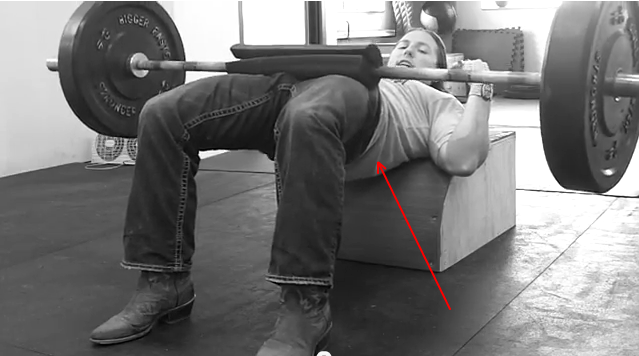
It’s worth mentioning that many other successful coaches and clinicians have had success cueing the glutes during hip thrusts – Stu McGill, Eric Cressey, Tony Gentilcore, and Ben Bruno to name a few. Pavel Tsatsouline cues to squeeze the glutes at the end range of kettlebell swings. If Evan is suggesting that we’re all doing it wrong, then I’d hope he has some evidence to back it up.
Per chance this is a matter of semantics. Maybe Evan simply believes that lifters shouldn’t rise into hip hyperextension and should stop before end-range is reached. If this is the case, I’d disagree, but maybe Evan can clear things up by commenting here on the blog.
If Evan is basing his knowledge off of his clients who are dysfunctional, I’d like to mention the following. We DO NOT base the training of healthy populations on the training of clients in pain. If we did this, nobody would squat or deadlift as back pain clients find them problematic, and nobody would bench or military press as shoulder pain clients would find them problematic. Healthy populations can and should do these lifts consistently as long as they use good form. They form the cornerstone of a good S&C program.
There are various physios who demonstrate a proclivity toward overstepping their bounds by making recommendations to the S&C world having never stepped a foot into our world (healthy athletes lifting heavy loads in the weightroom). So although strength coaches should indeed listen to physios and pay attention to their expertise, at the end of the day we need to stick together and share anecdotes. If all we went by was typical physio recommendations, we’d be using therabands for resistance and would cringe at the site of a loaded barbell.
Final decision: Squeeze those booties like there’s no tomorrow!


Great response to Andrew’s question BC!!! You such as the few select definitely bridge the gap of science & practice. Much appreciated to what you teach the rest of us.
great question. fantastic response.
I’m someone that used to suffer from right anterior hip pain. Especially when deep squatting. After consulting with Eric Cressey, I learned that my right glute was severely under active and my right hamstring was overactive/ over dominant. I was diligent with single leg hip thrusters with a conscientious glute squeeze. Lo and behold… my anterior hip pain resolved. Eric Cressey defends exactly what you speak of in a 2007 blog post here.
Thanks for the input Tad!
ooops. Related blog post from EC > http://www.ericcressey.com/guilty-femoral-anterior-glide-syndrome
This was extremely well done, Bret. Answered several lingering questions. Thank you so much!
-J
And this folks, is how you cover all your bases. Nice job Bret.
Hi Bret,
Good article ! I’ve been waiting for a question like that to be answered for quite some time now and I jump on the occasion to ask you something that is related to it : when doing (back and front) squats, RDL and lunges, is it advised to squeeze the glutes intentionnely during the whole lift ? I’ve found it to increase tremendously the activation of my glutes and would like to know if I am doing it right.
Thanks in advance !
Math, I don’t believe so. Some coaches I know advise this, and I don’t feel it’s “bad” to do. It could be good practice simply for purposes of gluteal awareness. But I just don’t think it’s necessary. Glutes provide propulsion down low, but up top hip extension torque is very low in these movements. I discuss this in my new product (Hip Extension Torque) and show the torque curves of these movements.
Great question!
Thanks a lot for your answer. So one should pay attention to actively squeeze the glutes in the bottom/stretch position of lifts like squats and RDL but not during the rest of the lift ? I’ll probably get your new book as I already have your first one. 🙂
good reality-based response over theory.
Oh man…I watched this one unfold in real time like a slow motion train wreck. Dr. Osar does seem passionate and committed, and BC, you know that I love a contrarian as few do, but goodness his advice is problematic, to put it mildly.
How are you ever going to create maximal torque at the hip while avoiding “gluteal hollowing”, per Dr. Osar’s advice? It is impossible. It’s like saying “flex your arm hard, but avoid creating a bicep peak.”
Saw people start to bring it up on another website, and BC begin the debunking. Now, predictably it has filtered down to the general fitness/personal training arena. New generations of trainees will not know how to activate their glutes, as they try to form a MMC while avoiding “hollowing” of their hips. My goodness. Learning how to move effectively through the hips and pelvis is challenging enough without this hoop to jump through.
From my understanding of Dr. Osar’s recommendation if for people who are ‘butt grippers’. Esentially these people use their hip external rotators as stabilisers instead of the TA, pelivc floor etc. These people are constantly hollowing when they stand and walk. It’s fine to maximally contract a muscle when training them directly but using a high threshold stratagy to stabilise all the time causes problems. I think the trainer in question has taken the recommendation for a certain issue and just applied it to everyone.
Hi Gerds, in this video, Dr. Osar is specifically discussing the correct execution of the DL. He is not referring to postural strategies, or stabilization during gait, which is a whole ‘nother post. But to stay on point:
http://www.youtube.com/watch?v=HfSzRkzOYlw&feature=plcp
At 1:27, he advocates not going into “massive hip extension” b/c that jacks up the spine. Trouble is his model is actually demonstrating MASSIVE LUMBAR EXTENSION, which does in fact put the spine at risk. Guess what the cure for overextension of the lumbar spine? Humping the bar, or concurrent glute activation/squeezing and lower ab activation. This powerful PPT controls the pelvis at the top of the lift and protects the spine from going into extreme extension. Thus the prophylactic and protective solve is incorrectly being labelled as the culprit.
I actually went over to MWOD to look up a vid on the postural issue, and in a weird synergy, Mssr. Starrett just put up this post which is almost a perfect counterpoint.
http://www.mobilitywod.com/2012/12/creating-a-stable-low-back-with-better-hip-mechanics.html
I like Dr. Osar’s energy, and have picked up a few helpful tips from him. I politely, but vigorously, disagree with his particular point of view. He offers a caveat that he is not referring to professional athletes, or powerlifters, of which I’m neither. But I believe there is a biomechanically safe and effective way to pick up heavy shit, and I believe it does, in fact, involve “glute squeezing”.
No disrespect to Dr. O.
Better example:
http://www.youtube.com/watch?v=JzH2SFe80i4&feature=plcp
At 4:30 – 4:50, the admonition to not create the “huge divot in the lateral hip” during squat, lunge, and DL hip extension patterns.
Hence the trainer that advised the OP was indeed accurately following the advice as presented by Dr. Osar.
Now if you have ever done a max DL, you better be firing your glutes like your spine depends on it, b/c it does; and you better not be thinking about whether or not you are creating a divot in the side of your hip, or for that matter, whether or not you kept your scaps tucked, but I don’t feel like ranting about that today…
🙂
Derrick, have I told you lately that I love you? 😉 Thanks for your input, it’s always appreciated.
Ha ha! Thanks, brother, I hold you in high regard as well…(awkward pause)
So, how ’bout that game last night?!
LOL..Hope all is well, my friend.
Gosh, I love reading this s_ _ _. Thanks for the post Derrick, and thanks Brett for the excellent article!
Thanks for the mwod link Derrick. Extremely helpful.
I think if someone has an anterior pelvic tilt pattern or lower cross syndrome they should avoid jamming their hips into hip extension due to the improper femur to acetabulum relationship.
I think glute squeezing with a ppt like Bret recommends can help get the hips in a more proper position if someone presents with an anterior pelvic tilt. ( Most desk workers, students )
Here is a review on labral tears that talks about the possible risks of anterior pelvic tilt on labral pathology : http://www.ncbi.nlm.nih.gov/pmc/articles/PMC2697339/
Here is a snippet from the review:
The search for biomechanical predisposing factors may be of benefit in cases of labral tears. Janda has described a predictable pattern of muscular imbalance in the pelvis, known as the lower crossed syndrome. Tightness of the hip flexors and lumbar erector spinae and weak, inhibited gluteal and abdominal muscles characterize lower crossed syndrome. The resultant imbalance leads to anterior pelvic tilt, increased hip flexion, and a hyperlordosis of the lumbar spine. Hip flexion contracture might lead to increased weight bearing on the anterior acetabulum and labrum predisposing to tearing. Many patients presenting in the primary setting with low back pain due to lower crossed syndrome can be rehabilitated to correct these aberrant pelvic mechanics. If the patient is participating in high-risk sports, they may be in a position to distribute forces more evenly around the labrum and acetabulum, reducing the risk of tearing
Thanks Bret
Hi Will, I think you just nailed it on the head. We are all dancing around it, but I think you just succinctly broke the code.
The relationship of the pelvic tilt and how it sets up the glute to extend the hip.
(This strikes me as analogous to the T-spine and how it sets up the scap and humerus for success or failure.)
Lower crossed syndrome or as I like to call it: old guys with big guts and no butts
Great stuff Bret! In your experience have you found a numerical percentage carryover to the squat and deadlift from weighted hip thrusts? Say one can squat 300 for a single, should he be able to rep that say 8 times?
Appreciate all the info!
Thanks!
Hi Brandon, no I have not. In untrained hip thrusters, it’s all over the place. For example, I’ve trained folks who could hip thrust 500 pounds their very first time (powerlifting types), and other powerlifters who couldn’t budge 135 their very first time.
In trained hip thrusters (those with around 6 months of progressive overload), I think that most 300lb squatters could do between 250 and 300 for 8 reps. In other words, around 80-100% of squat poundages for 8 reps or so.
But it definitely depends on anthropometry.
Another good question!
Bret,
Thanks for a great article. I haven been anxiously awaiting your response on this issue since reading Osar’s book a while back, which I really liked.
I agree with a lot of what you say here but after browsing through the 2007 Sahrmann paper (I haven’t read the others yet) I notice that it seems to provide some support for one of Osar’s reasons for recommending against squeezing the glutes at the top of a lift. Namely, that this can encourage a forceful hyperextension of the hip, which increases stress on the anterior part of the hip capsule.
My reading of the Sahrmann paper is that she would agree. Although it definitely supports glute activation as a way to counter hamstring dominance that tends to pull the femur forward, it also expresses concern with the hyperextension of the hip which I assume is likely to occur when someone is cued to squeeze their glutes powerfully at the top of a lift. Here are some relevant quotes:
“We also hypothesized that the magnitude of the anterior force would increase as the hip extension angle increased beyond neutral.
…
In both simulations, the anterior hip force increased with increasing hip extension angle regardless of muscle participation. The maximum anterior force for each simulated exercise was at the maximum angle of hip extension, 20 degrees for prone hip extension and 10 degrees for supine hip flexion (Figure 3).
…
The increase in anterior hip force with increasing hip extension angle is also consistent with clinical observations of runners with hip pain, and may play a greater role in the development of anterior hip pain than changes in muscle force contribution. Anterior hip force consistently increased with increasing hip extension angle. This increase in anterior force may help explain the presence of subtle hip instability and acetabular labral tears reported in distance runners who frequently achieve angles of hip hyperextension (Sahrmann, 2002; Guanche and Sikka, 2005).”
On the basis of these findings she recommends avoiding hip extension beyond neutral as a way to minimize stress on the anterior portion of the hip capsule.
Given these quotes, wouldn’t you agree that this paper provides at least some support for Osar’s concerns about forcefully contracting the glutes when the hips are fully extended?
Hi Todd, great input. Glad you wrote this as it forced me to go back through the article (I read it 2 yrs ago and am a lot smarter now).
Here are my thoughts:
1. I agree that Sahrmann would recommend against hip hyperextension (and that this could be a reason why Osar recommends against it).
2. Definitely agree that hip hyperextension is more risky for the anterior hip capsule, acutely.
3. However, the glute squeeze may simultaneously decrease hamstring activity, which would decrease anterior hip force, possibly leading to a balanced net result.
4. Sahrmann’s paper didn’t look at the effects of slight PPT, which will probably prevent hip hyperextension (because it mimics it) but also might create some space in the anterior hip capsule??? Just a thought…could be wrong.
5. Glute activation is maximized at end-range. I discuss this in my new product (Hip Extension Torque). This data is from Worrell 2001, but there are other studies showing the same thing.
6. So end-range hip extension is good for glute hypertrophy, and glute hypertrophy can spare the anterior hips.
7. Therefore, though acutely the hip thrust w/hip hyperextension may cause some damage, perhaps chronically it also can increase glute power and thereby protect the anterior hips.
8. I don’t know enough about anterior hip pain as I’m not a PT and I haven’t researched this enough. I don’t know if the damage/pain is created by weak glutes failing to do their job during 5,000+ low load hip extension cycles per day, or if it has more to do with less-frequent activities of higher load.
9. As always, genetics and injury history are huge. Those with a predisposition for anterior hip pain or prior injury in that region should definitely stop at neutral and also engage in slight PPT. Healthy folks with good genetics and good glute activation might not need to worry about it.
10. Sarmann’s study also looked at straight legged hip extension. I wonder if things would change when the knees are bent and the rec fem comes more into play. Her study went to 20 degrees of hip hyperextension but most folks don’t have that much ROM with bent knees. So it might not be as dangerous, or it might be more dangerous depending on how the forces change in that new position.
Awesome question my friend!!! – BC
Bret,
Thanks of the response, I appreciate it. Here are some quick thoughts in reply.
Point number 3: I am not convinced that glute activation during hip hyperextension would cause a net zero on anterior hip force, because Sahrmann concluded that the larger factor on the amount of force was the degree of hip extension, and the relative muscle contribution was less important.
Point 4: Wouldn’t PPT increase hip hyperextension not decrease it?
Points 5-6: Here’s a question: does the amount of vertical load in a DL or squat make a big difference in the amount of gluteal work that it takes to get from neutral hips to hyperextension? My experience is that the muscular work of aggressively extending the hips by squeezing the glutes while holding a barbell is not much greater than doing the same thing unloaded. So the load doesn’t make it much harder but it does make the movement harder to control in the hips and the back. So I don’t do it. Maybe that’s just me, but I feel like my glutes have done quite a bit of work to get me to neutral and the last couple degrees don’t add much. Of course the hip thrust is totally different. The last few degrees are the hardest!
Points 8-10: Great points!
Thanks again for sharing information.
Point 3: Good call!
Point 4: Yes because it mimics it, but I don’t know if the muscular mechanisms cause different forces on the hip capsule. When I sit here and experiment with hip hyperext vs. PPT during hip thrusts, for some reason it feels different. Like PPT is less stressful to the tissue. Could very well be wrong and completely making this up though!
Point 5-6: Almost negligent for a squat, for the deadlift there is some work (but not much). Escamilla did a good study on this and broke it down into Newton-meters of torque in the different ranges. Most torque in squat/dl is down low, not up high.
But you’re exactly correct, the hip thrust (and back extension) are completely different.
Good stuff Todd!
Thanks Bret!
Point 4: I know what you mean about PPT feeling different than hip hyperextension. Feldenkrais does this a lot – asks people to do basically the same move but focus attention on different moving parts. The movement feels different and it is different because the different intention creates slightly different patterns of movement. For a standing hip thrust, at least with me, I think focusing on PPT might lead to less forward translation of the pelvis, which might make the anterior forces on the hip capsule easier to control. And it might change the nature of the forces a little too I suppose, as well as the back alignment.
Hey Todd, if I could approach this from a slightly different angle (literally):
1.) Say you don’t want to hyperextend the hip because it irritates your anterior capsule. Okay fine. Refraining from maximally activating/exerting the glute is not a good solution in my view. How is it ever going to get stronger using this strategy? Simply, how is the glute ever going to get stronger without powerful contractions?
Rather, simply divert a goodly portion of the gluteal force to the superior side of the hip to PPT. You can get a massive glute pump/workout doing PPT bridges/HT’s, and never even go into hip hyperextension.
In fact, it is actually EXTREMELY difficult to even achieve hip hyperextension from a PPT. Your glutes have a length/tension relationship like all muscles. If a certain amount of the muscle’s force is being used to control the pelvis, less length/force is available to extend the femur. To oversimply, the muscle runs out of room, by performing movements at two joint relationships at the same time. (Pelvis to spine, and pelvis to femur)
So it is entirely possible that you are hollowing your glutes, clenching and squeezing them, extending the hip as hard as possible, and you never even make it into hyperextension if you PPT a bit. If you don’t want to hyperextend the hip then INSTEAD siphon off some that force and use it to PULL THE PELVIS POSTERIORLY.
Stand up and try it. PPT hard, and then try to extend the femur behind you. You will likely find it very difficult, if you keep the pelvis stable. You will also find an enormous glute contraction, and severe hollowing of the hip. And that’s unloaded. It becomes exponentially harder as you change the lever, and load it. Try it, and hold the attempt for 10-seconds, and you glute will cramp, and feel like it’s going to explode.
2.) Furthermore, when you get stronger, HT-ing 2.5 BW violently in the air from your hips, APT is a problem. It is a big problem.
Problems have solutions. Again, the solution is to control the pelvis. The lower abs play a role, they are also notoriously weak. Glutes on the other hand, are the strongest muscles in the body, (or should be!). Now maybe if you were just standing upright, violently freely swinging and hyperextending your hip over and over, it might irritate the anterior hip. But you aren’t. Rather, you are holding a 450-lb. barbell in your lap, and if you even make it to neutral hip extension with a neutral or PPT spine, then you are feeling pretty good about that rep.
3.) One last thought: If the pelvis is being pulled posteriorly, does it not naturally follow that position of the “container” opens up room in the socket on the other side for the femoral head? Much like the humeral head is to some extent at the mercy of the scapular position, the femoral head, is beholden to the position of the pelvis.
I think I just wrote a mini “e-book” here! As the incomparable Rob P. says, “Just my opinion.” DB
Bret,
I certainly agree that many factors especially an athlete’s genetics, as you stated, is likely the prominent factor of consideration in exercise performance. Our genetics will determine our anatomical structure which correlates with the arthrokinematics that occur during exercise performance. We certainly need to consider the athlete’s injury history as well, but going back to the athlete’s anatomical structure and arthrokinematics, shouldn’t the athletic history of the athlete be considered as well?
As an example, in this day and age of organized sports, children initiate their participation in year round organized sports (i.e. soccer, baseball, hockey, lacrosse, gymnastics, football, etc…) not only at an early age (i.e. 5-6 years old) but also participate in these organized athletics for long durations of time (i.e. year round). We know through scientific evidence that baseball pitchers who initiate their prolonged participation in the sport at an early age, develop not only retroversion of the humerous (the “ball” of the shoulder joint) at an early age (i.e. + or – 12 years of age) but also a corresponding change at the glenoid (the “socket” of the shoulder joint) as well. Therefore an athlete’s early aged and prolonged athletic participation in association with the bone and joint osseous years of maturation will result in joint changes to occur from the “norm” as a result of this prolonged athletic participation at such an early age.
The same thought process is now occurring in the field of Sports Medicine with regard to the hip. With early aged and prolonged athletic participation, it is certainly feasible to consider that osseous changes also occur at both the femur (ball of the hip joint) and acetabulum (socket of the hip joint) since this is also a ball and socket type joint being stressed through the early formative years.
My recommendation would be to train the hip based on a scientific foundation of evidence but certainly do not forget to consider each client as an individual, especially athletes, as those who initiate their participation in organized athletics at an early age, and continue in their participation of athletics through their “formative” years, may present with differences in osseous and joint anatomical structure. Exercise “modification” (if necessary) based on exercise technique, athletic performance, and the athlete’s feedback is also crucial for the safety of our athletes. The proper instruction (i.e. exercise technique) and when necessary, the “modification” of exercise performance (technique) is the “art” of coaching, isn’t it?
Just my opinion
Rob Panariello
Excellent input Rob, as usual! Makes perfect sense that the hip could behave similarly to the shoulder, and that feedback should always play a critical role in the coaches’ decision. I remember as a younger trainer trying to force a square peg into a round hole by having all my clients flare their feet at 45 degrees when squatting, occasionally some would complain and I’d tell them that they just needed to get used to it. Later on I learned more about the hip and realized the err of my ways.
Derrick,
Thanks for the response.
You asked: how is the glute ever going to get stronger without powerful contractions?”
I don’t think anyone is saying that the glutes shouldn’t be powerfully contracted. The question is whether they should be powerfully contracted isometrically when the hips are fully hyperextended. I think glutes can be strengthened quite a bit without ever doing this.
You also said: “In fact, it is actually EXTREMELY difficult to even achieve hip hyperextension from a PPT.”
If you stand and rotate your pelvis into maximum PPT, you will also put your hips into maximum hyperextension. If you squeeze your glutes at this point and relax the hip flexors, the reason you don’t go further into PPT is that the hips have reached end ROM, and you are just pushing against the passive resistance provided by the anterior structures in the hip joints.
I agree that in a hip thrust, it is much harder to apply significant force into hyperextension, because of the resistance of the bar. But, as you point out, in a standing position, in a swing or DL, an aggressive hip thrust is not countered by the weight of the bar or the KB, but instead by the anterior structures in the hip joint.
As to your third point, I don’t know!
Hi Todd, great and provocative points!
PPT= hip hyperextension via the pelvic angle. Great point. It does “feel” more stable in the socket than a classic hip hyperextension with a slight APT, but yes I see that if the pelvis is rotating posteriorly that effectively changes the femoral angle.
RE: Glute iso contraction in extended hip:
Todd, this may be where we see it most differently. I think the ability to quickly access and exert powerful gluteal force isometrically and dynamically at that end ROM is pretty important. The crux of the dilemma as I see it is “where are we going to get stability to perform movements with the limbs? The spine or the hips?”
One need only stand on one leg, and raise the other knee to see how hard the grounded, extended leg’s glute needs to immediately isometrically fire to control and balance the body. Take a desk jockey and ask them to do this. What’s the first thing they do? Crank the spine back and over looking for stability. We use the spine too much b/c we don’t know how to use our glutes and core to stabilize! That end range of hip extension lock is a powerful stability baton passed from the spine to the glutes.
Dynamically, if you’ve ever seen DL’ers with inadequate strength/activation in that range, they invariably compensate by hyperextending the lumbar spine, usually breaking the “whip” off into a few vulnerable segments in the process. Ironically, this is what Dr. O is demonstrating in the video I linked above.
Statically, this comes into play with the OHPR, and the push up (which is a moving plank). On the OHPR, end range glute contraction in tandem with core stiffness is what provides the stable base for you to press from. Without it, we again default to good old lumbar hyperextension, and then further up the chain we start trying to scrounge up stability through excessive scapular control (this sounds vaguely familiar for some reason, ha ha)
If you watch children learning to do push ups, the first thing they do is “sloppy pushups” allowing their hips to sag to the ground. Their next strategy is to flex the hips. They are trying to shorten the lever and make the stabilization easier. They don’t yet know how to use their abs and end range glute contraction to lock the plank into place.
Ditto KB swingers who must decelerate the rapidly rising bell, and must quickly default to a strategy: use their glutes or passive structures of the spine to help their lats and abs achieve this. A boxer throwing a punch better have a pretty tight lock on their extended back glute to better anchor and transfer force through the core.
At some point, if you want to vigorously run up a hill, or a flight of stairs, or just run/sprint period, you are going to need to be able to forcefully hyperextend the hip. “But you are anteriorly leaning into the hill which mollifies the degree of hip hyperextension!” True, but as the opposite leg swings forward and up the pelvis goes with it, the back grounded leg is going to find itself in that end range position that we are referring to.
I’ll defer to BC’s MVC % findings here, but I suspect that end range contraction is extremely high. When you look at the prevalence of APT in both desk jockeys, and athletes, and the difficulty many have even learning to activate, feel, and use their glutes, it is going to be monumentally difficult to achieve that MMC in a “gluteal amnesiac” while avoiding gluteal hollowing. Gluteal hollowing is the telltale evidence that the muscle is activating/working! Some even suggest palpating this area to better link up the MMC.
I’m rambling a bit, but I guess in sum, I think whatever the risks of training end range glute contraction are far outweighed on balance by the positive effects of having bulletproof strength and activation in that range. Thanks Todd, for making me think, this is a good thing!
P.S.: Kudos on your Paul Hodges writeup, you did a great job making pretty nuanced stuff very digestible. I’m a big time “over-stabilizer” and the timing of core stabilization muscles trumping outright strength makes a lot of sense. Looking forwards to PT. 2!
DB
Thanks Derrick,
This is a very interesting conversation, thanks for contributing your thoughts. I think I need to bow out for now, but I may be back later when I have had time to think this through more!
Great conversation guys! The only thing I can add is that there’s a good article describing the relationship of the pelvis and hip (http://www.jospt.org/issues/articleID.2395,type.2/article_detail.asp), author describes how posterior pelvic tilt “mimics” hip extension. I’m unaware of any research showing whether the forces at the anterior hip are altered when reaching end-range via different combinations of hip extension and pelvic tilt. This would make for an excellent study!
I would also approach this question from a different perspective. I think it better to go into slight PPT than lumbar extension when squatting or deadlifting, but how does this influence compression loads on the disks? We would anticipate them to be higher in PPT, right? Enough to be potentially problematic, or does the fact that you’re standing upright nullify this concern? I am aware that the spine is very strong in compression, but this is one question I had.
No! In our new product (Hip Extension Torque), Chris and I recommend using a PPT with end-range hip thrusts, back extensions, kb swings, planks, reverse hypers, pull throughs. But APT with initial-range squats, deadlifts, good mornings, kb swings. We have an excellent quote from Verkoshansky and Siff explaining how “slight” pelvic tilt can protect the spine. With most folks you don’t need to worry about compression so much as flexion or hyperextension along with that compression, so the slight pelvic tilt just buttresses the spine from going into those opposite ranges. Great question!
Great post, Bret. I appreciate your extensive research on the glutes and your practical knowledge to back it up. You have helped mold my training philosophy tremendously. Thank you.
I was gonna mention that the hip pain you mention sounds very much like anterior femoral glide syndrome. Forgive me if I’m wrong but that is something Shirley Sharman mentions in Movement Impairement Syndrome. If anyone here hasn’t read that book I’d highly reccomend it. It’s the most invaluable resource I have as a sports medicine physician. As I’ve mentioned to Brett in the past glute bridges and hip thrusts have changed my training and overal movement efficiency. If this is your first read of Brett’s material, most certainly don’t let it be your last
Yep. Anterior femoral glide syndrome. Good call Christian.
Anecdote is never evidence so take all of this with a heavy pinch of salt.
I’ve had anterior hip pain likely from FAI as a result of a femoral anterior glide. Hip extension and even hyper-extension felt like a nice stretch and a challenge, which temporarily relieved pain, but the pain always came back. After reading Dr. Osar’s latest book I toyed around with some of his cuing and I’ve found it led to a more permanent solution for me. Extra emphasis on the FOR ME.
The cue of relaxing through the hips that does nothing for me. That just makes the movement more hamstring dominant, which as stated provides an anterior pull on the femoral head. By imagining pulling my sit bones out the back of my hips I get a different sort of glute contraction felt in the more inferior medial section of the glutes, which Dr. Osar suggests apply a posterior glide to the femoral head. I can still go to town with squeezing hard on this pain free, though I find it nearly impossible to get any sort of hip hyperextension this way, which may contribute. I have yet to try loading this in any meaningful way so it’s entirely possible that for loaded exercise this cuing is irrelevant.
I trust that Dr. Osar has everyone’s best interest in mind, but his message may have been somewhat lost in the sound bytes. Alternatively perhaps the positive results he sees (and I see) in ameliorating anterior hip pain comes from just one of the many cues he uses as opposed to all of them.
As always the answer is that more research is needed.
Thanks for the great discussion everyone,
Matthew Danziger
I would just like to say you have a lot of smart people reading and commenting on your posts. Some of this stuff has me reading and re-reading and scratching my head. What I do know is I do both hip thrust loaded and unloaded. Not only do I enjoy the exercise but I feel that it has contributed greatly to my increasing strength in other exercises. My balance has improved and of course the booty is looking and feeling activated…have a great holiday Bret to you and your family. Thanks again for all the great reading material
Hi Bret. In the recent past (after reading your stuff and Sahrmann’s stuff about the importance of the glutes) I decided to start training them. Actually started training all of the lateral and external hip rotators. What does one do if they strain and or tear the weak synergist muscle (glutes)? I’ve read all about treating hamstring and groin strains with muscular balancing, working (PGM, lateral rotators/ glute max etc.), but what does one do when they strain or possibly even tears one of them? I’m guessing rest, but that’s kind of hard to do with symptoms on both sides and just walking involves all of those muscles. Cortisone injection an idea? Thanks. Hope all is well.
Hi Bret, Great stuff. Just a quickie, when doing glute bridges (even body weight) I squeeze my glutes at the top. However when i do this I feel pain around my coccyx area, and sometimes when its bad enough my coccyx is tender upon palpation. Any idea what could be causing this, or do you recommend seeing a therapist? Many thanks, SP
SP – one of my favorite quotes comes from Mike Boyle – “if it hurts, don’t do it.” This general guideline is so important in strength training, and if more people adhered to it we’d see much less pain/injuries. So don’t squeeze glutes at the top for your situation. The vast majority can and should squeeze glutes at the top, but nothing in fitness is set in stone.
Hate to come into this so late but this article and the responses are excellent. Have recently developed anterior hip pain due to femoral glide on my right side. I have also experienced spasms in right piriformis area. I am also naturally in PPT with a flat back. Do you think my problem still needs to be addressed using glute activation exercises? Evan Osar’s work seems to make sense to me as I BELIEVE PPT is corrected by psoas activation and glute stretches.
But could the piriformis spasms be due to a lack of ‘pull’ from my right glute? Glute activation exercises don’t appear to aggravate it but is there any way I could do them, ensuring the risk of hip hyperextension is minimised?
As a side note, I can whole-heartedly agree with the idea of minimising hip hyperextension. A PT prescribed hip flexor stretches which really aggravated it. This is why I’m hesitant to do so much glute work as I feel the opposite of psoas stretching would work better in my case.
Could strengthening psoas AND glutes be a possibility whilst maybe doing piriformis stretches?
Feel like that was a massive ramble compared to some of the comments here but I’m so conflicted! It seems everything on the Internet is geared towards people with APT!
Thanks
Kieran
Does he always get a boner when he lifts weights
I’m starting to come to agreement with Dr. Evan Osar and Diane Lee when it comes to hip thrusting, pelvic tucking and glute squeezing. I’m starting to see a lot of people with anterior femoral glide. It is interesting to wonder whey these cues came about when you think about children who perform functional tasks such as squatting, I highly doubt that they are thinking about any such cues. Yes, EMG’s will spike higher for more contraction in these muscles, but at what cost? Unstable hips? I’d rather not take the risk.
Looking back on this topic, I have a few questions regarding glute squeezing. First, Bret, has there ever been someone who’s glutes just never activated well for you client wise? Also, Evan Osar working with dysfunctional clients comment got me. Most people have glute weakness which causes dysfunction. That is most people. I don’t see it as a functional/dysfunctional issue but a spectrum. I don’t see why Brets technique wouldn’t work for people who are dysfunctional enough to see Evan Osar, if Brets technique is correct.
Also, I see a lot if discrepancy in glute activation cues and it’s troubling. You have great coaches who cue glute activation completely differently, so differently that it would seem that one side would have to be wrong or right.
Some cue a squeeze early some cue the squeeze at the end, some don’t cue a squeeze at all, some say push through the heel some say don’t push through the heel some don’t mention the heel, and on and on… What is going on here in your opinion?
I read your interview with Stuart McGill who mentioned he was able to avoid a hip replacement by doing glute exercises. I have labral tears in both my hips and have started doing glute exercises (bridges with bands/BBs, one legged extensions, standing exercises w bands around knees, etc). I was wondering if you have helped any clients with similar problems and if they were successful in their rehab.
Thanks
Came across this old article while searching for cues for butt grippers… found the discussion to be VERY interesting, but I wanted to speak in defense of the original point Dr. Osar was making, using myself as an example.
The problem that many people (including myself) have is that a cue to “squeeze the glute” leads to us actually squeezing the wrong muscles – like the deeper external rotators (the ones that cause the butt grip/butt clench – which just further exacerbates all the hip centration/AFG issues.
I think Dr. Osar has done a much better job explaining this in writing than he did in those videos (though I can’t speak to whatever seminar the original post was based on).
When the hip is properly centrated, then yes, absolutely, squeeze like your spine depends on it (loved that quote)… but if you’re me, you need a different cue. Some way to effectively shut off the overactive ones so you can train the glute max to do its job correctly.
I wish I could say I had this better cue, but that’s why I was googling. Even with many years of training, powerlifting, strongman, coaching, and what I’d call a very strong MMC, this is one area where I fail miserably. Maybe I’m guilty of just out-thinking myself, but I’m constantly worried that I’m firing in the wrong pattern, overusing those deep rotators, and just making things worse. And for all my experience, I still haven’t been able to make that connection inside myself to know when I’m gripping/clenching and creating the wrong hollowing and when I’m free to just squeeze away.
Maybe this is just a long way of saying I think you’re all right here. If Osar is broadly telling everyone to just avoid any glute squeeze cue, that’s not so good, but I think/hope that if he’s speaking to an audience of therapists/trainers that work with dysfunctional people there’s an assumption that they’ve properly evaluated the clients and know what’s going on in their hip. So if we wrap it in a conditional – ie IF(hip dysfunction) THEN: don’t cue something that is going to use the wrong muscles (and find a different way to train the glute max to get that pelvis more stable); but IF(hip centers properly) THEN: Squeeze like hell!
Of course, we want the glute max to be squeezing like hell no matter what, but with people like me that are dysfunctional in this way, we run into trouble whenever we try to fire it, even when we know exactly what’s happening and what we’re trying to avoid. Not surprisingly, this is because I lack the core and pelvic stability and the proper patterns exactly as he describes in that groin pain video. Hell, even getting to and maintaining a basic PPT is difficult for me.