
I haven’t written an ABC post in a while but I’m bringing it back! Lately I’ve been getting a lot of emails asking the same thing so I’d like to address some of them here on the blog. Today’s question is from Jordan:
Hi Bret,
I am a huge fan of your blog and content, you have completely innovated the way I think about training for athletic performance.
I have been working for a while to implement the glute thrust in my training, but have encountered a problem. My hamstrings always take over! Any suggestions on how to remedy this? Maybe that would be a good article, as other lifters at my gym have had the same problem.
Keep up the good work!
Jordan
Hi Jordan,
Thanks for the kind words. Here are my thoughts:
1. Be Patient
It probably took a lot of time for your glutes to gradually shut down. Your body has learned to rely upon your hamstrings during hip extension. You can indeed cure this quickly, but it won’t happen overnight. It might have taken you 5 years of neglecting your glutes to get to this point, but luckily it will only take several weeks to get the glutes up to par.
2. Static Stretch the Hip Flexors First
If your hip flexors are tight, stretch them first so you can reach end range hip extension and get into the zone of maximal glute activation. Many people have tight hip flexors, but not all people do. Stretch the psoas and the rectus femoris if need-be.
It may also be wise to stretch the hip flexors for other reasons; you may be able to inhibit them a bit and create some slack to make things easier for the glutes.
3. Static Stretch the Hammies First
You may be able to inhibit the hammies a bit by stretching them prior to bridging, and this inhibition could theoretically coerce the glutes to become more active during hip extension.
4. Experiment with Pushing Through the Forefeet
Pushing through the forefeet rather than the heels could be of help. In theory it should increase quad activation and decrease hamstring activation, which would therefore require the glutes to kick in to a greater extent.
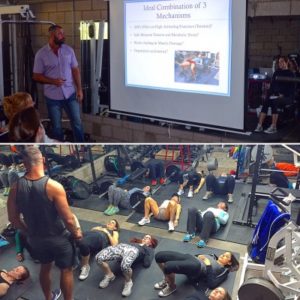
But theories don’t always pan out in the real world. Some individuals find this tip helpful while others find that it makes matters worse. When I conducted my glute seminars in New Zealand last year, I had every attendee experiment with this technique. I ended up polling over a hundred attendees regarding forefeet pressure and hamstring activation. The results? Around a third of the attendees felt that it helped reduce hamstring activity, around a third felt that it made matters worse and increased hamstring activity, and around a third couldn’t feel a difference. Give it a try and see if it works for you.
5. Focus and Visualize
Think of the brain as a lake, the spinal cord as a river, and the nerves that feed the erectors, glutes, and hamstrings as waterfalls. I realize that this is not accurate and way too simplistic but it serves as a good analogy. You want to steer more water to the glutes and less water to the erectors and hammies over time.
Focus very intently on using the glutes to push the hips upward. Research shows that intense concentration and visualization can dramatically affect motor learning and muscle activation. Over time you’ll automatically use the glutes heavily during hip extension, but you have to create these neural adaptations and increase the juice delivered to the glutes during hip extension, which may take several weeks of consistent practice.
6. Practice the Posterior Pelvic Tilt Hip Thrust (PPTHT)
The PPTHT is a great way to improve upon your mind-muscle connection to the glutes. First off, most people are incredibly week and uncoordinated with posterior pelvic tilting and lack strength, power, and endurance in this regard. A posterior pelvic tilting moment (torque) is required to prevent anterior pelvic tilt and keep the pelvis stable during heavy deadlifting so strengthening this motion is important.
Second, the inability to dissociate the pelvis from the spine is not an ideal situation and could lead to low back pain and injury especially if the individual engages in heavy or explosive activity.
Third, combining PPT’ing with hip extension requires that the glutes do two things at once which dramatically increases glute activation.
Some individuals who are flexion intolerant could find the PPTHT problematic but most people can easily tolerate it and will benefit from the added glute activation and PPT’ing skills.
Fourth, PPT’ing slackens the hamstrings which places them at suboptimal lengths, theoretically causing the glutes to have to do more to make up for the lack of hamstring force. The act of using the glutes to PPT therefore increases the glute requirements by interfering with the length-tension relationship in the hammies (it should be mentioned that the hammies may slightly contribute toward PPT’ing so this line of thinking could be more complicated).

Fifth, it takes the erectors out of the equation.
And sixth, PPT’ing can theoretically improve anterior pelvic tilt (APT) posture. I’ll expound upon this in a future article. As you can tell, I think the PPTHT is a very good thing that more people should incorporate into their routines. I’ve been employing it myself and with several clients and the consensus is that it’s very helpful and worthwhile.
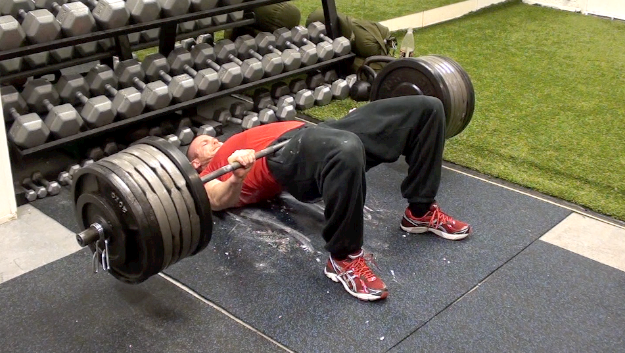
To perform the PPTHT, focus on pelvic motion. You want anterior pelvic tilt at the bottom and posterior pelvic tilt up top. Squeeze the glutes forcefully and hold the contraction for 1-3 seconds up top. Here’s a video:
Hopefully you find some of these tips useful, but the most important thing is to simply concentrate and focus on using more glute and less hammy which will shift the neural tides over time.
Best of luck Jordan!
BC

Great post, Bret! Vital stuff for all of us.
Cool to see my pic on your site. 🙂
Thanks Eirik I knew you’d like that I used your pic! Cheers to my glute building buddy across the globe, BC
Very useful stuff- thanks!
I have been searching for this answer! Ask and it is given! Thanks for this great post.
Hi Bret,
What do you think about doing bridging the way Mark Verstegen suggests, with dorsiflexed feet?
This definitely seems to help increase glute activation (perhaps by somehow inhibiting hamstring activity somewhat).
I’d be curious for your thoughts on why this would be effective.
Thanks!
Hi Scott,
Watch this brand new Nick Tumminello video with Carl DeRosa. I’ve met Carl, he’s brilliant.
http://www.youtube.com/watch?v=_hTx5pUttxA&feature=player_embedded
Thanks Bret, I’ve been waiting for someone to give some info about that! I can certainly tell the difference w/ my feet dorsiflexed and so can my clients/boot campers but it was nice to see some more tangible verification like that!
Hi Bret,
One of my adductor’s is taking over when performing the glute bridge on the right side. Any ideas of how I can fix this? Some of the above tips will obviously help but just wondering if anything changes with the adductor muscles. I think it is adductor magnus.
Thanks
Hi Peter, does this happen more at the bottom ROM, more at the top ROM, or the entire way through?
It happens at the top ROM when I am locking out the hips. If I squeeze the glute to finish hip extension the adductor goes wild
Peter, have you had any luck resolving this. I have been fighting with my left rear adductor (magnus maybe) engaging while doing bridges and such. It’s really tight after I run so I think it’s messing with my mechanics while I run as well.
Could please respond to this comment or provide a link.
There are a few additional things he can do:
1) Squeeze the abs extremely hard.
Try this: sit on your belly on the floor, body straight. Tell someone to put one hand one your left glute, one hand on your left hamstring. With your abs relaxed, lift the left leg off the floor 2 inches and ask them what muscle contracted first. It’s probably going to be your hamstring.
Then do the same thing, but squeeze (contract) your abs extremely hard. You’re most likely going to see (the person checking you will feel) an improvement in your glute activation, and maybe the glute will actually fire first.
2) I don’t think it hurts to tire the hamstring out with a couple sets of high rep leg curls. This is just an idea though – based on the fact that if the hamstrings are tired, maybe the body will automatically going to use the glutes to perform the hip extension.
The problem is that if you do leg curl, then:
a) It’s a knee flexor activity – so not sure how is that going to work vs. a hip extensor activity.
b) It could make the body aware of the hamstrings and make it actually used them more – again, experiment.
Hi Raptor, I’ve never been a fan of the “squeeze the abs” cue as it’s more about learning to move at hips with glutes. Ab contraction isn’t really necessary during bridging…they don’t contract that hard even when going super-heavy. But abs contraction can help prevent lumbar extension, but I think it interferes with achieving full hip extension (hip hyperextension) due to adding complexity/sending mixed signals to the body. So I avoid that cue for the most part.
So you’re basically saying that since the “ab complex” is pretty much a hip flexing muscle complex (generally speaking) and you’re doing hip extension… those are the mixed signals?
I’ve noticed some funky things with the forefoot that go against conventional wisdom too. Mine was more so with squats and knee pain, but great to see you’re having similar findings.
I’m not sure if you remember this, but I e-mailed you a while ago about hip thrusts and knee pain. I started doing them with more weight on the forefoot back then and the pain disappeared. Funky.
Very interesting Anthony! The knee mechanics involved in subtle shifts in movement is quite complicated… Thanks for the comment bro.
Good post Bret. I think the ability to perform the ppt could be viewed as the most necessary muscle function when it comes the the.ability to perform compound leg movements.
The PPT is highly underestimated!
Thanks guys for the extended discussion on the “crunch”! I for one have built a pretty strong core using the crunch as the bread and butter of my abs routine. I do have bulging dics and the crunch only seems to improve my issues with my lumbar spine. I even do the crunch while upsidedown! Saw Yuri Elkim the other day with diagrams and all the supposed research about spinal bio-mechanics, spouting with all the authority of Job that the crunch is bad. My theory is crunches hurt and nobody likes to do them so when everybody says they are bad, it’s easy to agree!!
Thanks again for the awesome interview!!
Thanks Phillip, there’s more to the story than what most people think. We have unanswered questions regarding spinal biomechanics. Glad you enjoyed the interview!
Hi Bret
Great post as usual thank you.
Marc
Very cool article. In regards to thought number 4 about using the quads to shut off the hammies, my strength coach at school uses this same idea in an activation drill where you glute bridge with your toes against the wall. You drive the toes into the wall which activates quads, then squeeze cheeks and lift. I have found this method to be very effective for myself and I do it frequently in my warmups.
I was actually working with a client last night who’s hamstrings were cramping big time while he was doing BB hip thrusts. I took him over to the wall and had him do a couple sets of this activation drill. When he went back to hip thrusts his hamstrings stopped cramping and he said he could feel his butt more.
Anyways, another great post. I enjoy reading your stuff. I’ve learned alot since I came across your site a little while ago.
Interesting! Thanks Joey.
Bret, Just wanted to let you know real quick, once again, that I appreciate all your work a great deal.
I just read the latest T-Nation article and could not believe such a piece was actually published (the entire site and their approach changed in my opinion). That made me think of you and your work. I have yet to read a post or article by you that did not impress me or, at the very least, was food for thought. I do not always agree with you 100% (it would be weird if I did), but you always give me a good reason to have nothing but respect for you. Please continue providing quality content.
It saddens me to have to say this, but a lot of my favorite writers from a couple years ago have been a major let down lately – it’s like they have nothing else to say/contribute and then try to keep a discussion going about them by saying the most bizarre, redundant, useless, etc. stuff ever. I do not see this happen with you, and you got my support 100%, bro!
Thank you Ted, I appreciate the encouragement!
I teach my patients to bridge with the heels together to put the hip flexor on slack and allow for full hip extention.
I was wondering also if you change the distance of the heels from the buttocks you could put the hamstrings at a mechanical disadvantage.
What do think bret?
Chris, not sure how heels together could slacken the hip flexors…but heels closer to the butt definitely shortens the hammies (but too much and the lift feels awkward). This is why I like a 90 degree angle at knees and vertical tibia when locked out. But if the feet are further away then the hammies will be more active.
Thanks a lot, Bret!
I look forward to implementing these strategies at the gym later, that PPTHT looks awesome!
Great stuff as usual Bret!
The lovely Suzi Nevell told me to wrap a belt around my thighs and push out into it while bridging up. Works a treat to get the glutes firing better without hamstring. In 2-4 weeks you should be able to remove the belt and the glutes will know what to do without the hammys trying to help :-). I’ve tried this and it works a charm. It’s something I give to my beginner and advanced bridgers.
Thanks Stacey, for some reason I never prescribe squats or bridges with bands around the knees. Not saying it’s not wise to do so…it’s just that I prefer to prescribe variations of band walks (monster, sumo, x-band) for this purpose. Never thought of using a belt rather than a band though. I think I like that idea more so than using bands. Thanks for the idea!
Bret- Good article!
I know you are very research oriented, so I thought I’d point out the EMG results a Dr. Rafael Escamilla shared in a interview by your friend Nick Tumminello, regarding having the feet flat on the floor vs. dorsiflexed during hip bridging exercises. In general, feet flat showed increased hamstring activity and feet dorsiflexed on some tests showed more glut max activity. There were different activation patterns with single leg variations as well. Check it out below:
http://www.youtube.com/watch?v=_hTx5pUttxA&feature=player_embedded
Thanks Tim, Nick sent me this yesterday. I love that Nick attends these conferences and films vids of various experts providing insight. I hope Rafael publishes his data as I’d like to analyze it better, but from the looks of it I don’t think foot placement/ankle position/foot pressure etc. matters too much in terms of activation. You only get a few percentage points of difference.
For this reason I think the best strategy is to simply push through the entire foot just like with squatting and deadlifting. I like to cue push through the heel so they’re heels stay down but in reality they’re pushing through the whole foot.
Great exercise.
Keys to success:
1. To deactivate the hammies’ contribution, either lift ball of foot off the floor (or try Bret’s suggestions of lifting the heels); either way, the brain’s usual approach to extension is changed (all mediated through the proprioceptors and mechanoreceptors in the soles of the feet; change that and the activation patterns can change).
2. Do the exercise on a sticky mat, and as soon as you feel the hammies activate, light push the feet *away* from you; this activates the quads, and reciprocally inhibits the hammies; thus the glutes have to work harder.
3. The posterior pelvic tilt is essential to deactivate the erector spinae group; not only should you tuck the tail (use glutes and/or abs to ‘PPTHT’ as Bret suggests) while still on the floor, it is essential to *re-tuck* the tail (PPTHT) just before the point you reach full hip extension; at this point all the former reasons for this suggestion become even more operative.
Last, you will not be able to perform this movement (PPTHT) if your hip flexors are tight (rectus femoris is the culprit here, just because both knees are bent—this muscle crosses the hip and knee joints). Having hip flexors loose enough to allow hip extension while the knees are bent is essential, because otherwise just when you really need to access the glutes (the extension end of the ROM), the brain will shut them down (again, reciprocal inhibition reflex). If an agonist experiences stretch in a strengthening movement, the antagonist will be inhibited by the neural system.
So, stretch the hip flexors before you begin.
Bret, if you permit this, you can link some effective hip flexor stretches from my YouTube channel, if you want. I will email the link to you. I cannot stress how important to this exercise (and spinal health more generally) that loosening these muscles enough for the pelvis to sit more neutrally, without effort.
Cheers to all, KL
Kit, you always have my permission to post your hip flexor stretches here. I really liked the one’s I watched from your site. Thanks for the input!
Hi Bret, thanks for this info. Any idea why I would feel pain and/or tightening in my knees when I’m doing the glute bridge? Are my quads contracting too much? My knees have been killing me lately and I laid off of lunges and such, but lately when I”m doing the bridges, I’m feeling a pain on the outer part of my left knee… thanks for any ideas. Maybe I should try and exercise band around my legs to see if that changes anything?
Dawn, many people don’t know this but the quads contract harder in a hip thrust than they do with just about any lift. Quad contraction as measured by EMG exceeds that seen in a squat or lunge! The co-contraction is indeed very intense and some people will find this to be problematic due to the pressure on the patella or other structures.
You can try to extend the knees a bit and place the feet further away from the buttocks. You might benefit from strengthening the hammies and then returning to bridging. Or you can just stick to db back extension.
Best of luck!
Thanks for that Bret, well at least I’m not crazy!!! It never used to bother my knees until lately.. Ok, I’ll back off for a while and try to strengthen my hamstrings more and do some back extension work. I appreciate you answering my question, thanks!!
I also had this exact problem, Dawn and Bret. Realized my glutes were externally rotating so powerfully that it was torquing my knee, a hinge joint not really designed to rotate.
In a roundabout way, I came to the solution that BC mentioned above: push evenly through the entire foot (tripod foot) which evens out the lateral forces on both sides of the knee, and also seems to create a nice quad/hamstring balance, too.
Btw this can also happen at the elbow during benching or doing pull ups from a fixed bar if the shoulder torques enough to pull the elbow in front of the bar. Same principle. Don’t twist a hinge.
Hmm..the”perfect hip thrust” with fixed, but rotating foot pads..??
Derrick, I’ve recently been going through some PT after a disc bulge and was told my pelvis was tilted. I have been working the medial glute with clams and xband stuff a lot and was wondering if now I super unbalanced that way and need to do more inner thigh work, I think I’m incredible unbalanced right now and it’s rasing havoc with all my lower body lifts… I’m not sure the best route to be evaluated and straightened out.. another PT, chiropractor, I need to find the right exerices to make all my parts happy!! haha, thanks for sharing that, I’ll try the bridges that way, if it doesn’t feel good, I’ll back off for awhile.
So bret, it is normal to wake up with very sore quads after hip thrusts?? also I feel my glutes working during hip thrusts but i dont get much soreness the day after..
Thanks Bret, this is an awesome post and something I’ve been trying to rectify in my own training recently so will definitely be giving the tips ago. Would these also help with femoral anterior glide syndrome I’ve recently started getting pain in my hip when deadlifting, do you have a post in regards to this, or would it be a good topic?? Thanks again and keep up the awesome work. Will you be in Australia anytime soon?
Here are two self-contained partner Hip Flexor stretches.
Beginners:
http://www.youtube.com/watch?v=yQk3GD53DV0
Intermediate–Advanced:
http://www.youtube.com/watch?v=JtsQTfAwE4Y
There are no really good solo exercises until these have been done; there are many reasons, but the key one is that there are so many ways the body can escape the stress of any of the solo exercises (hips counter-rotating away from it; lumbar spine extending instead of HFs lengthening, and so on). Once a decent partner exercise has been practised and *experienced*, then a solo one can be very effective, from the same hands-and-knees lunge position, because the brain knows where to go/what to feel. This means there is a lowering of the protective reflex (we named it the “apprehension reflex” in the latest edition of Overcome neck & back pain) and you will be able to relax into it, only using the lats and the hamstrings on the front leg to provide the stretch (plus your body’s weight, of course).
There’s more: there is a HUGE fascial dimension to stretching the HFs. Bret asked me to mention psoas stretches—but in my view, until you are *really* flexible in rectus femoris, you will never be able to stretch iliacus or psoas (because only rec. fem. (“RF”) crosses both hip AND knee). As well, in respect of anterior pelvic tilt, RF is way the most important of the HFs: look at where it attaches (AIIS); and see how far in front of the hip joint this is—then compare iliacus and psoas (inches closer to the pivot point, the hip joint, and hence less effect for the same tension).
So, in Bret’s wonderful glute bridge, where the knee is flexed approximately 90 degrees AND there is little to no extension in the hips AND the spine is in line with the thigh in the final position, rec. fem. will the limiting muscle group to full hip extension. Try one of these YT HF stretches and use the reciprocal inhibition reflex to decrease the hamstring contraction, and build those glutes! Thanks all, KL
How do you feel about placing a band around the knees during hip thrusts?
Wrapping a band or belt around the knees works very well and has helped a lot of people I work with feel this exercise in their glutes more. Yes stretching the RF can help, but if you’re that restricted there could be other issues to deal with relating to the core and pelvic control. Are you looking at a mobility problem or stability problem…but thats a whole different article in itself.
However, there is one simple suggestion that hasnt been mentioned……take some weight off the damn bar! A lot of people who cant feel this exercise properly are doing it with way to much weight and horendous form. You should be able to lock out the weight and hold it for a good pause at the top. Taking weight off the bar is easy to do, doesnt involve watching youtube clips, and doesnt need a santa’s list of references to back it up.
I find isometrics the best way to teach my hammies to relax (especially at the top). I think its because i can spend time at the peak contraction for glutes and focus on relaxing the hamstrings. With some clients whos hamstrings dominate bridges i’ll start of with iso holds up to 1 minute before continuing to dynamic reps and adding resistance. for a really low load activation exercise (for someone who feels only hammies in bridges) this variations seems to work very well:
http://www.youtube.com/watch?v=eAaBXq90AAM
this^^ and kneeling pull throughs (like kneeling squats but using a band/cable round the hips and the other end attached to a rack etc) are my go to exercises for someone with poor activation. Then just progressively increase resistance until glutes function in bridges. Never failed me yet! My two cents. Thanks for the blog its one of my favourite websites. Every article has something to teach! George.
i use a belt and it works very well.
Bret, have you experimented with mid-range partials for hip thrusts? What, if any benefits could be seen from doing these? I am primarily referring to top end from a dead start. thoughts?
Cheers!
This advice has been most useful. Can anyone explain the improvements in sprinting speed, that would be seen with activated glutes, instead of non-contracting glutes?.
Hi Bret
I feel glute bridges “too much” in my left, medial hamstring. The day after deadlifts my left, medial hamstring are noticeably more sore than the left, lateral hamstring and entire right hamstring.
Do you have an idea as to what is the cause and how to fix this particular issue?
Best regards