
While I usually write about strength and sport training topics, today I’m going to venture off a bit and address a topic that I believe is very important to my fellow trainers. I’ve been lucky enough to have met many personal trainers in the past year at local and top levels. During conversation, I’m always surprised to find that most of them don’t have any sort of retirement plan. I must confess, currently I don’t either, but it’s something that’s always on my mind.
As a former high school mathematics teacher, this topic is of great concern to me. When you work a government job, it’s not just about the money you make during your years working, it’s also about the money you make when you retire.
Example 1 – Firefighter
A chief of a local fire department started working 32 years ago as a firefighter. His starting salary was $20,000 per year. Over the years he rose through the ranks from firefighter to captain, captain to battalion chief, and battalion chief to chief. He currently makes $150,000 per year. His average salary over the 32 years is $70,000 per year. During his career, he made $2.24 million dollars.
Since he worked for 32 years, his pension is 80% of his base salary averaged out over his last three years of work. FYI, if you put in 20 years you get 50% and 75% for putting in 30 years; it rises as more years of service are reached and tops out at 80%. Many individuals in the fire service will work a ton of overtime during their last three years to boost their pensions.
Let’s say that this particular chief started out as a firefighter at age 23, retired at age 55, and lives until he’s 85. During his 30 years of retirement, he makes $120,000 per year in pension. This equates to $3.6 million dollars. So he made $2.24 million while working and $3.6 million while retired for a total of $5.84 million. Of course, I’m ignoring what Uncle Sam takes out but you get the point.
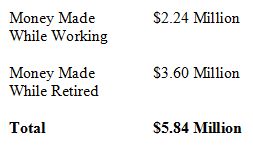
He made 61% more money from his pension than he did from his years of service.
Now, there’s more to retirement than just pensions. There’s social security, savings accounts, 401(k)’s and 403(b)’s, IRA’s and Roth IRA’s, stocks, bonds, CD’s, employer matching programs, etc.
Why is this important for trainers?
We are responsible for our own retirement. Most of us aren’t paying into social security and won’t have a pension.
Example 2 – Typical Personal Trainer
Let’s say a personal trainer makes $60,000 per year. His earnings fluctuate slightly over the years but stay relatively constant. He spend money carelessly, parties relentlessly, and doesn’t save anything. He needs to keep working until he dies in order to continue providing for himself. At sixty years of age he suddenly realizes that nobody wants to hire an old-ass trainer and nobody wants to listen to what was popular back in the 1980’s. This trainer started at age 25 and worked until he was 60 and made $2.1 million over the course of his career…a far cry from the $5.84 million earned by the individual in the fire service.

Even worse, now he’s living in a van down by the river, he has old balls, and nobody wants to talk to him. His desperate attempt at a motivational speaking gig is ill-fated and he ends up succumbing to a drug addiction.

Example 3 – Smart Personal Trainer
Another personal trainer also starts at age 25, works til he’s 60, and makes an average of $60,000 per year (we could speculate that he keeps on learning, attends seminars, networks, and keeps earning more money over the years but that’s not the point). He only spends $36,000 per year and saves the rest. He puts some into savings, a lot into an IRA, and a little into the stock market. Since he was so fit and responsible, he was able to find himself a beautiful wife who also worked and earned income. At age 60, they’ve paid off their mortgage, saved enough to be able to retire, and can spend their days kicking back on the hammock while sipping on coronas.

Bottom line – the best time to start thinking about your retirement is NOW!



LOL!! Old Balls! Its one thing to be poor, but to be poor with old balls, well that’s a tragedy!
Rock bottom Scotty!
Good to bring awareness, Bret. With 30 years of doing this, I have a 401K though my own company, keep a Roth IRA, and also put away for the kids school and my retirement. AND my balls are still young!.
Trainers need to look at this as a career and not a hobby.
Man I laughed for a minute straight after reading your comment! Good for you Tim. I figured that you would have your financial affairs on track. With continuing education/seminars, new equipment purchases, and other ongoing costs, it’s not easy to set aside money, but we have to do it. Thanks!
Bret, I’m a firefighter in Toronto Canada . Those retirement numbers seem a little rich. After 30 years of service, we get 60% of our salary and after 35 years, we get 70% of our salary. Diffferent cities, provinces, states maybe slightly different, I just don’t want the public to think that all those lazy ass firefighters have great pensions like the one that was quoted. I like your blog and all your input on Strengthcoach and T-Nation. Keep up the good work!
Ad, these figures are actual figures from Glendale (and probably Phoenix) fire department. I know this because my uncle is the chief! Thanks for your input. I’m curious if other major cities in the U.S. pay more, as AZ is not known for good-pay (especially in education – we’re 50th out of 50 states). It seems that U.S. has a little better benefits than Canada…Thanks again!
Actually, if you pay SS you are elligible to collect SS. http://www.ssa.gov/pubs/10022.html Its an average of 10 years of work – 4 credits per year. $4,480 = 4 credits. Otherwise, that would be a crazy system to pay SS but not be able to collect…Now of course, self-employed have to pay 100% of their own SS as opposed to those of us who are employees – we pay half and our employer half.
Amanda, years ago I read some Robert Kiyosaki and Donald Trump Books and both warned that by the time the newer generation aged their might not exist social security, medicare, and possibly even pensions. Something needed to change or the money would dry up. I’ve always tried to keep this in mind over the years as you can’t really rely on the government.
100% agree with that logic.
Hi, nice post! It is really informative and useful for me.
Keep the good work! 😀