
Two weeks ago, I wrote a blogpost titled How to Fix Glute Imbalances. Since then I’ve received several questions from readers wondering how to determine whether someone possesses a glute imbalance.
Here are 4 different ways to tell:
1. Ask
Clients/patients are usually keen about their bodies, and they’re usually well-aware if they have a glute imbalance. They can feel one glute firing harder than the other when they’re performing exercises, and it feels “off.” Therefore, you should always ask questions when clients/patients are exercising as there is much to be gleaned in this regard.
2. Palpation
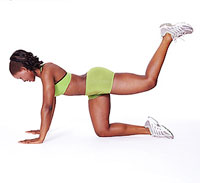
Poke and prod both glutes during quadruped hip extension, single leg glute bridges, side lying clams, side lying abductions. See if equal tension exists in the glutes for the same movements. Also see if hypertrophy is equal in both sides. Poke upper and lower glutes as they function uniquely.
3. Strength
Ideally we’d all have access to dynamometry as we could see actual torque production in various movements from left and right sides. However, dynamometers are uncommon, so we must rely on exercises. This is tricky though, as there can be marked compensation. For instance, hip extension strength can be equal on both sides, but this doesn’t mean that glute strength is equal as one side could involve greater hamstring/adductor firing. The same can be said for other glute actions (hip abd, hip ext rot) as they all have synergists. This is why palpation is also vital. Nevertheless, test to see if the movements are same in form from one side to the next. See if the same reps can be performed from right to left, and pick movements that are simple in addition to ones that are more challenging. For example, side lying clams, quadruped hip extension, single leg box squats, Bulgarian split squats, reverse lunges, skater squats, single leg glute bridges, and single leg back extensions can all be used for glute imbalance testing.
4. Symmetrical Movement
Test bilateral and unilateral movements for symmetry. For unilateral, “true” single leg movements are ideal here (pistols, skater squats, and single leg RDLs) as stability from the other leg isn’t provided. See whether the movements are symmetrical, in particular, see if one hip rotates internally while the other remains more neutral? Also look at bilateral movements – squats in particular. See if the hips shift to one side as the movement descends.
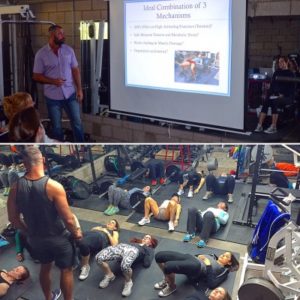
I filmed a clip on this topic as this question is best answered in video format:

good thans for the information
Thanks Brett
for taking the time to explain glute imbalances,I would agree with palpation verses looking or viewing for glutes working in my experiences with clients thanks again for the tips.
Since reading your last blog on how to fix imbalances I have been poking ,squeezing ,flexing my glutes. I was thrilled to find this blog in my email. Now I have actual exercises suggestions to choose from to figure this out . I do not have a coach or anyone to do this for me but with your suggestions I feel, I hope I can figure this out. Might have a little trouble with the viewing part. I know mine are both firing but just not equally. I would like to also mention that mind muscle connection is extremely hard for people new to exercise. I don’t know how many times I read squeeze this muscle and unless you have some muscle it is hard to isolate it. I am still trying to feel my lats…so whether its my glutes or lats I will just keep trying and eventually I will get it. Thanks again for all the info…
I resisted writing this at first, but I reconsidered because I felt it was a legitimate question. I am sure some people will say WTH. I know this is not in your area of expertise but it involves the area you are best known for. I don’t have PFD (pelvic floor disorder) but to prevent it I have been doing Kegel exercises for years..Over the last few days of squeezing and flexing I noticed how familiar it felt to the Kegel exercises. I was wondering if stronger glutes could also play a part in preventing PFD. If so, this would be another great reason for males and females to do your hip thrusts. PFD effects males and females. We want to keep our insides as strong and healthy as we age.. PPP Positive Pelvic Power….I made that one up for my hubby. LOL
Definitely. Consider that glutes provide a cushion when seated, preventing nerve damage. A weak glute can easily turn chair sitting into a dangerous activity for the pelvic floor. Another major thing is that many people with PFD have major trouble flexing their glutes without flexing their PC muscle as well. Learning to flex glutes without using the PC muscle is critical.
If you’ve got any pelvic asymmetry then there’s probably a left to right muscle asymmetry as well.
http://www.youtube.com/watch?v=Ui1o4AtMvao
I’ve printed this off and marked it up. Thanks! Still, a question remains (forgive me if you answered it): beyond the rehabbing exercises, if you have an imbalance and are doing bilateral work, which side should you work first? My instinct is to work the stronger side first, because it usually steals the work and at least it will be a little tired by the time you get to the weaker side. But there could be an argument for starting fresh on the weaker side. Any advice?
Hi there,
Thanks for this informative post, much appreciated. I don’t think I have a glute imbalance; however, I have sciatica that flares up from time to time. I’ve noticed that working out my glutes and stretching the piriformis muscle using yoga has really helped. Do you know of any specific yoga poses to help with toning the pelvic floor area and your glutes?
Thanks!
Alana
The lower glute area of my left leg is very hard and seems to be packed with muscle. Taking most of the fat off my left leg making it skinnier and with more muscle. And my right leg has *some muscle. More fat than left leg and my butt is lower and bigger than my left. So witch leg is stronger…. Left one or right one.