
Peer-Reviewed Articles (Journal Publications)
-
- Exercise Technique: Barbell Hip Thrust
- Strategies for Optimal Core Training Program Design
- Do Single Joint Exercises Enhance Functional Fitness?
- Non-Uniform Changes in MRI Measurements of the Thigh Muscles Following Two Hamstring Strengthening Exercises
- The Biomechanics of the Push-Up: Implications for Resistance Training Programs
- Effect of Hand Position on EMG Activity of the Posterior Shoulder Musculature During a Horizontal Abduction Exercise
- Exercise Technique: The Long Lever Posterior Tilt Plank
- Movement Pattern Continuums – A Fundamental Component of Personal Training
- Are All Hip Extension Exercises Created Equal?
- In Response to Letter to the Editor
- Is Postexercise Muscle Soreness a Valid Indicator of Muscular Adaptations?
- The Muscle Pump: Potential Mechanisms and Applications for Enhancing Hypertrophic Adaptations
- The Increasing Role of the Hip Extensor Musculature With Heavier Compound Lower-Body Movements and More Explosive Sport Actions
- The Role of Kettlebells in Strength & Conditioning: A Review of the Literature
- Effects of Different Volume-Equated Resistance Training Loading Strategies on Muscular Adaptations in Well-Trained Men
- The Effect of Maturation on Adaptations to Strength Training and Detraining in 11-15-Year-Olds
- Regional Differences in Muscle Activation During Hamstrings Exercise
- lncreasing Role of Hips Supported by Electromyography and Musculoskeletal Modeling
- An Electromyographic Comparison of a Modified Version of the Plank With a Long Lever and Posterior Tilt Versus the Traditional Plank Exercise
- Muscle Activation During Low- Versus High-Load Resistance Training in Well-Trained Men
- The Functional Movement Screen: A Review
- Effects of Load on Good Morning Kinematics and EMG Activity
- Influence of Resistance Training Frequency on Muscular Adaptations in Well-Trained Men
- Biceps Brachii and Brachialis Cross-sectional Areas Are Major Determinants of Muscle Moment Arms
- A Comparison of Gluteus Maximus, Biceps Femoris, and Vastus Lateralis EMG Activity in the Back Squat and Barbell Hip Thrust Exercises
- A Comparison of Gluteus Maximus, Biceps Femoris, and Vastus Lateralis EMG Amplitude in the Parallel, Full, and Front Squat Variations in Resistance Trained Females
- A comparison of two gluteus maximus EMG maximum voluntary isometric contraction positions
- Acute effects of anterior thigh foam rolling on hip angle, knee angle, and rectus femoris length in the modified Thomas test
- An examination of the gluteal muscle activity associated with dynamic hip abduction and hip external rotation exercise: a systematic review
- Biomechanical implications of skeletal muscle hypertrophy and atrophy: a musculoskeletal model
- Greater electromyographic responses do not imply greater motor unit recruitment and ‘hypertrophic potential’ cannot be inferred
- A comparison of gluteus maximus, biceps femoris, and vastus lateralis EMG amplitude for the barbell, band, and American hip thrust variations
- A comparison of increases in volume load over 8 weeks of low- versus high-load resistance training
- Attentional Focus for Maximizing Muscle Development: The Mind-Muscle Connection
- Effects of Varied Versus Constant Loading Zones on Muscular Adaptations in Trained Men
- A Comparison of Increases in Volume Load Over 8 Weeks of Low-Versus High-Load Resistance Training
- Upper body muscle activation during low- versus high-load resistance exercise in the bench press
- Effects of a six-week hip thrust versus front squat resistance training program on performance in adolescent males: A randomized-controlled trial
- The modified Thomas test is not a valid measure of hip extension unless pelvic tilt is controlled
- Strength, body composition, and functional outcomes in the squat versus leg press exercises
- Differential Effects of Heavy versus Moderate Loads on Measures of Strength and Hypertrophy in Resistance-Trained Men
- Effects-of-a-six-week-hip-thrust-vs.-front-squat-resistance-training-program-on-performance-in-adolescent-males-a-randomized-controlled-trial
- Roman Chair Back Extension Is:Is Not a Safe and Effective Exercise?
- Biomechanical, anthropometric, and psychological determinants of barbell back squat strength
- Differential effects of attentional focus strategies during long-term resistance training
- Exercise-Induced Muscle Damage and Hypertrophy: A Closer Look Reveals the Jury is Still Out
- Resistance Training Volume Enhances Muscle Hypertrophy but Not Strength in Trained Men
- Vertically and horizontally directed muscle power exercises: Relationships with top-level sprint performance
- Response to “Statistical Power in a Recent Study by Schoenfeld et al.”
- To flex or rest: Does adding no-load isometric actions to the inter-set rest period in resistance training enhance muscular adaptations? A randomized-controlled trial
- Do the anatomical and physiological properties of a muscle determine its adaptive response to different loading protocols?
- Force-velocity-power profiling of maximal effort sprinting, jumping and hip thrusting: Exploring the importance of force orientation specificity for assessing neuromuscular function
- Hip thrust and back squat training elicit similar gluteus muscle hypertrophy and transfer similarly to the deadlift
- Stretch vs Squeeze: The Impact of Varying Resistance Challenge at Long vs Short Muscle Lengths. A Randomized Controlled Trial
TRAIN WITH BRET

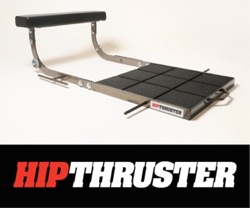
The Ultimate Glute Shaping Machine
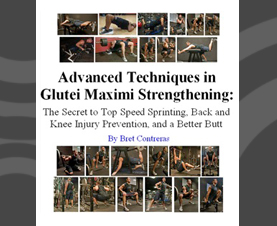
Bret’s Glute eBook
Subscribe for the latest in Glute Guy event announcements!
Follow Bret