
The progression of the Strength & Conditioning industry is intriguing. We’ll simply never know what many bright coaches from the 70’s, 80’s, and early 90’s knew because they never had a platform to allow their voices to be heard. Sure the top dogs were writing books, publishing articles, and speaking at conferences, but the majority of good strength coaches during those times kept to themselves or at best attended a conference each year and shared their expertise with a few colleagues. The late 90’s and early 2000’s gave rise to some popular fitness marketers who started educating fitness professionals on the art and science of internet marketing.
The Ryan Lee Backlash
One of these marketing gurus was Ryan Lee. Ryan has helped many of today’s top Strength & Conditioning experts improve upon their marketing skills by teaching them about branding, website development, advertising, sales tactics, list building, membership sites, increasing revenue streams, and product launching strategies. This helped the experts make more money, which freed up time to allow them to create more products and write more articles. As an industry we’ve benefited from many of these products – in fact I’m a proud owner of many of them and I’ve benefited from participating in membership sites as well. For this reason, Ryan Lee did a good thing for the fitness industry. If you have an hour to spare, click HERE to hear an interview where Ryan tells his story.

However, the focus on marketing produced a backlash, and now the industry is suffering as a result. Though I’m sure that Ryan didn’t seek to sabotage the online Strength & Conditioning industry, I believe that he has done more harm to S&C than any single individual in our industry’s history. To give Ryan credit, all he did was teach trainers how to market themselves, so he shouldn’t be faulted for the backlash. The problem is that he equipped a ton of fitness douchebags with world class marketing skills. This is akin to handing a street thug a rocket-launcher on his way to a rumble. Again, I’m sure this was not Ryan’s intent.
The Biggest Problem in Strength & Conditioning
I am very optimistic about the Strength & Conditioning industry, but it needs work. We’re going to have to put forth some time and attention in order to get it back on track. We won’t be able to stop the hardcore internet marketers; as long as there is money to be made they’ll be at it full-throttle. But the top level coaches – the most respected of the bunch, can adopt a more scientific outlook, teach critical thinking skills, and demonstrate integrity and balance.
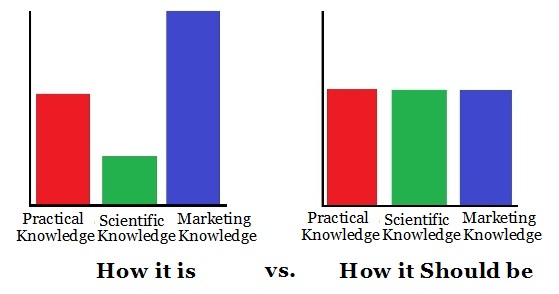
The biggest problem with the Strength & Conditioning industry is that we constantly have to try to separate the wheat from the chaff since it’s hard to know who to trust and believe. There is so much misinformation out there, and many of the writers who are reaching the masses possess marketing skills that far supersede their practical and scientific knowledge.
We all have bodies and train ourselves, not to mention most of us train other people as well, so practical knowledge is usually up to par. But many top writers spend their spare time reading marketing books rather than reading scientific articles and staying on top of the research. This leaves an imbalance, with scientific knowledge trailing far behind marketing knowledge. There’s nothing wrong with acquiring marketing skills and learning how to promote one’s self, but optimal balance should always be sought between these three pillars of knowledge.
I pity the individual whose primary goal is to maximize profit at any expense. This individual will never get a second chance to make a first impression, and unless he changes his ways he’ll be shunned by the same industry that made him rich since the experts will see through his bullshit and the consumers will eventually realize that they’ve been scammed.
Personally I’ve never read a marketing book or attended a marketing course. I’m pretty sure that if someone with Ryan Lee’s marketing skills possessed my knowledge of sports science, he’d probably double his wealth within a few years.
My point is not to brag about this; I actually think I’m an idiot for not doing so. My intention is to show you that it is indeed possible to succeed by focusing on science rather than marketing. Nowadays many would consider me to be a top expert in Strength & Conditioning. And yet I’ve achieved this not by extensively studying marketing (for my marketing practices I just imitate what I see some of my colleagues do as I figure they’ve got the marketing concepts locked down), but by being innovative, testing my methods prior to writing about them, and gradually building upon my scientific knowledge.
I’ve found that many internet experts in Strength & Conditioning are too ignorant to realize what they don’t know and mistakenly believe that science can’t teach them anything, which is unfortunate as this is not how optimal innovation is realized. At this point I want to offer my advice to S&C writers.
The Ten Commandments of Strength & Conditioning Writing Practices
Several weeks ago I wrote a sarcastic article titled, How to be a Fitness Guru in 25 Easy Steps. The article was actually the second most popular blogpost I’ve ever written, finishing just behind The 50 Commandments of Commercial Gym Etiquette. My intention with the Guru article was to point out some of the absurd behaviors I see in S&C Gurus and Wannabe Gurus these days. I believe that times are changing, and the days of overly cocky gurus making incredibly bold claims and utilizing shady tactics to get a leg up on their fellow writers will gradually come to an end, simply because they’ll be called out more frequently by a more-educated population of readers (and the subsequent embarrassment that follows).
At any rate, I’m going to do my best to lead a crusade aimed at improving the practices of internet strength & conditioning writers. If you’re a writer in the field of strength & conditioning, then here are the rules that I’d like for you to follow:
1. Stick to What You Know
This is the single most important rule to follow. Just stick to what you know. Don’t go writing about stuff outside of your area of expertise. I’ve seen powerlifters, bodybuilders, weightlifters, strongmen, personal trainers, strength coaches, track & field coaches, physical therapists, and researchers obtain considerable respect and popularity by sticking to their sole area of expertise.
Many writers feel the need to chime in about a particular topic that’s outside of their expertise and they end up looking foolish to those who are truly “in the know.” If you’ve never performed an exercise or prescribed them to clients, don’t write about it. If you haven’t experimented with a particular methodology, don’t write about it. If you don’t work with certain populations, don’t offer advice as to how to train those populations.
Moreover, many of today’s S&C writers get annoyed when they get called-out by researchers or writers who are better-versed in science, but it’s their own damn fault for writing about things they don’t adequately understand. If you’re not a sciency-type it’s perfectly fine; just don’t delve too far into the science in your articles. Choose instead to focus on exercise form or potential benefits and steer clear of advanced scientific explanations.
Ben Bruno is a strength coach who is making a big name for himself in the strength & conditioning industry by simply sticking to what he knows. You don’t have to wonder if Ben is talking out of his ass; if he writes about something then you can count on the fact that he’s tried and tested it.

2. Be Real
If you’ve been reading various blogs in the S&C industry over the past several years, then you can probably spot who is “real” and who is phony. Phony writers tend to make really bold claims, exude tremendous cockiness, repeatedly bash others, and over-exaggerate and mislead. They’re also usually mysterious and difficult to reach.
Real people tell you a bit about their lives, they’re not afraid to say they don’t know the answer to something, they’re transparent, and they’ll make you feel comfortable and at ease when you’re in their presence. They don’t have hidden agendas and they make you feel like you know them even if you’ve never met them. Tony Gentilcore has achieved amazing success by being real and showing his human side. In my opinion he’s the “realest” S&C writer in the biz.

3. Be Humble
To be frank I’m sick and tired of the cockiness, the arrogance, and the bashing of other coaches. I think that some of the S&C Wannabe Gurus these days have hidden aspirations to be WWE superstars. This isn’t fake wrestling; it’s the science and practice of strength & conditioning.
You don’t need to tell the world how smart you are; they’ll figure it out on their own. You don’t need to constantly remind people about your impressive strength; there will always be somebody stronger than you and this doesn’t automatically make them right.
If you were wrong about something in the past, admit it. If research discredits one of your theories, announce the findings to your readers, update your views, and move on. Your readers will appreciate your honesty.
And for the love of God, if you’re speaking at a conference you don’t need to act superior to the attendees. You’re not a celebrity, you’re a personal trainer, and even if you were a celebrity it wouldn’t give you the right to purposely try to make people feel inferior.
I met Dan John at a seminar in late 2005 and still find him to be the most humble Strength & Conditioning expert I’d ever met. He’s forgotten more about S&C than most coaches will ever learn, yet he treats everyone with respect and dignity. Dan is a class act and we should all follow his lead in this regard.
4. Be Cautious With Your Claims
You might think you have it all figured out, but chances are you don’t. Science is always advancing, and many times we get it wrong or simply fail to understand the big picture.
If you learn to be cautious with your claims, then you’ll protect yourself from looking like an idiot down the road. You can poke fun of researchers all you want, but there’s a reason why they’re always wording things safely and using phrases such as: “it appears that…”, “based on the following information…”, and “future research needs to…”
Furthermore, you may think that your latest discovery will revolutionize S&C and serve as the unifying factor of all things fitness-related, but chances are it’s not that cool. Humans tend to have a reductionist viewpoint and we want to hone in on a particular exercise or methodology, but things like injuries, power development, and performance have many facets and are due to a myriad of inter-related factors, so your Airex half-kneeling band anti-rotation perturbations probably won’t single-handedly eliminate ACL injuries or cause vertical jumps to sky-rocket.
Craig Liebenson is a world class chiropractor who is doing an excellent job at helping to create a “renaissance” in the fields of physical therapy and rehabilitation. He’s doing this by directing clinician’s attention toward the nervous system, fundamental movement patterns, and corrective exercise, which should be incorporated in tandem with joint manipulations, soft-tissue therapy, and other traditional therapies in order to produce lasting solutions to dysfunction rather than providing Band-Aid fixes. There are many reasons why I have the utmost respect for Craig, and one of these reasons is that he’s always cautious with his claims. For this reason you won’t find him having to eat crow too often.
5. Give Credit Where Credit is Due
Our industry has a rich history and involves plenty of intriguing characters. You need to know the movers & shakers and understand their contributions to current practices. I try very hard to stay on top of the various expert’s blogs and articles not only to stay current, but also because I’m constantly coming up with new ideas and I want to make sure I’m not repeating something someone else made public. We all have unique readers and should therefore be sharing others’ brilliant work, but we should make sure to give credit where credit is due.
I can’t tell you how often I come up with an idea only to find that one of my colleagues came up with the same idea, concept, or exercise variation before me. When this happens, I simply give that person credit and announce to my readers where I learned the information.
Here’s another thing I can’t tell you: the number of times I see my colleagues get “ripped off” by aspiring writers who try to play another individual’s idea off as their own. It’s not necessary to credit every single aspect of every article, but novel ideas should be credited and in general your articles should reference other writers.
Readers are always happy to be learning something new and as long as you’re the person who taught them the technique, they’ll be grateful whether or not you came up with the idea. In other words, it won’t impair your value to your readers by crediting another individual, but giving credit makes the idea’s originator feel good inside and makes for good practice in our industry.
I’ve noticed that the entire field of physical therapy writers is skilled in the art of referencing others’ work and ideas. For example, Mike Reinold is another excellent physical therapist who bridges the gap between rehabilitation and strength training, and he’s always sure to give credit where credit is due. I hope that strength & conditioning writers follow suit and start giving more credit and promoting other’s work and ideas.

6. First Learn the Science and Practice of Strength Training
Many readers really look up to the top dogs in S&C. To provide you with some of my own anecdotes, in the past year I’ve been asked to pose for pictures with my readers, my autograph has been requested, and I’ve even been “bowed” to following one of my seminars, as if I’m an emperor. I can understand this as it’s natural to admire the folks in your profession who consistently provide top notch material and education.
Many of these fans have a strong desire to join in on the fun. They want to start up their own blogs and start contributing articles to top websites and magazines. In truth, most aren’t ready for it and haven’t yet earned the right to contribute to TNation or Men’s Health.
You have to put in your time in the trenches in order to be an expert. It takes many, many years to really get it, and the truth is that you’re probably not ready. I thought that I was ready several years prior to submitting my first article, but looking back I realize that I wasn’t quite ready. Be patient.
You should be lifting weights and seeing consistent improvements. You should use good form when you lift. You should be training other people for many years before writing articles. You should learn the basics of Biomechanics. You should be regularly attending seminars. You should be learning the science. You should be interested in all aspects of sports science; not just one particular area. The late and great Mel Siff knew more about each particular area of sports science than 99% of experts out there, which is why he is so revered amongst fitness professionals.
You should care about physical therapy and rehabilitation tactics as most beginners to exercise (and surprisingly many athletes) possess significant dysfunction somewhere in their bodies. You should care about hypertrophy and fat loss as many clients rank these as their primary goals for embarking on an exercise regime. You should understand the basics of power development as many clients wish to improve performance in addition to aesthetics. Everything is related, and Sports Science is an all-encompassing field that includes Biomechanics, Physiology, Functional Anatomy, Psychology, and Physical Therapy.
One expert who has studied the science and practice of strength training extensively is Pavel Tsatsouline. Pavel is very interested in all aspects of strength development, not to mention the sport of powerlifting, core strength, flexibility, and spinal health. He’s studied methods used by the Russians, the Americans, and everywhere in between. He stays current with research and he participates in experiments in order to advance his knowledge of Strength & Conditioning. I have much admiration for Pavel in this regard.
7. Make Your Primary Goal to Master Your Craft, Not to Maximize Your Profit
As I mentioned earlier, it’s important for you to understand and practice sound marketing techniques. Get a blog, get on Facebook, Twitter, and Youtube, promote your work on these mediums, and be confident. But let your work speak for itself and don’t go overboard.
Don’t post links to the same articles over and over, and don’t title every single article and video you make with “The Truth About ___,” This is okay to do some of the time, just not all of the time. Don’t exaggerate regarding the quantity and quality of clients you train. During my first year of blogging I built one of the most popular strength training blogs in the industry by putting out good content and videos – all the while only training less than ten clients at a time out of my garage. Don’t make bold claims without supporting them with sound scientific rationale. Don’t be overly dramatic with every article you write – your article is probably not that cool in the grand scheme of things. Don’t fabricate physiological phenomena just to sell more products (yes this has happened before). And finally, don’t jump onto the scene with guns-a-blazing. The industry likes to see steady and consistent growth out of its experts, so don’t go pumping out five products during your first year of writing (or during any twelve month period for that matter). These practices may earn you more money, but they will not earn you the respect and admiration of your peers, and this will ultimately impact you negatively over time.
Brad Schoenfeld has been honing his craft for decades. He was a big follower of Mel Siff back in the day, he trained thousands of clients and owned his own personal training studio for many years, he reads research regularly, he’s an Exercise Science professor, he’s published many popular books and journal articles, and he’s highly respected amongst his peers. Yet his life-decisions are based on maximizing his knowledge and helping others, not on increasing his income. He could make a lot more money if he ventured down the same path as your typical marketing guru, especially since he arguably knows more about muscle hypertrophy than anyone else in the world, but he continues to work towards his PhD and publish free journal articles. Nevertheless Brad has done very well for himself financially. By focusing on quality content, the money has followed.

8. Be Passionate
None of the aforementioned advice should be confused with failing to exude passion. Passion for fitness should emanate from every pour in your body if you expect to become popular in S&C. Promote your favorite methods and exercises. Find ways to get people to listen. Defend an unpopular stance if it goes against your beliefs. Shout it from the freakin’ rooftops if you have to. Let your passion shine through as this is paramount in motivating people to exercise and experiment with new methods. Just be respectful about it and try to be part of the solution over time (I’ll expound upon this in a future article).
Joe Dowdell is a highly-respected individual in the field of S&C, and this respect is much deserved. Joe is constantly seeking continued education. He’s interested in functional training, hypertrophy research, flexibility research, fat loss research, Biomechanics, and nutrition. You will not find many people in this world who are as passionate as Joe Dowdell about training. This passion is apparent when you see Joe present, and Joe is never afraid to speak his mind. But Joe is always sure to be extremely tactful, humble, and respectful.

9. Be Altruistic and Have Integrity
This should go without saying, but have integrity and be a good person. If you say you’re going to do something, do it. Talk the talk and walk the walk. Admit when you’re wrong. Don’t be a “user” and don’t constantly request favors from people. And if you ask for a favor from somebody, make sure you even the score down the road even if that’s not what the person requests. The S&C industry has hosted some shady individuals throughout its history so do your part in cleaning it up by being the change you wish to see.
I often fail to charge enough for my services, I help too many people for free, and people sometimes take advantage of my good-naturedness. When I owned my studio Lifts I’d discount rates and even provide free months to those experiencing financial hardship. Guess what? I’m very proud of these things as it’s my way of giving back.
I’ve only met Mark Verstegen briefly, but I’ve heard from numerous colleagues that he’s one of the most stand-up professionals you’ll ever meet. His reputation is astounding. The word on the streets is that he spends his time bringing others up rather than putting others down, and that he’s oozing integrity and honor.

10. Focus on Ideas and not Humans
There’s nothing wrong with arguing and disagreeing. Just be sure to focus on the topic, not the person. Sure you can mention a person and quote them in your argument, but be fair, give them the benefit of the doubt, and don’t call them names. Try to be as unbiased as possible, but realize that no matter how hard you try you’ll never be able to truly be “unbiased.” We all have biases whether we realize it or not. Rely on logic and not emotion to the greatest of your abilities.
If someone disagrees with you, listen to their argument and address their concerns. I’ve spoken to Martin Rooney at a couple of seminars and the conversations we had were nothing short of amazing. Martin is incredibly knowledgeable and might be the most energetic expert in S&C. Guess what? I’ve never heard Martin utter a bad word about another fitness professional. This is just one reason why Martin is the consummate professional.
Conclusion
When trying to come up with individuals to fit each commandment, I realized that many of the experts I chose fit very well into most of the commandments listed. In other words, there are common traits shared by the top fitness professionals today; most of them stick to what they know, they’re real, humble, and passionate, they have integrity and are altruistic, they focus on ideas and not individuals, they’re cautious with their claims, they credit other writers, they’re students of the game, and the pursuit of financial gain isn’t the sole driving force in their lives.
I’ve made plenty of mistakes over the past several years, but I’m always learning and striving to better myself. I’ve got a ways to go in some of these areas but I know where I’d like to go which is half the battle. The Strength & Conditioning industry faces some challenges but as long as we hold each other to higher standards, then only good things can come as a result. I’m going to continue to do my part in improving the quality and practices of the online fitness industry by promoting critical thinking skills and effective communication, sharing scientific advancements, and leading by example.
Dear Brett,
What a fantastic article! I am a young coach in England and I cannot stress how much I related to your words! I follow experienced coaches like yourself, Boyle, Cosgrove, Rooney etc. I have absolute faith in what you guys are telling me for all of the reasons above!
This article really made me feel that I am on the right path and has encouraged me to be the best I can be whilst learning from others, helping others and doing so with integrity!
Thanks for the Tuesday motivation coach!
Ashley
Brett,
Absolutely on of the best articles I have ever read in this business!! I believe this article should be one of the first of many articles new and up coming S&C coaches read because like the article says, there are alot of shady individuals out there who only care about themselves and lining their pockets and it really fires me up.
uhm. how about Scott Sonnon?
Thanks for another great article Bret! As a newbie in the personal training business it is priceless to get these reminders on not jumping on the “only profit” wagon. Have found myself several times reaching for my creditcard to buy another solution for making my business and products go through the roof. But entries like this one always makes me think twice and stay humble to the industry and my knowledge instead of trying to becoming the topdog because of a “bulletproof system” i bought for the special price of xx dollars.
Wow! Excellent article that can be applied to all segments of the fitness industry! I love this and it’s great to hear that we may be swinging the pendulum 🙂
As an interested non-pro, it does seem like the focus in the S&C industry is networking, and impressing each other, rather than dropping the knowledge.
Cut my teeth on Ian King. Charles Poliquin. Pavel.
Then Thibaudeau. Waterbury. BC. Kelly Starrett.
Some of these guys have more science, some more art. All of them have made lasting permanent positive changes to my training.
If you’ve got the goods, let’s see ’em. Sizzle without steak will NOT hold up, as people become more and more savvy. Nobody knows it all, and even great minds are wrong sometimes. So I just try to learn from everyone.
Derrick,
I agree with your comment,and I also really like Charles Poliquin. He has some really good articles that have been very applicable to my training.
Thanks for this great post Brett. It has given me much to consider
Great article Bret!
In terms of the business model driving the bus, do you feel that it now has too much influence on program design? Some are of the opinion that the pursuit of small gains aren’t worth the bigger investment of time mainly because it’s too disruptive to their model.
Cometh the hour cometh the man. This article was just what I needed to read at a critical point of me building my personal training business. The balance between marketing and quality research was becoming a real issue. This article put things into perspective.
Fantastic article Bret. I love vertical jump training and have a website devoted to the topic and I try and live up to all of the things you loutlined here. Sadly the vertical jump space is an industry infected with people with high marketing skills and low training knowledge. It kills me to see some of the crap claims out there.
Great article, Bret. A buddy of mine recently turned me onto your site. Enjoying your insights.
Awesome article – Provides some great motivation to start the week off right! Thanks Bret…
Nice read Bret.
Great post Bret!
Excellent points!
Wonderful article and a great group of people referenced and credited, as well. Thank you very much.
Thanks for this, Brett. I particularly liked this part:
“And for the love of God, if you’re speaking at a conference you don’t need to act superior to the attendees. You’re not a celebrity, you’re a personal trainer, and even if you were a celebrity it wouldn’t give you the right to purposely try to make people feel inferior.”
Equal responsibility falls on the backs of attendees, too; I’ve taught at conferences (theatre, not S&C) and find that people approach me as if I’m some superhuman with all the answers, as well as a personal business plan already drawn up to serve their interests.
I’m just a person who happens to know a little more than you do about this field, or maybe I’m just good at explaining stuff. All of us would do well to approach others and their writings–especially on the internet!–with humility and curiosity, and keep forging ahead to always learn more.
Thanks for writing Bret. I totally agree on each point, but having a goal to make a profit is not a bad thing at all.
Selling a crappy product that you know is an utter turd IS bad.
There is nothing wrong with wanting to grow a business to help even more people as long as you are doing it with integrity.
This does not make marketing bad, it is the USE of marketing that can result in some horrible products being sold. Unfortunately, you don’t have to look too far in the fitness industry to find them.
I actually have learned a ton from Ryan Lee over the years and he has always supported the ethical use of marketing and to create awesome products.
The way most industries progress, if it was not Ryan promoting marketing to them, it would have been some one else.
I have a dream….
Take Mel Siff. I freaking love that guy and his work. Ok, maybe because I have a soft spot in my heart for engineers who seek to learn physiology; but imagine if Mel had someone doing top notch, ethical, marketing for him! Bad a$$. He would have been everywhere, and that would’ve been amazing. Imagine how many more people could have learned from him? Awesome.
Marketing is just communication. No more, no less. What each person decides to do with it is up to them.
I totally agree that we need to push the science of what works and admit I still spend a vast majority of my time reading research and testing stuff, because that is who I am.
But communication is needed and I feel our only hope is to reach a point where the better stuff dominates everything.
People wanting to use amazing marketing to sell a crappy product would not even dream of entering the fitness field, for fear of the massive beat down that would ensue, where they promptly go out of business.
I can dream, right?
rock on
Mike T Nelson PhD(c)
Brett,
Great read! I know some of the guys you’ve mentioned and have seen them speak and they are great. But I want to share a quick story.
I had a couple of graduate classes with Brad and to be honest, I thought he was bit cocky at first (as cocky as one can be on discussion boards). But the truth is it was more jealousy on my part. Brad is smart, successful, honest and…did I mention smart? He had such a profound grasp on exercise physiology that I quickly got over myself and realized how much of a privilege it was to be in the same class as him. In the classes I took with Brad (exercise phys, & biomechanics) he was so involved and eager to share with the other students. The two classes I had with Brad were my two favorite classes BECAUSE of Brad. I felt challenged without feeling inferior.
Great article Bret!
yes, a street thug taking a rocket launcher to a rumble would not be pretty.
Mike Boyle is the top of my list. Without his knowlege I would be on another planet.
I don’t care WHAT you say… I’m STILL going full steam ahead with my MLM goji juice and plyometric progressions project. You DO NOT need steak if you can obscure their view with enough of that sweet sizzle!
Brett:
This article was a recommended read to me by a fitness professional and one of my managers who I have the greatest amount of respect for working in the S & C industry. As a former journalist, group fitness instructor, and freelance writer where I do aspire to write articles that are fitness related, I truly believe I want to write about my passions on what I know, and discover what I do not to know, so that I can grow and help readers along the way. Thank you for shedding light on writing the right way to better inform the public.
I think Ryan Lee would enjoy reading this. He created quite a few monsters! I’m sure Coach Boyle gives him shit for it all the time. Much respect to Ryan and all the guys you mentioned, great article as usual.
Some good things to think about.
Bret – awesome article, thank you for the great points
Top read Bret.
Hi everybody, thank you very much for the kind words. Rather than respond to everyone, I’ll just write a general response.
I’m just like all of you; here to learn. I read something in the book “Muscle, Smoke, and Mirrors,” where legendary bodybuilder John Grimek wrote about legendary trainer of the stars and bodybuilder Vince Gironda.
To paraphrase (and I’ll probably screw it up), he said something to the effect of:
“Over the years I’ve amassed a ton of knowledge and expertise, which I assumed I had figured out all on my own. Vince recently asked me to review one of his pamphlets where he detailed all of his exercises and methods, and it dawned on me just how much I learned from Vince. I had taken for granted the fact that Vince taught me nearly everything I knew, and I hadn’t realized it until now. Vince is quite a character, but he’s made such a profound impact on everything I do, and for this reason I have tremendous respect for him.”
I can relate to Grimek’s thoughts. If I had to review all of my mentor’s methods, it would dawn on me how just much I’ve “absorbed/stolen” from each expert. I’m probably 80% a mixture of all my mentors, and 20% my own twist. In my workshops I’m always quoting my mentors and I sometimes laugh when I think to myself how much I sound like Mike Boyle, or Dan John, etc.
I’ve learned so much (and continue to learn) from all the greats…from Ian King and Charles Poliquin, to Eric Cressey and Mike Robertson, to Nick Tumminello and James “Smitty” Smith, and even from younger guys like Ben Bruno and Sam Leahey.
I have so much love for these guys for helping me be better at what I do, and I’m so thankful that they share their expertise with the masses.
There are some folks who aren’t mentioned anywhere in this blogpost who take the marketing way too far and are in fact irresponsible and dishonest. I don’t respect or admire these folks in any way, as we could all just abandon our morals and go this route.
However, there are plenty of guys (all the guys mentioned in this article) who know the right balance, and for this I’m very grateful.
To Ryan Lee, I’m sure he knows that all publicity is good publicity and I certainly didn’t mean to call him out (I have much respect for him too).
It is my hope that the online industry maintains the right balance and the best of the best hold each other to high standards. I think that the industry will improve over time, and I think we are starting to gain more respect for one another, regardless of our backgrounds.
Thanks again! Bret
Thanks brother, I’m humbled. Really excited to continue learning from you as well.
Bret.
Always enjoy reading your articles..You are a class act..
Thanks so much Bret, another great read. Some smart people on that list. Thank you.
Rob
wow, nice article.
Ben Bruno is the man! whenever I see his exercise vids, each rep he does is under complete control. phenomenal!
BTW for some reason Bruno reminds me of Igor from the film “Son of Frankenstein”.
2 coaches I would add to your list are JASON FERRUGIA and ZACH EVEN-ASH
Yeah, except Igor was always more of a bilateral movement, Wendler 5-3-1 guy, whereas Bruno is more of a single-leg, weight vest guy.
ha ha.
I would add that if you want to train like a man, you’d be wise to get coached by Wendler, but if you want to train like a school girl, then better choose Mike Boyle!
Well done and great analysis! S&C is an art and science!
WO BRET CRYSTAL CLEAR CLARITY IN THIS ARTICLE OF BEING A GREAT WRITER WITH PASSION ND INTEGRITY.
First, I think you did a great job with the article. And if I am man enough to take even some credit for people who have been through my training (cosgrove, boyle, cressey, etc.), then I should also bear some of the blame for the “douchebags” too.
As you stated, I taught the strength and conditioning pros marketing. And some of them took my messages the wrong way. I ALWAYS started every marketing program with the following..
“Your products MUST be the best” and
“Marketing is 50%, you must always strive to be better as a trainer/coach, etc.”
I even said if you don’t plan on creating the best products and programs – then please return this marketing system and get a refund. And I was deadly serious.
And I do think you are a bit insane for not reading marketing and business books. If you want to reach (and help) more people – then you must be proactive in your marketing. To ignore it means you are not having the impact you should.
I’m NOT talking about money – I’m talking MARKETING. Instead of reaching 2,000 or so people, isn’t it better to reach 20,000 people? Heck, you can give all your information away for free – but you really should learn more about marketing. Marketing is not a dirty word.
And just as a clarification – I do have a sports science background. I have a Master’s in Exercise Physiology, coached hundreds of athletes, lectured to physicians, started a sports medicine department at a rehab hospital, had a research study published and even did an internship with Yale as a S/C coach. I’m not saying that to brag – but just to let you know I came into this world like many of my students, as an “in the trenches” S/C coach. And even with all that “knowledge” I was still barely earning a living and living in my parent’s basement 🙂
I just happened to “get” marketing and worked my ass off to study it to get even better. Then, the money started to flow in. And, only after other S/C coaches started asking me to teach THEM marketing did my career as a “marketer” being to take place.
I LOVE this industry, love the people and many of my clients are still in this world. I’ll continue to teach them how to take financial control of their life and do it with integrity.
Again, great article and thanks for including me.
Rock ‘on,
Ryan
ryanlee.com
Thanks for the clarifications Ryan. You’re a rockstar. I have a lot of respect (and envy) for folks like you. I suppose that one major limiter in life is people’s failure to get out of their comfort zones. It’s easy for me to just copy my friends for my marketing practices(who learned from you) but to really grasp marketing and get a leg up I’d need to dive into it full-boar. But in my free time I prefer to read journals and study science as that’s what really interests me. I could definitely use more balance in this regard. Thanks again, BC
Thanks for this article… reading things like this always brings me back to reality a bit. I will definitely implement these ideas
Hey,Bret:
Very well done article and I too would concur with all of your points. I’m in my 28th years as a personal trainer, strength and conditioning coach and sports coach and I’ve definitely seen this transition take place from the ground floor. My best articles are posted in old Brick Bodies newsletters – the fitness chain in the Baltimore area that I used to work as fitness and personal training director for – and a few small pieces in the ACE personal training mags.
To be fair to Ryan Lee, I vividly recall when he hit the scene and he was a needed breath of fresh air and information in that most trainers were stuck making about $20K to $30K a year and didn’t have the first clue about networking, product development, copy writing, marketing, etc and we were in dire need of that information to make that next step up as credible professionals.
Some of the products that he hit the market with, fitnessgenerator and the strength coach website that Mike Boyle basically bought from him and still operates, were cutting edge and again tools that helped many trainers take their businesses to a new level.
If you’ve seen a number of Ryan’s posts over the past few years you probably also realize that Ryan realizes and readily confesses that not all of the people who took his seminars and bought his products were completely ethical and honest folks and from what I can see Ryan is the first to say that he’s not proud of those folks or of having played a part in their success.
All of that being said, trainers in todays world should pursue and need to pursue business and marketing skills along with their scientific and practical training skills and as you’ve pointed out creating a balance with these different skill sets is what we should be pushing for.
Love the article and the tone of humility that goes along with it and continued success to you and your training endeavors.
Great article Bret! Thanks for the sage advice! You have been killin’ it lately!
Sean
Thanks for the post Bret! I’ll definitely be following more than a few of these guys in the future.
Great post Bret! A lot of good info, but the one part I want to comment on is the marketing piece that you led the article with.
Honestly, I don’t think those in the fitness industry need a packaged marketing “system”. I believe that those in the fitness industry just need to follow a few marketing basics to keep current customers and gain new ones:
1. Know who your target customer is (don’t try to cater to both HS athletes *and* boot camp moms).
2. Spend your limited time and money to advertise and market *only* where your target customer is – online and offline.
3. Give your customers value – be very good at what you do and very knowledgeable about the services you provide. Word will spread that your services are top notch.
4. Communicate well and often with your customers and potential customers using the appropriate methods and media to reach them.
These are simple foundational points that can be expanded on and tailored for anyone’s business using marketing materials, social media, simple email marketing applications, etc. You don’t need a specialized system to do these things. In fact, once you are past the setting up and automating phase for many of these, they may take less time and money to maintain than the packaged systems.
I do agree with Ryan Lee’s comments that fitness pros (or any business owner for that matter) should learn marketing basics by reading a few books and following a couple of marketing or social media blogs. But, I’m not convinced a packaged “system” is the answer. I wonder how many people quit using their expensive marketing system after the novelty has worn off.
great blog I’m a huge Wrestling follower from Switzerland