
Given that my friends Marianne Kane and Tony Gentilcore have recently written blogposts discussing their sacroiliac joint issues, I felt that it would be a good time to jot down some thoughts, findings, and experiences with this confusing joint.
The biomechanics of this joint are not easy to comprehend, and to be perfectly honest, in the past year I’ve read at least a dozen papers on sacroiliac joint anatomy, biomechanics, and dysfunction and I still don’t have an accurate grip on the matter. Some of the papers are incredibly detailed, involving 3D finite element modelling and examining stresses, stiffness, compression, shear, and load distribution in different scenarios. However, the vast majority of folks don’t need to be bothered with these sorts of things, so in this blogpost I’m going to focus on what I feel is pertinent to the readers.
What in the heck is the Sacroiliac Joint?
Here’s what Wikipedia has to say about the sacroiliac joint:
The sacroiliac joint or SI joint is the joint in the bony pelvis between the sacrum and the ilium of the pelvis, which are joined by strong ligaments. In humans, the sacrum supports the spine and is supported in turn by an ilium on each side. The joint is a strong, weight bearing synovial joint with irregular elevations and depressions that produce interlocking of the two bones. The human body has two sacroiliac joints, one on the left and one on the right, that often match each other but are highly variable from person to person.
 As you can see, the SI joint is pretty damn important. We transfer huge loads through the SI joint when we lift weights, run, or play sports, so the structures that affect this joint need to be strong and fit.
Your Low Back Pain Might be Stemming from the SI Joint
This is an important take-home point for practitioners – somewhere between 13-30% of low back pain sufferers are actually experiencing pain due to sacroiliac dysfunction (Maigne et al. 1996, Schwarzer et al. 1995, Sembrano & Polly 2009).
Just how does this happen? The answer is pretty confusing. In case this is your sort of thing, then below is an excerpt from THIS paper. If this is not your cup of tea, just skip over this section.
It is widely held that a relationship exists between excessive soft tissue deformation and pain, mediated by group IIIand IV nerve fibers. Immunohistochemical staining of the articular surfaces, associated ligaments, and joint capsule suggests that, in addition to the joint itself, periarticular structures,when strained, could act as sources of pain typically ascribed to the SIJ. Spinal pain mapping studies suggest that deep somatic spinal structures including facet joints, posterior annulus, and lumbar nerve roots may refer deep, achy pain that can simulate an SIJ etiology. Immunohistochemical studies focusing on intraligamentous nerves found in SIJ ligaments lend credence to the possibility that SIJ ligaments could function as pain generators in LBP. Substance P and calcitonin gene-related peptide are both recognized as important neuropeptides in the transmission of pain. Immunohistochemical reactivity to substance P and calcitoningene-related peptide suggests that a tissue can function in pain transmission. SIJ articular cartilage, the anterior sacroiliacligament (ASL), and the interosseous sacroiliac ligament(ISL) have all demonstrated nerve fibers immunoreactive to both substance P and calcitonin gene-related peptide. In addition, the posterior SIJ ligaments have also demonstrated immunoreactivity for substance P, suggesting that both the SIJ itself, and the ligaments constraining it, could play a role in the genesis of LBP. These immunoreactive fibers likely conduct pain impulses in response to mechanical pressure or deformation.
When on One Leg You can Incur More Stress to the Structures than During Bilateral Stance
In THIS (click to download the pdf) review article, the authors stated the following:
The SIJ is 20 times more vulnerable to axial compression failure and twice as susceptible to axial torsion overloading than are the lumbar motion segments. Imbalanced or unilateral loads may jeopardize the interlocking sacral mechanics by impeding balanced transiliac bony fixation and ligamentous tension across the “keystone”. Miller et al. discovered a threefold increase in sacral rotation with both ilia fixed versus a 2- to 8-fold increase in sacral rotation upon loading with one ilia fixed. Hence, athletes and workers participating in activities requiring repetitive, unidirectional pelvic shear and/or torsional forces (e.g.,figure skaters) may have a higher propensity to develop sacroiliac joint dysfunction.
Muscle Balance
The same paper as above had this to say about restoring muscle imbalances:
Muscle balancing efforts should concentrate on the powerful two-joint muscles around the sacroiliac joint (e.g., gluteus maximus and biceps femoris) as they exert shear and torsion loads proportional to the strength of their contraction. Vleeming et al. have documented that muscles attached to the sacrotuberous ligament (i.e., gluteus maximus and, in some individuals, biceps femoris and piriformis) can significantly limit ventral rotation (i.e., nutation). The clinical relevance of Vleeming’s work may be seen in a patient with a flexed sacrum or ventral capsular tear, tight psoas muscles, and weak gluteus/hamstrings. This individual will require correction of the imbalance to impede aberrant sacroiliac motion and loading.
A Ton of Force Transmitted through the SI Joint? That’s Not Far-Fetched!
Check out THIS (click to download the pdf) review article by Stu McGill. It was published in 1989 – which was 23 years ago! In the article he states the following on page 91 (half-way down on the left hand side):
For example, if the forces of muscles that originate in the SI region are tallied for the trial illustrated in Table 1, then the total force transmitted to the SI region during peak load exceeded 6.5 kN. Such a load would lift a small car off the ground!
When looking at table 1 on page 86, you’ll see that this data was gathered when examining a 27 kg squat lift. This is just under 60 lbs, which ain’t shit! 6.5 kN equates to 1,461 pounds of force.
If you put 1,461 pounds of force on the SI Joint when squat-lifting a 60 pound box, I wonder what kind of force we put on the SI Joint when we lift even heavier loads! It should be mentioned that squat-lifting is slightly different than squatting or deadlifting…it’s actually a mix of the two lifts but involves picking up a box placed in front of the body. Since the load isn’t centered under your COM, you receive much more spinal (and SI joint) loading due to the increased resistance moment arm.
However, I’m pretty sure I could squat-lift 300 lbs if need-be, which is 5 times greater than the load used in the study! What would the SI Joint forces be in that scenario? I’m sure it would be well-over a ton. Insane in the Membrane!

What is Needed for Optimal SI Joint Functioning?
Though the joint itself is an inherently stable structure, there are a lot of muscles and ligaments that contribute to the stability of the sacroiliac joint, and these muscles vary in terms of contribution depending on the position of the body and force vector (magnitude and direction) or loading.
In THIS (click to download the pdf) highly complicated article, it was shown that the pelvic floor and transverse abdominis helped contribute substantial stability to the SI joint from an upright standing position, indicating that these muscles need to be functioning properly to distribute forces in an optimal manner. Vleeming’s work has suggested that the erectors, thoracolumbar fascia, inferior fibers of gluteus maximus, long head of biceps femoris, transverse abdominis, and lats can affect the tension of various ligaments.
Craig Leibenson discussed the muscular slings that work together to provide support to the SI joint in THIS (click to download pdf) article.
In general, to ensure good SI joint load transfer, you need:
- Ideal posture (lordosis, pelvic tilt, etc.)
- Proper force closure of the SI joint (created when muscles pull on ligaments that attach to the sacrum and pull it tight against the pelvis)
- A stable lumbar spine and pelvis characterized by (for lack of better terminology) a strong outer unit (glutes, obliques, erectors, abdominals, lats, etc.) and properly functioning inner unit (diaphragm, transverse abdominis, multifidus, pelvic floor)
- Good hip mobility
- Good bilateral and unilateral hip stability
- Good motor control and kinesthetic awareness during movement (not many people are fully aware of their spinal and pelvic posture during movement)
What to do When the SI Joint Flares Up
Now to the most important part of the article. Sure, the SI joint can take a beating, but if you consistently train hard, chances are your SI joint will act up from time to time – some folks will have issues more so than others due to genetics, posture, and dysfunction. Personally, I experience SI joint issues around once per year, and when this happens I have to pull back on the reigns.
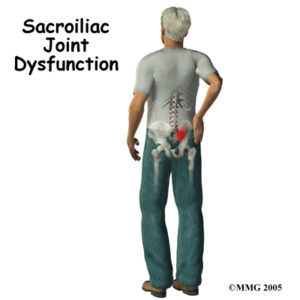
If it’s Bad, Take Time Off!
If the joint is really acting up, just take some time off and try to the best of your ability to give the SI joint some needed rest. Sure, bedrest is rarely the best option for rehab, but the SI joint is sort of like the ribs in that it’s damn-near impossible to truly rest. Anytime you’re on your feet you are transferring forces through the SI joint. If you’re on one limb, the forces increase. If you’re carrying something, the forces increase.
So definitely keep in mind that even excessive walking and having sex (especially if you’re a nasty little Wildebeest) can prolong recovery.

Don’t Overlook This! It Could Prolong Your Recovery.
Don’t underestimate how much force is transferred through the SI joint during upper body and core exercises. Definitely don’t be doing any heavy deadlifting, squatting, barbell Bulgarian split squatting, farmer’s walking, Pallof pressing, or landmining.
Let pain be your guide, but know that when you start training, the juices start flowing and your body can lie to you and fool you into doing more than you should.
Ease Back into Things
When things get better, gradually ease back into heavy lifting. Don’t go overboard on the volume or the intensity right off the bat. Give yourself at least a week to transition back into heavier lifting. Maybe three progressively more intense workouts over the course of the week, followed by a couple days off.
Correct any Dysfunction
Now it’s time to address the issues that got you there in the first place so you can avoid the likelihood of reoccurrences. Corrective exercise and improved form on the various heavy strength exercises are paramount. However, it’s also important to know that SI joint pain can happen to any lifter.
You can have good posture, a sound-functioning core, strong muscles, good flexibility, and great technique, yet still experience SI joint pain from time to time. This is the nature of the beast when you’re transferring over a ton of force through the region several times per week, 52 weeks per year!
Hopefully this article is helpful to some of you folks!

THis is one of the best articles on SI joint pain I’ve had the pleasure to read. Well done, sir.
Thank you Dean! Much appreciated my friend.
Knowledge bomb alert!! Excellent post Bret. Per Dean’s suggestions, I’ve been incorporating more glute work on my right side, and it seems to be helping A LOT. I’m wondering, too, if I need to look into stretching my psoas and/or BF? And, to be honest, my adductor brevis and pectineus are wickedly “stiff” too.
Anyways, thanks a lot of this! Glad my SI joint could be of some inspiration!
Came in at a great time cause I’m suffering from this right at the moment, after training 2x a day same muscle group for 10 days on a 5 day cycle, High threshold units AM for 40 min and Low threshold units in the PM for 30 min, my body will need some good time of recovery, great article, time to focus on my inner unit again.
Thanks SO much for writing about the SI joint, SI joint issues have vexed me when training my clients recently so this article is perfect timing. Im happy see I’ve been on the right track with strengthening the glutes/hammies and stretching the psoas. This is a solid article with info I can easily apply to my training practices. . .me AND my clients thank you!
Hello Brett,
Great post as usual. A number of things we have found in relation to the SIJ and to lifting weights and its effects thereon found below.
#1: SIJ pain is strongly correlated with structural leg length difference (LLD). 50% of the population have actual structural asymmetry of 5mm or more (this was part of my master’s research; re-crunching all the raw date from 14 studies). I can expand if you wish. As well, if someone has an actual LLD, and they squat/deadlift relatively heavily, then the following can always be measured:
asymmetry of hamstring flexibility (more than 10% as a rough guide)
asymmetry of hip flexor ROM as well as respective strengths
asymmetry of lateral flexion in the lumbar spine
asymmetry of strength L-R in the glutes
Now, as Olympic and powerlifting are among the most symmetrical of sports, if we find strong L–R differences, they need to be addressed. Tony posts on this above; excellent approach.
As the human body is assumed to be symmetrical in the L–R sense, asymmetry of function needs to be explained; what I have described is the most common causes of hip, low back pain, and SIJ pain.
However, SIJ pain is seen in the symmetrical body too; there are two more possible, and sufficient, causes of SIJ pain, and these are independent of the LLD I mentioned above (and, of course, may be experienced in the body at the same time, from separate causes):
tight piriformis (piriformis, an external hip rotator, arises from the medial border of the sacrum, very close to the midline of the body, and passes directly behind the SIJ in its spanning of the hip joint). Many lifters have one, or both, piriformis muscles testing very tight.
One tight hip flexor; this might be rectus femoris, most commonly, but also can be the other two. I have argued elsewhere that almost no one can stretch psoas, simply because rec. fem. is too tight. Note that iliacus and psoas are the closest and strongest of the anterior muscles, and asymmetry in strength or ROM (and hence length–tension) here can be a sufficient cause of SIJ. More in a forthcoming post.
Finally in this very brief note, all of the above is one of the reasons I strongly favour unilateral leg and hip training—any of these functional differences will manifest rapidly if present, and can be addressed by the exercises that reveal its presence. We like weighted lunges (but with vertical body movement only, not the usual ‘lunge’ you see that can really stress the knee joint, especially in deceleration); weighted step ups, one-leg squats, free initially, then weighted (sensational for remaking foot alignment and knee tracking as well) and then weighted one-leg squats.
There are a number of YouTube clips on my site that addresses much of this.
Kit –
That was very insightful, thank you for that! Of interest – as it relates to me – my manual therapist noted he saw a LLD on my right side (same side as the SI issue)……and all I have to say is that my glute med/TFL/and piriformis on the right side are jacked. I HAVE to assume that these could be playing into my symptoms.
A good sign, however, is that when I do some simple glute activation drills, the LLD seems to dissipate significantly.
Dean Somerset noted that I probably shouldn’t be too aggressive with soft tissue work on my glute med/TFL as they are probably what’s keeping stable. Thoughts?
BUT, I would think that some dedicated stretching for the piriformis might be in order…yes?
Tony, I have the same problem. Sometimes I wonder if the pain is coming from the SIJ or the muscle spasms in the glute med/TFL/and Piriformis. The pain always feels better after I stretch them out.
Also my left Psoas and RF are extremely tight.
The worst thing I can ever do, is nothing. Even if at first it hurt to exercise, it relieves the pain for most of the day. However if I rest completely, the pain is worse all day, especially after sleep!
So it’s a challenge for me to get the rest/train balance right when my issues flare!
Interesting stuff!
Hi Kit
I am blown away after reading your post…. In as much as I’ve just realised that my always ignored or disputed leg length discrepancy is probably at the core of my last six years of complete immobility and pain.
These have resulted in five major operation including a double anterior and posterior fusion.
The SI joint may not have been responsible for all of this but certainly plays a huge part and not post op 8 months I am having increased Si joint pain.
I really would love to contact you please send me your info or contact me on my email address
I have so many asymmetrical symptoms that I can feel need to be addressed asymmetrically and nobody here even understands this…….!!
In very eager anticipation of your reply.
Shannon
Nice summary of a very complicated area! Just a note for anyone suffering ongoing SIJ pain that cannot find a resolution – try and get your upper cervical area looked at since a subluxation pattern at the top can mean something similar at the bottom and create difficulties with the natural function of the SIJ. I also see a lot of 1st rib subluxations that drive SIJ pain on the same side. Not trying to be smart here – I had years of problems with this until I learnt about other potential for SIJ pain and now I rarely have the problem. But it took many dollars to find the answer so I would like to offer this info in an attempt to help anyone with ongoing SIJ pain.
Hi Gavin,
My wife is suffering from SIJ since 4 years with no concreate diagnosis and treatment options. I am interested in your post regarding other potential reasons for SIJ such as Cervical subluxation etc. Could you advise me how this was diagnosed for your case and what was the treatment option which resulted in pain free days for you.
where can I get this information about your solution?
Thanks for the article Bret. This is absolute vital knowledge for many people (me included) who have lower back pain with no discernible cause.
I’ve often tackled and corrected problems I’ve had by going by fail – if training sucks, I stop and wait and ease back into it.
I wonder what stress sitting puts on the SI joint? Specifically driving – so as to lifting one leg at time on and off – sometimes for hours in Manhattan traffic.
Great article Brett,
In my experience the psoas plays an important part in SIJ stability. I have great success through performing full range of motion training for the psoas as well as glutes, ab- and adductors.
Bret,
How do you find the SI joint reacts to heavy hip thrusts or single leg RDL’s?
One thing that came up for me as a result of your stuff – I was familiar with having a dominant arm, and also a dominant leg. Using Ian King’s ‘little brother rule,’ I’d would, and had clients, always work the non-dominant side first.
But after adding your quadruped pendulum hip extensions, which I just call The Scorpion, it became obvious that I and everyone else had dominant hips. A tough weight on my left side is a breeze on my right. More volume for the non-dominant side needed!
I have to believe this is a big player in SI pain and disfunction.
Very informative article and loved the Hansel reference!!
I struggle with hip issues about once a month and my ortho thinks the SI Joint is the most likely culprit. Good to know more info behind it. Thanks for sharing!
Thanks for the info Bret. Luckily, my SI issues are settling once again. But I will be much more aware of how to try to reduce future flare-ups. With so many others suffering from these same issues, it makes me wonder are mine even caused by Ankylosing Spondylitis, or could it be from a genetic structural issue.
Great article, very precise. I am a victim of this myself and a tidbit of information I learned about this from my PT Bruce Snell (18 years experience with men’s national soccer team), this is very common amongst soccer players. In particular their kicking side will be dominant in symptoms. This is due to the shear forces and repetitive nature of the kicking action and the fact that the opposite side of the SI will have greater stability by the action of it stabilizing the body through the kick movement. Aside from that, once again a great article and gave me some practical ideas from my side of recovery.
Thanks for all the great info! Do you think inversion would help or cause more issues?
Excellent article and I will add a most important factor in S.I. joint dysfunction is the dysfunction of organs in the pelvic basin. Organs such as the bladder, prostate, uterus, ovaries, cecum and sigmoid colon and their ligaments. I often have to release ligaments of these structures to resolve S.I. joint issues.
Great read Brett, thanks for the solid info.
It’s hard to find good info that is “easy” to read,thanks for this.
Rob
Bret, this is a fantastic article. Very very applicable to powerlifters and me right now actually hah.. It has both practicality and nitty gritty details. Do you mind if I share this on my website?
onconstant pain?So I have been having SIJ problems and extreme pain for a year. I have been to a chiropracter, physical therapist and even a spine specialist and everyone tells me there is nothing they can do and I just need to live with the pain. Any recommendations do that I an notliving
Do Not Let any Doctors tell you there is nothing wrong with you! I have SI joint dysfunction along with piriformis syndrome that goes hand and hand with si dysfunction.
Some of these quacks have ignorance,and arrogance with this debilitating pain and need to go back to school to learn the fundamental of this type of discomfort. I found out the hard way…I had a bilateral SI joint injections to confirm what I have. If left untreated it does seem to get worse. Good luck
I did a laser procedure and was episode free for almost 4 years then I just had a flare up. Went to Chiro to help. If problem persists I will go back and do the surgery again. Its a laser procedure and its out patient without stiches. If you need doctor name let me know.
I’m not sure if you have had any luck with getting a solid diagnosis of your SI JOINT pain. I went thru many spine specialists before I found a Dr who was trained in treating the SI Joints. Many ortho or Neuro surgeons are not trained or educated in the SI Joints. If you will due a search of SI Bone institute you will find the needed information to find a doctor who is trained specifically for the SI Joints.
Good luck to you. My email, cblackburn871@gmail.com, if you want to contact me for more information. I have undergone SI Joint surgery and have a lot of lititure. Thanks.
Bret, do you recommend performing hip thrusts or barbell glute bridges if someone is having si joint pain?
Great article. I wanted to share something I discovered when dealing with an aggravated SIJ. Thta is, do NOT bother using muscle relaxants to ease the pain, because the SIJ is NOT a muscle! It is the inflammation of the SIJ that is causing the pain. Therefore, stick to pure ibuprofen, which will target the inflammation and provide MUCH more relief to the issue than muscle relaxants ever could.
Just wanted to share that in case I can save some readers any more discomfort then they need to endure 🙂
Jonathan, Thanks for the advice on NOT taking muscle relaxers for S I joint pain. Never thought about Ibuprofen . I have had this problem for 10 years after a fall from our RV steps in the backyard. Was just diagnosed with S I joint dysfunction within the last 2 months!
Was scheduled for a minimally invasive S I joint fusion surgery but insurance has denied it
Now praying and looking for another solution, meantime taking Tramadol and Gabapentin. It works for about 4 – 5 hours and comes back. So
It can’t hurt to try the Ibuprofen until a permanent fix comes along that insurance will cover. Thanks for sharing your advice. Any other ideas or suggestions are most welcome.
What part of having sex can prolong the healing of SI joint dysfunction? The positional aspect of sex or the ejaculation? I’ve read that excessive ejaculation will weaken ligament strength
Just thought I would comment here. I had a herniation of my L45 disc which instantly caused the loss of strength in my right leg and right foot. I have what they call a Trendeleburg gait that is putting a big stress on my SIJ on my left side. I have very limited use of my Glute Medius on the right side. A test is to lay on you left side and try to lift your right leg (there are other tests). I cannot lift my right leg at all. So…the reason I am telling you this is that you might want to look at strengthening your Glute Medius as it helps support your hip/SIJ. I am not an expert but I didn’t hear anything about Medius in this article. I begin PT next week to see if they can do anything to strengthen my left leg and hip and therefore correct my gait while I wait to see if the nerve repairs itself since surgery.
I have been suffering from pain in my lower back and si joint for 11 years. I now have arthritis in my lower back in the flanges of my vertebrae and the vertebrae themselves. I have told my doctors a thousand times that it started in my si joint and than got worse, they never have a clue what to do. Ive done physical therapy, pain management, what can be done for this injury if it wont go away?
Kit is the Man. His book helped me much during first flare up in 2004. Recently reinjured trying Lester Horton dance warmup. Word of advice…avoid wide stance side to side stretches! Seated wide leg forward bends also kill it. I think asymmetrical hamstring flexibility is a result of SI inflammation, not causative. When all else fails, STRETCH YOUR CALVES. Front foot up, lush navel forward, helps.
Should read PUSH not lush.
Hi bert,
I do have a question though, i had painful si joint, then underwent rehabilitation and physical therapy, i dont have any pain now. i play football(soccer), and after 3-4 mnths still i feel sth through my hip when kicking the ball, it feels weak and sometimes have pain/ feeling while doing certain excerises as hip split dragging leg and such. The pain is predominant on my left, and most excercise i dont feel much on my left than right, i can feel the right side of my back but not left
Hope you could suggest me something.
What are your thoughts on deficit dead lifts in general as well as for those with a temperamental SI joint?
I have just been to the ER twice now in two days and no closer to finding answers. I have had bad lower back pain since I sustained an injury as a caregiver. I caught a client who was in the process of falling in a bathtub and since than my back has never been the same. Three days ago my uterus and ovary started cramping and hurting. Than the back pain moved in and it is SO painful I have been desperate for relief. The hospital found blood in my urine, so did an ultrasound to look at my pelvic area and kidneys and found nothing. Now I am home in agony trying to look after my young toddler. Stabbing pains in my left hip area sort of behind and up from my lower back. The uterine cramping is severe and highly unusual for me to experience. Tylenol 3’s are not helping at all, I am weeping on and off with the pain and I am so frustrated that the hospital did not seem to believe me or make a real effort to find out what is causing my symptoms. One of the ER doctors mentioned a joint in my lower back that could be inflamed, which led me to this website. I have to see my family doctor on Monday and hope he can recomend a course of action. They did find trace amounts of blood in my urine and no explanation for that, either. Pregnancy test was negative, nothing abnormal Withh my kidneys or ovaries that they could see on ultrasound. If you have any knowledge of these symptoms associated with sjp I would love for you to contact me.
Hi I’m having similar pain and i’m wondering what you found out? Stabbing pains in my ovaries, low back and SI joint simultaneously. Only thing I can think is my psoas must be the tightest muscle on the planet to cause this pain or something’s really messed up!
Hi. Thank you so much for posting this wonderful read of the SIJ problems. I am a victim of this,too. This aricle has raised more questions for me and I am more aware of the different muscles that I probably need to address when my SIJ acts up, it is always about leg discrepancies I have a wonderful PT that I go to and many times ( not always) he gets me back into position. Taking Aleve sometimes prevented the need to go to myPT which I thought was totally amazing . But since the new warnings for the NSAIDS, I regretfully have stopped taking them. And resorting to mixing turmeric spice with maple syrup (to make it more palpiitble) I am 61 years old and love to walk and hike. I don’t want to see this with me for the rest of my life. I would love any suggestions of exercises I should be seriously doing. Is doing plank okay?
Thank u again for the great read! And thank u to all the people who replied I read them with eager!
Laura B
I hashed or the max for my 315lb squat max and the total pressure put on the SI joint dieing that lift (Assuming that the relationship between the weight of the squat max was directly proportional to the pressure put on the joint) was 7670.25lbs!
Hello Bret,
What is the time range for an aggravated sacrum to heal?
Sean
My son who is 16 is experiencing SI pain with squatting – I am fairly educated regarding good posture and technique when exercising, and he is very aware of keeping good form, but something just gets him with squatting. He does not even go that heavy – I can do 110 for being a small woman and he struggles even with 70 pounds. Smith machine or free barbell does not seem to matter. Slight posterior pelvic tuck (well, just keeping core tight) seems to help a tiny bit as he used to over anterior tilt to keep his form and this would really flare things up. Being a 16 hear old who is into exercise, he struggles that he cannot squat more. i had read many of your articles, and there are many – any specific articles I could point him to that might give him some ideas how to address this, or even other exercises that he can do to build his legs. He is fine with walking lunges (which surprises me due to the increased stress on the SI joint with unilateral action and rotation forces that come into play), but he can only advance so far with free weights in that area at our particular gym! Thanks for any advice or information that is not too complicated that you can offer!!