
My friend Brad Schoenfeld and I are currently conducting a study on the long lever pelvic tilt plank (LLPTP). This is the exercise-name we came up with for the study. I’d have called it the RKC plank, as this is how I learned it from my friend Joe Sansalone several years back. However, the RKC teaches their planks differently now (with a normal lever length and a “piking” action), so we had to come up with a generic name.
It sounds complicated, but it’s just a plank with a narrowed and extended lever, along with a posterior pelvic tilt.
In the video, I’m not using good form. My elbows aren’t truly lined up underneath my nose (do what I say, not as I do haha) – I cheated and made the exercise easier by lining my elbows up with my mouth.
If you do it correctly, this plank variation is extremely challenging. Just make sure the lever is really extended out so that your elbows are underneath your nose…and make sure that you squeeze your glutes as hard as possible.
In our study we’ll be looking at the traditional plank, the long lever plank, the posterior pelvic tilt plank, and the long lever pelvic tilt plank. This way, we’ll be able to make comparisons as to what effects extending the lever length, posteriorly tilting the pelvis, and doing both have on planking.
Many individuals possess poor posterior tilting motor control and weak glute function and are therefore unable to hold the maximal glute squeeze for sufficient time. If you struggle with the posterior pelvic tilt, try the following progression: 1) posterior pelvic tilt plank from the knees, 2) posterior pelvic tilt plank from the feet 3) long lever pelvic tilt plank.
I’ve taught this at seminars and have heard back from attendees saying that the PTP’ing made their glutes very sore the following day, which is quite surprising to me as I’ve never felt soreness from this action of the glutes. I confess – I struggle with a 30-second hold with the LLPTP – give it a try!
We’ll start collecting data soon and will of course try to get it published as quickly as possible.
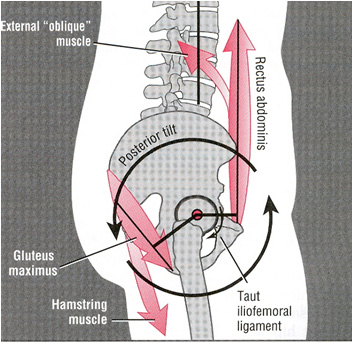
An important role of the glutes that many coaches fail to acknowledge

i’ve started doing this and def am shaky with it! love it though. plan on keeping it as part of my daily am routine. 😀
Hey Bret.
I always tell my clients to squeeze their glutes (PPT) in any plank variation that I am having them perform. So I always figured this cue was assumed… as in, the PPT is just part of planking. Are there situations where you purposely do not instruct people to PPT while performing planks?
And I understand that there are pro/regressions to each plank variation, but again, whatever variation is performed, I have them PPT their pelvis. And if they are not PPT, they are doing it wrong. You agree?
Thanks,
Danny
Hi Danny, great question as usual. Some fitness professionals propose that this type of plank is disadvantageous as they think it will force the body to resort to “high-threshold strategies.” I think that this is rubbish, but I just wanted to inform you about the alternative theory. The way I see it, most people have 1) crappy pelvic control, 2) crappy posterior tilting strength, 3) crappy glute endurance, so this only helps.
I suppose that if an individual has flexion-intolerance than they would probably feel this in their low back. In that case, I’d go with the glute squeeze and avoid the PPT.
Just for experimentation purposes, the other day I did a plank without squeezing any muscles and I found it to be basically worthless! Way too easy. So we’re definitely on the same page.
Can’t wait to try this, if my shoulders will allow it!
Hi Bret,
Very informative as ever.
I am into doing more dynamic planks this days, mostly because static planks bore me to the death.
I have one question regarding your posture in LLPTP. It seems that this way of doing is very AB dominant as you crunch and T-spine region is very hunched over which by some other trainers isn’t sign of good/correct form. What is your opinion on that?
But I am sure that this way is harder than “regular” plank because of lever.
Take care
Another excellent question and I’ve seen plenty of trainers say this too. Not to sound like a prick, but sometimes I wonder if these trainers/coaches/therapists actually train people or just sit around and speculate as to “what could happen.” I train real people so I’m aware of “what does happen” haha.
If I listened to these silly physical therapists and trainers none of my clients would be strong, and if these guys were correct then all of my clients would be walking train-wrecks. But nothing could be further from the truth. My clients are incredibly strong, functional, and healthy.
LLPTP’s will not induce kyphosis, they work the abs and glutes much more so than traditional planks, they won’t teach the body to resort to HTS’s, they won’t screw up the body’s ability to stabilize the core, and they won’t do any other silly things that other trainers suggest such as interfere with breathing patterns or lead to shoulder dysfunction.
Furthermore, a good coach considers the total program, not the theoretical adaptations from a single exercise. Strong pelvic muscles are important, and strong abs compliment the strong erectors induced from deadlifts, squats, etc.
I should write a separate blogpost on this topic 🙂
Again, very good question. – BC
Hi again from Manhattan, KS. Went out and tried it a moment ago. Definitely gets the glutes fired up! I was thinking that I will have clients do some of these followed or preceded with “stir the pot” on the ball in neutral pelvic tilt.
Great video bret, this version seems to me to be a great way to progress clients into be able to maintain pelvic position while doing rollouts. It’s amazing what teaching clientes to use their glutes in all the prone ab exercises does for them.
Agree! So the progression could be:
1. PPT plank from knees
2. PPT plank from feet
3. Long lever PPT from feet
4. PPT ab wheel rollout from knees
5. PPT ab wheel rollout from feet (this is incredibly difficult – I can’t do it!)
BC, what are your thoughts on another baby incremental progression, might fit between #3 and #4:
3a. Elevating the feet
3b. Elevating the feet unstably (i.e. TRX straps)
or does this start shifting the focus away from your intention?
Another escalation of difficulty might be to start walking the elbows out. Ouch!!
Referring to Danny’s query above, when I progress the plank to an unstable feet elevated (TRX straps), loaded push up (with chains, weight vest, or I just strap plates to my torso), I find that I really have no choice but to go into PPT, as the load increases.
Without sky high MVC glute and ab contraction locking up both groups from both sides (PPT), the potential for buckling at the middle of the spine suddenly seems very real!
Done with any degree of volume, and my glutes are sore as heck for days!
Plus if you have kids they can be a very useful loading implement for this exercise. Just toss them on your back, and plank and push away.
Family time!
Good call Derrick!
1. PPT plank from knees
2. PPT plank from feet
3. PPT plank feet elevated
4. PPT plank feet unstable (TRX)
5. Long lever PPT from feet
6. PPT ab wheel rollout from knees
7. PPT ab wheel rollout from feet
Bret i’m thinking about the video you posted a while back with the big dude sat on your bsck. i’ve been working these for a year or so now with apt. in the past few weeks i’ve studied with the rkc and as you know they encourage a ppt.
when you filmed that video what were your postural considerations specifically with regards to your pelvis? do you work weighted planks still and have your thoughts on weighting them changed?
thanks for putting out so much interesting content btw Bret.
The human loaded plank – right here: http://www.youtube.com/watch?v=_ZZ3bRSn4S4
I’m definitely not in APT…I’d say I’m in neutral.
I love this exercise – one of the hardest abdominal exercises out there. I wonder if I could do this with a PPT…
Isn’t this pretty much an RKC plank?
Oops just watched the video at first, read it up at the top, thanks.
No, they do it like this now (I believe): http://www.youtube.com/watch?v=6TKktamzq4o
Hello Bret,
This is the way we do this plank, except we do an even harder version: off straight arms, and absolutely straight legs (at the knee), plus an even stronger pelvic tilt, so that the lumbar spine is flat. This requires much looser hip flexors than most people have (one of the reasons I think loosening these is so important, as we have discussed in the past) . And when I was teaching and demonstrating this yesterday (here in Alicante, Spain), I asked my lady friend Olivia (60Kg) to sit on my lower back (like sitting on a horse) and the shape of the spine did not change one iota.
You can develop tremendous strength in this exercise, and literally every muscle is contracted in this version (so, for example, quads and hamstrings co-contracted, etc.).
As well, there is a reverse plank version of the same basic exercise, also using the strong posterior pelvic tilt; the limit for most here is shoulder flexibility; it is the posterior chain equivalent. Both are staples in gymnastics—5 x 60″ in both is considered excellent.
Best wishes, KL
Hi Bret,
For sprinting, is it better do involve the PPTing action in planks and hip thrusts for the added glute/core activation – or to stay in neutral because you sprint in neutral PT?
Also, will getting better at the LLPTP loosen my hip flexors/strengthen my glutes for glute bridges – I can only get 1/3 of the way up which is kinda frustrating (even though I’ve at it for ages!)
Thanks!
Tom
Thank you Bret for this video and I will definitely make it part of my training.
when performing a plank (especially) weighted planks YOU HAVE to posterior pelvic tilt to prevent anterior pelvic tilt.In fact the goal is to remain in NEUTRAL spine which of course means PPT tilt and strong contractions of the core musculature….love this RKC and will give it a go…..
Great cue points on the PPT. I like to progress to a bit more torture by turning this into iso pushup. Get in extended position fully braced and then push against hands and feet maintaining good posture pop up to pushup position. Control return to plank then reapeat. I have an unstable shoulder so I have to be careful how far I extend but the iso pushup seems to be OK, no popping or grinding. Also you can add more torque for anti rotation variation by alternately raising a foot vertically or horizontally. I only need to move a couple of inches to creat the torque/anti rotation effect.
Love your info and videos. They are great for a visual learner.
John
I see your training program on female glutes and I have one excruciating question. Do your programs address Posterior Pelvic tilt?? I ask with great concern because I have been lifting since the age of 12 and still have flat ass syndrome. I did manage to gain a little during a year I prepped for a bikini competition. I hired 4 different trainers that year and still no results and large of pain on my lower back. Squat, squat squat everyone says…. I just can’t! it hurts and now when I stop working out I’m getting shocking lower back pain, tightening on buttocks and pain from my butt to the back of knee.